Active filters

  • Year of publication:: 2018
  • Year of publication:: 2024
  • Publication language:: slovenčina, angličtina
  • Faculty:: Faculty of Law
PRÁVO – OBCHOD – EKONOMIKA XIII.

PRÁVO – OBCHOD – EKONOMIKA XIII.

E-book

E-book

Ján Husár - Regina Hučková (eds.)

Publication Law Business Economy XIII. is collection of international scientific works which contains scientific contributions of wide variety of branches of law, as well as related fields of scientific expertise. Among areas of issues which were discussed in this publication are questions of civil, commercial, tax, custom, competition, intellectual proporty, arbitration and corporate law, as well as other partial areas, including scientific works dealing with economic regulation and business and IT law. Entire publication is significant with richness of scientific contributions from various jurisdictions, because of renowed authors from various countries. Apart from theoretical contribution and expansion of current state of the art in submitted interdisciplinary area, solutions to legal problems were formulated at de lege ferenda level.

Download the e-book for free (pdf)

KOŠICE CRIMINAL LAW DAYS 2024

KOŠICE CRIMINAL LAW DAYS 2024

E-book

Sergej Romža - Dávid Priščák - Matej Biroš (eds.)

Proceedings of scientific papers „ Elimination of racism, xenophobia and otherforms of intolerance by means of criminal law. Recodification of Criminal Codes - Current Challenges and Perspectives. " is the output of the national interdisciplinary scientific conference with intemational participation organized by the Department of Criminal Law ofthe Faculty ofLaw of the University of Applied Sciences in Košice. The proceedings contain contributions focused on the issues of elimination of racism, xenophobia and other forms of intolerance by means of criminal law and on the issues of recodification of criminal codes, their current challenges and perspectives, both in the field of substantíve and procedural law.
This is a highly topical issue, as the need to eliminate racism, xenophobia and other forms of intolerance by means of criminal law is an important topic with regard to the social situation. The recodification of the criminal codes in 2024 has significantly affected both the substantíve and procedural areas of criminal law, which is the means of ultima ratio. Considering the social developments and the recent amendments to the pena! codes, we consider the theme of the conference and the titlc of the proceedings to be highly topical, containing a significant scope for scientific research.
The participants of the national interdisciplinary scientific conference with international participation in their contributions also dealt with de lege ferenda considerations and at the same time offered solutions to application problems in the field.
The aim of the published proceedings is to continue to improve and develop new knowledge in the field of criminal law, while respecting human rights and freedoms, based on the existing professional knowledge.

Download the e-book for free (pdf)

20 YEARS IN THE EUROPEAN UNION IN TERMS OF LAW AND THE ERA OF SUSTAINABILITY

20 YEARS IN THE EUROPEAN UNION IN TERMS OF LAW...

E-book

E-book

Ján Klučka - Ľuboslav Sisák - Laura Gazdagová (eds.)

This publication captures the conference proceedings of the international scientific conference "20 years in the European Union in terms of law and the era of sustainability". The conference took place on 3rd September 2024 at the Faculty of Law, Pavol Jozef Šafárik University in Košice, in hybrid form.

The first part of the conference proceedings includes contributions concerning EU law in proceedings before the Constitutional Court of the Slovak Republic with focus to current issues and challenges after 20 years of membership of the Slovak Republic in the EU, European law from the perspective of international constitutionalism in a green coat, the impact of the entry of the Baltic states into the European Union on the question of the nationality of natural persons, the single digital market in the context of the Slovak Republic, the impact of European Union law in the field of personal data protection on the territory of the Slovak Republic, the principle of environmental protection in economic competition and international jurisdiction for private law claims for compensation for damage caused to the environment.

The second part of the conference proceedings includes contributions concerning the process of enshrining human right to environment in international law and European law, the development of biodiversity protection in the EU, NATO´s role in climate change response to meet the sustainability and suing tort damages from the Dieselgate emissions scandal.

Download the e-book for free (pdf)

Správne právo bez hraníc

Správne právo bez hraníc

E-book

E-book

Radomír Jakab-Diana Repiščáková-Eva Berníková

Collection of contributions from the international scientific conference was created as part of the international scientific conference entitled "Administrative law without borders" held on October 19 and 20, 2023 in Tokaj in connection with the solution of the scientific project entitled "Extraterritorial effects of foreign administrative decisions in the conditions of the European Union " supported by a grant from the Scientific Grant Agency under no. 01/187/2022. The main goal of the mentioned project is the scientific investigation of the extraterritorial impact of administrative decisions of the member states of the European Union on the territory of other member states for the purpose of knowledge as well as the subsequent assessment of the need and extent of harmonization of the legislation of the member states of the European Union, perceiving the growing necessity of increasing the degree of free movement of administrative decisions in the conditions of the European of the Union. As part of the research project, an international scientific conference was held under the title "Administrative Law without Borders". At the conference, contributions were presented by members of the investigative team, who are also members of the Department of Constitutional Law and Administrative Law of the Faculty of Law of the University of Pavel Jozef Šafárik in Košice, as well as their colleagues from all over Slovakia, the Czech Republic and Hungary. The main goal of the conference was the presentation and confrontation of knowledge in the field of cross-border effects of administrative acts (primarily in the conditions of the European Union), perceiving the increasingly increasing globalization of law, as a result of which it is no longer possible to perceive national law separately, but in mutual contexts with the legal systems of other states , or with the right of transnational, or international organizations, as well as obligations arising for individual states from concluded international agreements. Individual sections and blocks of the conference also corresponded to this goal, within which not only knowledge from positive-legal disciplines, but also knowledge of a theoretical-legal and historical-legal nature was heard.

Download e-book for free (pdf)

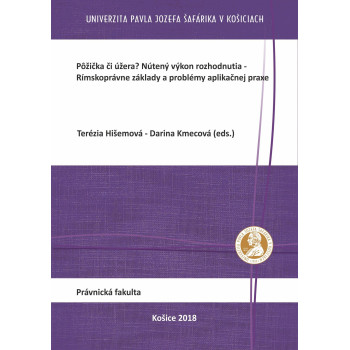
The loan or usury? Compulsory enforcement of judgment - roman and law foundations and problems of application practice

The loan or usury? Compulsory enforcement of...

E-book

E-book

Terézia HišemováDarina Kmecová (eds.)

Reviewed proceedings of scientific papers of Conference of Slovak and Czech law romanists, which take place at May, 10.-11.5.2018, at Faculty of Law, UPJŠ in Košice.

The submitted reviewed proceeding of scientific papers on „The loan or usury? Compulsory enforcement of roman - law basics and problems of application practice.”  is prepared within the solution of the grant project VEGA on: „The loan or usury? Compulsory enforcement of historical - law basics and problems of application practice.”, no. p. 1/0198/17.

The authors of papers are important personalities of Roman law working in the Slovak and Czech Republic, as well as PhD students and young scientists from Slovak and foreign universities who are active in the academic environment as well as in legal practice. The main goal of the editors is to help improve the current legal situation, which is assessed as unsatisfactory, and through a historical excursion of the development of the loan institute and then the forced execution of the decision, to create de lege ferenda proposals considering all areas of research.

The Proceedings trace the interrelationships between the substantive law institute in terms of the Roman law of contractus unilaterales - mutuum in its various types, often realized by the attachment of high interest rates, which bordered on the insurrection and the procedural law of individual lawsuits enforced in the legislative, formular and cognitive process. If there was no possibility to impose certain behaviour on the obligated person (the debtor, the sentenced person), then the declared general obligation to enforce the legal norms was only a legal term. It has always been the case that every internally well-organized state, whether antique or present, has to use power tools - often with the use of gross violence - but within the limits of the law, to promote what it has declared valid law. It must protect creditors on the one hand, but it must also prevent self-help and the use of illegal, unjustified and disproportionate violence.

The loan contract as a real contract has often become an integral part and relatively the most frequent reason leading to the compulsory enforcement, especially when contracting parties often agree on the connection of interest - sometimes within the legal limit, sometimes exceeding the legal framework - and in this way the potential future creditor (the plaintiff) significantly increased the insolvency risk of the debtor (the defendant, the sentenced) and of the subsequent execution. The pronounced and deepening social stratification of the Roman population and the secondary depreciation effort, the cancellation of the debts of the poor part of the population logically culminated in social unrest and revolt against the enforcement of the enforcement law.

The proceedings capture not only the rich scientific discussion of Slovak and Czech legal Romanists, but also the opinions, experience and knowledge of experts on contemporary law dealing with this type of issues. As a result, it provides a unique interdisciplinary view of the subject and raises many stimulus points for future research. This work proves that the problems encountered by the various representatives of the Roman jurisprudence and their legal and theoretical bases and solutions are undoubtedly useful and serve as a guideline also for solving legal issues in the field of modern enforcement proceedings.

Download the e-book for free (pdf)

This website uses cookies to ensure you get the best experience on our website