Filter By

Categories

Categories

Year of publication:

Year of publication:

Publication language:

Publication language:

Faculty:

Faculty:

Method of publication:

Method of publication:

Active filters

  • Year of publication:: 2013
  • Year of publication:: 2013
  • Year of publication:: 2013
  • Year of publication:: 2013
  • Year of publication:: 2013
  • Year of publication:: 2016
  • Year of publication:: 2016
  • Year of publication:: 2016
  • Publication language:: English
Qauntum theory of magnetism

Qauntum theory of magnetism

E-book

E-book

Michal Jaščur

This is a supporting text for the undergraduate students interested in quan- tum theory of magnetism. The text represents an introduction to various theoretical approaches used in this eld. It is an open material, in the sense that it will be supported by appropriate problems to be solved by student at seminars and also as a homework.

The text consists of four chapters that form closed themes of the in- troductory quantum theory of magnetism. In the rst part we explain the quantum origin of the magnetism illustrating the appearance of the ex- change interaction for the case of hydrogen molecule. The second chapter is devoted to the application of the Bogolyubov inequality to the Heisenberg model and it represents the part which is usually missing in the textbooks of magnetism. The third chapter deals with the standard spin wave-theory including the Bloch and Holstein-Primakoff a approach. Finally, we discuss the application of the Jordan-Wigner transformation to one-dimensional spin-1/2 XY model.

The primary ambition of this supportive text is to explain diverse math- ematical methods and their applications in the quantum theory of mag- netism. The text is written in the form which should be sufficient to de- velop the skills of the students up to the very high level. In fact, it is expected that students following this course will able to make their own original applications of the methods presented in this book.
Download the e-book for free (pdf)

Histology (Practical lessons)

Histology (Practical lessons)

€9.26
Availability: 48 In Stock

Eva Mechírová - Iveta Domoráková

The content of this "Practical lessons" represents a record of the appearance, under the light microscope of the tissues, organs and systems of the human body. In addition, it provides visual guidelines during the practical phase of a histology course. It is hoped that this book will be especially useful to students to understand fully the microscopic structure of human tissues and organs.

Authors

Medical Biophysics: Practical Exercises

Medical Biophysics: Practical Exercises

€11.23
Availability: 19 In Stock

Michal Legiňa kol.

Progress in biology and medicine has always been significantly related to advances in physics. Not only has physics supplied instruments and methods of measurement that have led to many discoveries in physiology and medicine, but methods of physical research have changed many of the older approaches to the biologic sciences. Such circumstances have even led to development of a new scientific field: biophysics, which uses to a great extent physical instrumentation procedures applied to an experimental system. Because any instrument is an additional factor in any experimental system, it may affect the data. To interpret physical data on biological material correctly then, it is necessary to consider the characteristics of instrument response.

A practical course enables a student to acquire some skills, experience and methodological knowledge for performance of experiments and evaluation of measured data. Due to the fast development of instrumentation technology, it is not possible to teach every operation and procedure upon instruments we may use in a future. Besides the basic physical principles, the aim of a practical course is to point out some general rules and skills for instrument operation and for the interpretation of the measured values derived from such operation.

There are two kinds of lessons in practical courses. The first one focuses on laboratory measurements of some important physical quantities and the evaluation of the measured data. These measured quantities are components of the subject “medical biophysics” or of the phenomena studied. Experience provided in managing various scales and tables, as well as in the construction of tables and graphs is substantial. Lessons also enable students to repeat and to strengthen their knowledge of secondary school physics, which is useful for understanding of many phenomena studied in medical biophysics. The second kind of lesson provides experience with some of the diagnostic and therapeutic medical instruments, which can be seen in practical medicine.

The understanding of basic physical principles of corresponding instruments is both recommended and demanded. Theoretical preparation is not only an appropriate condition for the practical managing of the whole lesson, but also helps to avoid injury. This textbook, therefore, intends to help students in preparing for both the practical lessons and the final exam.

Authors

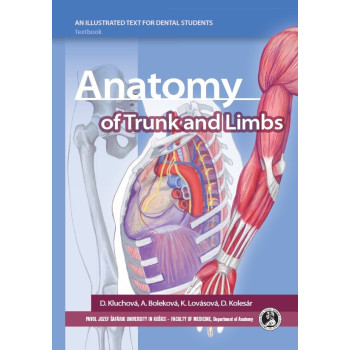
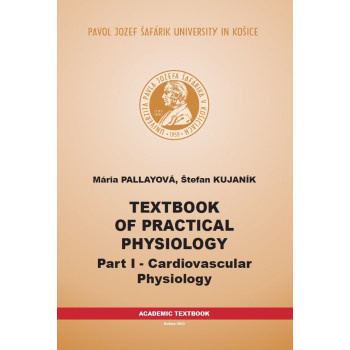
Textbook of practical physiology: part I - cardiovascular physiology

Textbook of practical physiology: part I -...

€11.50
Availability: 10 In Stock

Mária Pallayová - Štefan Kujaník

The “Textbook of Practical Physiology, Part I - Cardiovascular Physiology” by Mária Pallayová and Štefan Kujaník is a practical textbook of Human Physiology intended for English speaking medical students from general medicine and dentistry curricula.

The textbook covers basic principles in cardiovascular physiology and methods of the cardiovascular examination. Adequate knowledge of the cardiovascular physiology is important for the understanding of cardiovascular system function, as well as for the diagnosis and proper treatment of cardiovascular and other diseases. The practical tasks are constructed to facilitate knowledge acquisition and encourage students to develop practical skills, for instance the ability to follow experimental protocols, to work as part of a team, and to interpret data.

The textbook is written in English and comprises 91 pages in B5 format, grouped into twelve chapters. Each chapter is divided into six sections (Introduction, Principle, Importance, Materials, Procedure, and Protocol) to facilitate students’ understanding of the topics and assist them with preparation of the laboratory reports. The text is accompanied by explanatory figures, graphs, and tables that contribute to the learning experience.

Authors

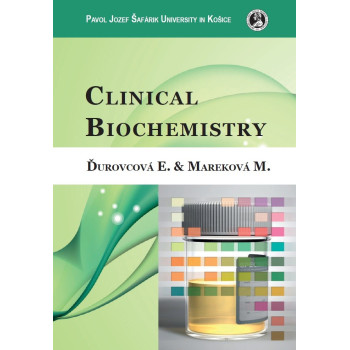
Clinical Biochemistry

Clinical Biochemistry

€24.90
Availability: 48 In Stock

 Eva Ďurovcová - Mária Mareková 

The presented textbook is intended for students of general medicine and should support their knowledge about indication and interpretation of basic biochemical tests. Clinical biochemistry continues to be one of the most rapidly advancing areas of laboratory medicine, which in line with using of modern technology more and more emphasizes the evidence-based medicine in order to improve diagnosis and monitoring of patients. Selected topics have an ambition to outline and explain the most common issues of biochemical diagnosis of in internal medicine. Individual chapters are devoted to disorders of water, electrolyte and acid-base balance, kidney and liver disease, diabetes mellitus, and biomarkers used in the diagnosis of cardiac necrosis and heart failure. Given the limited range, the textbook merely summarizes the basic knowledge that students have obtained during the study of other subjects, such as medical biochemistry, pathophysiology and internal medicine, and emphasis is given to laboratory diagnosis in accordance with the newer guidelines of professional societies. We hope that the textbook will be helpful in the study of clinical subjects and encourage students' interest in laboratory medicine.

Authors

This website uses cookies to ensure you get the best experience on our website