Filter By

Categories

Categories

Year of publication:

Year of publication:

Publication language:

Publication language:

Faculty:

Faculty:

Active filters

  • Publication language:: Polish
  • Publication language:: slovenčina
  • Publication language:: slovenčina
  • Publication language:: slovenčina, čeština, angličtina
  • Faculty:: Faculty of Arts
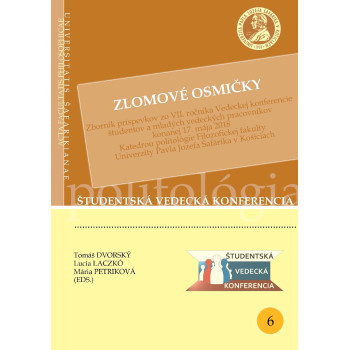
Zlomové osmičky

Zlomové osmičky

E-book

E-book

Tomáš DvorskýLucia LaczkóMária Petriková  (eds.)

The collection of articles from the VII. International Scientific Conference for Students and Young Scientists, organized by the Department of Political Science of the Faculty of Arts of the Pavol Jozef Šafárik University in Košice, in cooperation with the Res Publica Civic Association the Faculty of Social Sciences of the University of Saints Cyril and Methodius in Trnava, held on 17 May 2019 in Košice.

The aim of this publication, entitled The Turning Eights, is to point out the importance of the years ending with number eight, which have significantly affected historical development and appear to be justified in the current political context.

The almanac consists of 11 articles, which are primarily in the Slovak language. The individual contributions deal with aspects of national and foreign policies that are united in theme called The Turning Eightswith the individual interest of each author.

The topics of the almanac are the municipal elections, the position of municipalities at the public administration system, development in self-governing regions and the non-governmental organizations. The presented publication also contains articles that deal with topics in specific countries, such as China, Israel and Russia.
Download the e-book for free  (pdf)

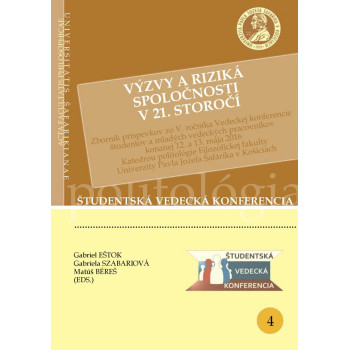
Výzva a riziká spoločnosti v 21. storočí

Výzva a riziká spoločnosti v 21. storočí

E-book

E-book

Gabriel EštokGabriela SzabariováMatúš Béreš (eds.)

Presented publication is an outcome from the scientific conference for students and young scientists that took place on 12th and 13th May 2016 at the Department of Political science, Faculty of Arts, Pavol Jozef Šafárik University in Košice. The main aim of the presented is to bring up outcomes of research of young scientists and students from Slovakia, as well as from abroad. Many of the presented papers have become integral part of qualification theses of their authors.

This conference proceedings contains 22 papers in Slovak, Czech and English language thematically creating four different parts.

Papers regarding international relations or issues exceeding a level of state power are dealing with issues of globalization, counterculture, international terrorism, extremism and a role of the EU in the Arctic. Papers dealing with the situation in the Slovak republic and abroad cover reform of security in Slovakia and in Romania, issue of dealing with totalitarian history of the states of the Visegrad group as well as development of funding of education system in Slovakia since 1919. In case of authors focusing on the socio-political situation in Slovakia we can find papers analyzing role of a reeve in city of Košice, first great political conflict during a rule of Vladimír Mečiar in Slovakia, role of Roma population in political environment in Slovakia, but also those concerning local activist or action groups and examining attitude of nursing care students towards euthanasia. The conference proceedings contents also four papers regarding theoretical or philosophical issues.

Their authors focused on topic of social state, social equality, democratic theories and transformation of human nature in “post-human” era.

Download the e-book for free (pdf)

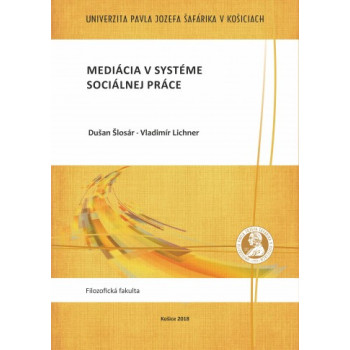
Mediácia v systéme sociálnej práce

Mediácia v systéme sociálnej práce

E-book

E-book

Dušan ŠlosárVladimír Lichner

This university textbook aims to provide readers with knowledge of the philosophical foundations, meaning, and purpose of mediation, based on research and analysis of mediators' activities. In countries where mediation services operate, their staff often include graduates of social work departments.

An individual approach to both the perpetrator and victim of a criminal offense requires knowledge and skills from social work, psychology, sociology, communication, and related fields tied to social work. The principles of social work apply not only in social policy and social care but also in justice. A mediator’s mission is to facilitate alternative resolutions to unlawful acts while preserving the purpose of legal proceedings as defined by valid legal norms. They fulfill this mission through specific methods of individual social work applied in the justice sector. The mediator’s focus extends beyond the current conflict to uncover related issues, activate parties to resolve disputes, and prevent new conflicts.

Special attention is devoted to the philosophical foundations of mediation in Slovakia. We provide an overview of mediators’ core activities and mediation types used to uphold justice in Slovakia. We analyze mediation goals, the roles of parties involved, and procedural steps. In applying mediation, we explore its potential and implementation in both legal and social work contexts.

As indicated, mediation cannot be understood solely as a specialized activity in criminal justice, as it has broader applications in non-judicial dispute resolution, such as family or community work, which are often overlooked by the public. The mediator’s approach to diverse target groups is grounded in theoretical frameworks. From this foundation, we derive activities expected of mediators in the future. Expanded activities arise from concrete situations encountered during mediation.

Download the e-book for free (pdf)

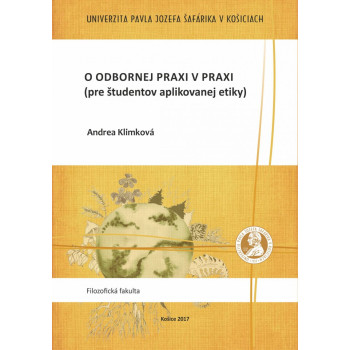
O odbornej praxi v praxi (pre študentov aplikovanej etiky)

O odbornej praxi v praxi (pre študentov...

E-book

E-book

Andrea Klimková

The current development of applied ethics globally suggests that applied ethics is entering a new, qualitatively distinct era of innovative application approaches, methodologies, and methods, as well as novel educational formats. The application levels in applied ethics (in bioethics, business ethics, technology ethics, professional ethics, etc.) are tied to critical reflection on previous strategies and methodologies in their teaching.

Combining ethical rationality with practical variability and implementing ethical policies and tools in concrete practice truly demands new competencies, new skills, and the ability to work in novel ways with empirical and normative frameworks. This requires working with ethical theory and moral practice inventively, heuristically, innovatively, and propedeutically.

The creation of useful and professionally constructed procedures and formats is part of the professional and academic preparation of applied ethicists at modern departments of applied ethics.

Download the e-book for free (pdf)

This website uses cookies to ensure you get the best experience on our website