Filter By

Categories

Categories

Year of publication:

Year of publication:

Publication language:

Publication language:

Faculty:

Faculty:

UPJŠ Unit

UPJŠ Unit

Method of publication:

Method of publication:

Active filters

  • Categories: Science
  • Year of publication:: 2013
  • Year of publication:: 2019
  • Publication language:: Slovak
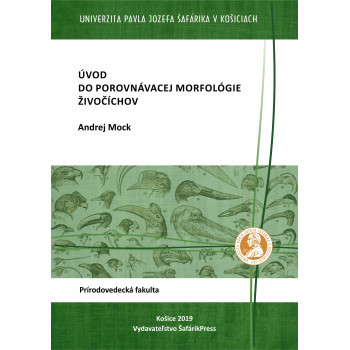
Úvod do porovnávacej morfológie živočíchov

Úvod do porovnávacej morfológie živočíchov

E-book

E-book

Andrej Mock

The structure of the animal body is extremely varied. Each species has its distinctive morphological features, which bears as a testimony to long-term development and belonging to the developmental lineage. At the same time, the body has been tested for a long time by natural conditions, resulting in unique adaptations to the environment and life strategy. Despite this admirable variety - which includes both recent and fossil animals and which we have far from mapped – a comparison of body parts brings knowledge we can generalize: the main building principles, and boundaries within which phenotypic diversity is realized.

Comparative animal morphology today uses the latest methodological material and knowledge from other disciplines, from genetics, molecular biology and experimental embryology, through progressive imaging methods (e.g. electron microscopy, computer micro-tomography) and the possibilities of subsequent software processing of image material (measurement, staining, etc.) to the view of physics, chemistry, statics and geometry on the structures (to nanostructures) of the living body. Detailed knowledge of historical and contemporary conditions on Earth is an important interpretative context in the study of animal morphology. Surprisingly, the knowledge accumulated after centuries of research is now rapidly supplemented by new knowledge, and often the traditional knowledge is subsequently reinterpreted. Finally, and no less important, in studying animal (and human) morphology, we learn surprising knowledge about ourselves.

The author of the presented textbook had the ambition in a simplified form to introduce the reader, especially the student of biological studies, into a dynamic and fascinating scientific discipline, as the current comparative animal morphology is.
Stiahnite si e-knihu zadarmo (pdf)

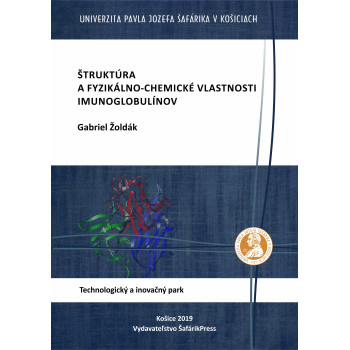
Štruktúra a fyzikálno-chemické vlastnosti imunoglobulínov

Štruktúra a fyzikálno-chemické vlastnosti...

E-book

E-book

Gabriel Žoldák

The textbook is intended as background material for university students and for education in science, biotechnology, and medicine. During the textbook conception, the emphasis was on recent trends and development in the understanding of the physicochemical properties of immunoglobulins.

The textbook is divided into ten chapters and 294 pages dealing with the following topics: Immune system and immunoglobulins, General properties of immunoglobulins, Chemical and proteolytic cleavage of immunoglobulins, Structure of immunoglobulins I, Structure of immunoglobulins II, Detection of immunoglobulins, Post-purification and purification immunoglobulin modifications, Immunoglobulin stability and aggregation, Therapeutic immunoglobulins. In addition to the summary of the established knowledge about the properties of immunoglobulins, the textbook also contains new information collected from recent scientific publications.

Download the e-book for free  (pdf)

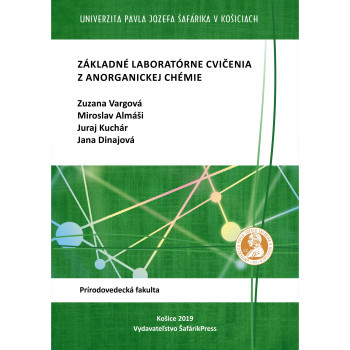
Základné laboratórne cvičenia z anorganickej chémie

Základné laboratórne cvičenia z anorganickej...

E-book

E-book

Zuzana VargováMiroslav Almáši - Juraj KuchárJana Dinajová 

The script „Základné laboratórne praktikum z anorganickej chémie“ builds on previous editions of the script, with some thematic units updated and supplemented with new knowledge, principles, and detailed work procedures.

This script is intended as a teaching aid for first-year students of the chemistry and interdisciplinary study programs at the Faculty of Science, Pavol Jozef Šafárik University in Košice. The introductory part of the volume acquaints students with safety regulations that they should follow during work in a chemical laboratory. Subsequently, in five chapters, basic laboratory techniques are described in detail, which students will use in the further part of the practices for preparing inorganic compounds. These chapters are enriched with illustrative images created using the freely distributable ACDFreeLabs 10 program or taken from literature listed at the end of the script. Some images were created by the authors, and others were taken from the catalog of Fisher Slovakia, s.r.o., which provided written permission for their use. The chapters describing the preparation of inorganic compounds are organized according to their composition, from simple elements or molecules, through binary compounds, acids, and salts, to complex compounds.

Within this subject, students should apply their theoretical knowledge gained during lectures on General Chemistry and Inorganic Chemistry and thereby acquire basic practical experience and skills that they will use in further studies.

The last two chapters were developed based on cooperation with Duslo a.s., Production Plant Strážske, which participates in the innovation of practical teaching through direct involvement of experts from practice as part of the KEGA project No. 008UPJŠ-4/2018.

Authors

Download the e-book for free (pdf)

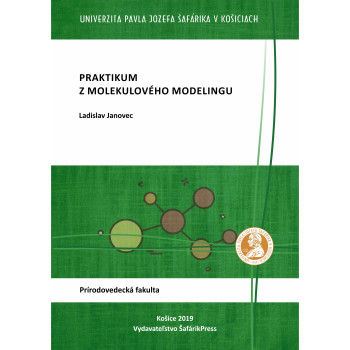
Praktikum z molekulového modelingu

Praktikum z molekulového modelingu

E-book

E-book

Ladislav Janovec

An enormous progress in computer technology, closely linked with advances in computational chemistry, has enabled the user to exploit the principles of quantum chemistry to elucidate the chemical phenomena.

Computational chemistry is the branch of science that requires, except an academic knowledge, software skills to fully exploit a potential of theoretical methods. The aim of this textbook is to help the user take the legendary first step in the field of computational chemistry to opening a new horizon of knowledge.

Download the e-book for free (pdf)

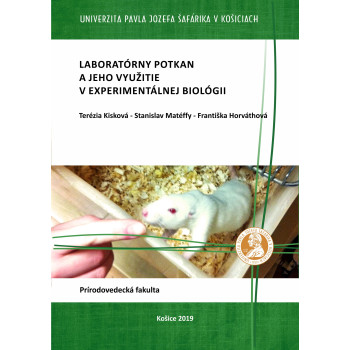
Laboratórny potkan a jeho využitie v experimentálnej biológii

Laboratórny potkan a jeho využitie v...

E-book

E-book

Terézia KiskováStanislav MatéffyFrantiška Horváthová

The laboratory rat (Rattus norvegicus) is one of the most commonly used experimental animals. It serves as a model organism for analyzing numerous biological processes and pathological mechanisms, such as cardiovascular diseases, metabolic disorders (e.g., lipid metabolism, diabetes mellitus), neurological and neuropsychiatric conditions (e.g., stroke, epilepsy, or Alzheimer's disease), neurobehavioral research, autoimmune diseases (e.g., arthritis), cancer, and renal diseases. It offers many unique advantages for modeling human diseases, testing drugs and natural substances, and studying responses to environmental factors. The size of the laboratory rat, compared to the mouse, creates ideal conditions for physiological manipulations. Additionally, rats are used in clinical toxicology to test chemical substances (Hedrich, 2000).

Download the e-book for free (pdf)

Študentská vedecká konferencia PF UPJŠ 2019

Študentská vedecká konferencia PF UPJŠ 2019

E-book

E-book

Katarína Cechlárová (ed.)

This year, the Student Scientific Conference was held on April 24, 2019, across 17 sections in disciplines such as biology and ecology, chemistry, physics, geography, mathematics, informatics, and their didactics. Bachelor’s and master’s students presented a total of 124 contributions. The most successful participants advanced to national or traditional Czech-Slovak student scientific showcases in fields like physics, chemistry, mathematics, informatics, and mathematics didactics.

In addition to faculty students, 10 high school students participated outside the competition. They were invited based on their achievements in subject-specific Olympiads or because they were already engaged with the faculty under the guidance of dedicated teachers in laboratory work as part of their preparation for future studies. The day also featured a programming competition with 23 participants, an IHRA contest involving 16 teams of high school students and 15 teams from elementary schools, and a new Puzzle section where 72 high school students from the region competed.

The abstracts from the Student Scientific Conference demonstrate that our faculty's students not only absorb theoretical knowledge delivered in lectures but also actively engage in solving partial scientific problems that align with research objectives at the institutes of PF UPJŠ. This collection serves as both a record of scientific activity at the faculty and a dignified presentation for the broader public.

Prof. RNDr. Katarína Cechlárová, DrSc.

Vice-Dean for Education

Doc. RNDr. Gabriel Semanišin, PhD.

Dean of the Faculty

Download the e-book for free  (pdf)

Vybrané kapitoly z elektrochémie

Vybrané kapitoly z elektrochémie

E-book

E-book

Kveta Markušová - Daniela Kladeková

Electrochemistry is the science that studies ionic systems and the processes or phenomena that occur at the interface between ionic systems and metals or semiconductors. At the current stage of development, electrochemistry can be divided into two main areas based on its focus. The first one - ionics - deals with the properties of ionic systems (solutions, melts, solid electrolytes). The second area - electrodeics - focuses on phenomena at the electrode/ionic system interface.

Both ionics and electrodeics investigate equilibrium and non-equilibrium phenomena and processes. Research into the properties of ionic systems under equilibrium conditions provides information and insights into the structure and composition of electrolyte solutions, melts, and solid electrolytes, while measurements under non-equilibrium conditions provide data on the electrical conductivity of ionic systems. In the field of electrodeics, the study of equilibria at the electrode/solution (or melt) interface is the domain of electrochemical thermodynamics. Measuring the rates of processes occurring at this phase interface and explaining the principles governing these processes fall under the scope of electrode process kinetics or electrochemical kinetics.

Download the e-book for free (pdf)

Teória efektívneho poľa pre lokalizované spinové modely

Teória efektívneho poľa pre lokalizované...

E-book

E-book

Michal Jaščur

This monograph is devoted to the discussion of effective field theory based on the differential operator method, originally introduced by Honmura and Kaneyoshi in 1979, which remains actively used for theoretical studies of localized spin models of magnetism—particularly variants of the Ising model. To date, this methodology has been applied by numerous authors to investigate a wide range of systems, including crystalline systems, diluted magnetic systems, systems with random exchange interactions, amorphous magnetic materials, systems under random magnetic and crystalline fields, thin magnetic layers, magnetic systems with free surfaces, binary and ternary magnetic alloys, among others.

During my scientific career, I have collaborated with several leading experts in this field—including Prof. Kaneyoshi, with whom I completed two long-term research stays—to advance the development of the differential operator method (and consequently effective field theory). Within this research area, I have published over 40 scientific papers in prominent international physics journals. These works include both methodological advancements and significant applications that predict intriguing physical phenomena, such as multicompensation phenomena in ferrimagnets.

Download the e-book for free

Úvod do termodynamiky

Úvod do termodynamiky

E-book

E-book

Michal Jaščur - Michal Hnatič

This textbook covers the fundamentals of phenomenological thermodynamics to the extent typically taught in standard theoretical physics courses at the undergraduate level in the Physics degree program. A slightly reduced scope is also taught in all interdisciplinary study programs combined with physics. In recent years, the time allocation for individual courses has been slightly reduced, which is reflected in our selection and coverage of topics.

Our primary aim was to provide a sufficiently solid explanation of the key concepts and laws of thermodynamics necessary for mastering further theoretical physics courses at the master's level (e.g., Statistical Physics, Condensed Matter Physics, Quantum Theory of Solids, Quantum Theory of Magnetism, etc.). The book also presents the essential minimum knowledge required for the study of further applications of thermodynamics in biophysics, biology, chemistry, and engineering disciplines.

Understanding individual sections, as well as the text as a whole, requires a grasp of the basic concepts of thermodynamics at the level of a General Physics course and knowledge equivalent to a standard university mathematics course. Each topic is treated with the utmost emphasis on conceptual clarity and mathematical rigor.

Download the e-book for free (pdf)

Študentská vedecká konferencia PF UPJŠ 2013

Študentská vedecká konferencia PF UPJŠ 2013

E-book

E-book

Vladimír Zeleňák (ed.)

The publication contains abstracts of contributions presented at the Student Scientific Conference of the Faculty of Natural Sciences at UPJŠ in Košice, held on April 25, 2013. The event was marked by the celebration of the 50th anniversary of the Faculty of Natural Sciences at UPJŠ and was part of a series of events called ScienceFest.

Download the e-book for free (pdf)

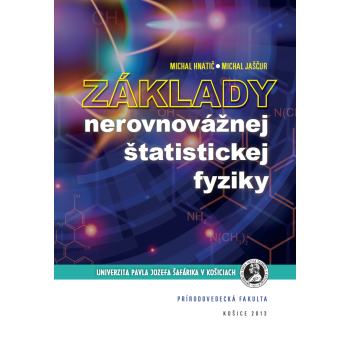
Foundations of nonequilibrium statistical physics

Foundations of nonequilibrium statistical physics

€29.22
Availability: 10 In Stock

Michal Jaščur -Michal Hnatič

In the textbook, the processes belonging to an area of  nonequilibrium physics, which make the basis for the study and analysis of compex phenomena  of statistical mechanics, are described. The Boltzmann equation for distribution function is derived and on this basis the hydrodynamic equations are constructed.  Stochastic processes are described separately and Fokker-Planck equation for density probability  is derived. Textbook is intended for the students of second year of master study at Faculty of Science of P. J. Šafarik University.   

Autors

This website uses cookies to ensure you get the best experience on our website