Filter By

Categories

Categories

Year of publication:

Year of publication:

Publication language:

Publication language:

Faculty:

Faculty:

Method of publication:

Method of publication:

Active filters

  • Categories: Medicine
  • Categories: Science
  • Faculty:: Faculty of Arts
  • Method of publication:: E-book (pdf)
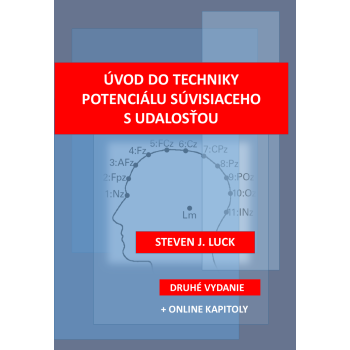
Úvod do techniky potenciálu súvisiaceho s udalosťou. Druhé vydanie

Úvod do techniky potenciálu súvisiaceho s...

E-book

E-kniha

Steven J. Luck

Preklad: Július Zimmermann a Eva Kiktová

Kniha je slovenským prekladom anglickej monografie Stevena J. Lucka An Introduction to Event-Related Potential Technique (2014). Technika potenciálov, ktoré súvisia s udalosťami (ERP), je neinvazívny spôsob skúmania procesov percepcie a kognície ľudského mozgu. Subjekty – skúmané osoby, vnímajú špeciálne navrhnuté formy vizuálnych alebo rečových stimulov. Zo snímanej sústavy EEG signálov sa matematickými metódami extrahujú osobitné ERP signály, pričom sú u nich zaujímavé tri typy rozlišovacích schopností: časové rozlíšenie (latencia), amplitúdové rozlíšenie (magnitúda) a priestorové rozlíšenie (oblasť mozgu), v ktorej sa generujú ERP signály. Latencia a magnitúda signálov sú v tejto metóde unikátne parametre prezentujúce uvedené procesy, priestorové rozlíšenie je v tomto prípade menej dokonalé.

V knihe je výklad celého experimentálneho ERP výskumu: návrh a prevádzka laboratória, dizajn experimentov, akvizícia EEG signálov a korekcia šumov a artefaktov. Nasleduje detekcia ERP signálov: filtrovanie a Fourierova analýza, kvantifikácia amplitúd a latencií, osobitné metódy v časovej aj frekvenčnej doméne a podobne. Nakoniec štatistickou analýzou a interpretačnými metódami sa formulujú dosiahnuté výsledky výskumu. Pre čitateľa sú cenné aj poznatky v kapitole o tom, ako sa píšu štúdie s dobrým kreditným ohodnotením a ako sa takéto štúdie oponujú.

Kniha je cenným zdrojom pre výskumných pracovníkov, pre doktorandov a postdoktorandov, ale aj pre študentov, ktorých zaujala nesmierne zložitá a málo preskúmaná činnosť ľudského mozgu.
 Prečítajte si knihu online

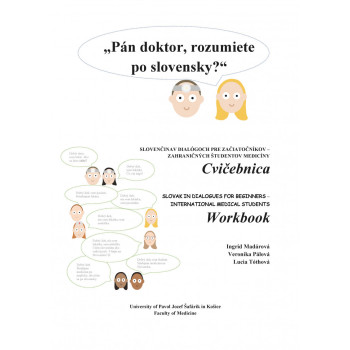
„Pán doktor, rozumiete po slovensky?“

„Pán doktor, rozumiete po slovensky?“

E-book

SLOVAK IN DIALOGUES FOR BEGINNERS – INTERNATIONAL MEDICAL STUDENTS - Workbook

E-book

Ingrid MadárováVeronika PálováLucia Tóthová

Audio attachments - format RAR

The audio-exercise workbook “Pán doktor, rozumiete po slovensky?”is a follow-up to the textbook “Pán doktor, hovoríte po slovensky?” (Madárová et al.)and is intended for international students of Slovak as a foreign language in the medical environment.

This workbook provides the students with an opportunity to practise and enhance mostly their listening skills and pronunciation through various short dialogues between doctors and patients in the Slovak language. Dialogues contain the vocabulary used in the textbook Pán doktorhovoríte po slovensky?.  Students are encouraged to build their confidence in speaking Slovak by practising these dialogues in the new workbook.

The audio-exercise workbook is comprised of 16 units. Each unit offers short dialogues and recordings

A number of dialogues enable its wide use for self-studying while the most frequent phrases related primarily to body parts, signs and symptoms of illnesses, diseases or various medical conditions are practised in different contexts in a variety of exercises.

Original illustrations enable students to understand dialogues more easily and the correct answers of the exercises and the scripts of the recordings can be found in the Answer key at the end of the workbook.

Download the e-book for free (pdf)

Bedeker onkologickej liečby

Bedeker onkologickej liečby

E-book

E-book

Lucia TóthováKatarína ŠiňanskáEva Žiaková

Here is the translation of the provided text into English: A guide to oncological treatment was created at a time when the importance of health became even more emphasized, becoming a kind of mega-value for the new modern "pandemic" human. The use of the term "pandemic" person arose, of course, in connection with the emergence of the coronavirus pandemic worldwide, but primarily because other dangerous long-term diseases that threaten contemporary humans are somehow being pushed into the background.

The severity of such diseases (including cancer) does not diminish just because attention has shifted to something more acute. It is very important to realize this and not fall under the illusion that if we overcome an acute danger, then automatically improve conditions for chronic diseases as well. We believe it's quite the opposite; prolonged stress and social negative factors constantly affecting us—among which undoubtedly includes pandemic situations—worsen not only psychological but also somatic states.

The guide to oncological treatment aims precisely at highlighting those psychological and social factors that negatively "support" cancer development in any form and can positively influence treatment and coping with illness. The guide offers opportunities for social engagement with groups of people undergoing similar oncological treatments, allowing them to share psychologically as well as professionally similar situations with those facing similar problems in treatment. The authors hope that this guidebook will reach those who will become more self-sufficient in overcoming such a formidable enemy as cancer.

Authors

Download the e-book for free (pdf)

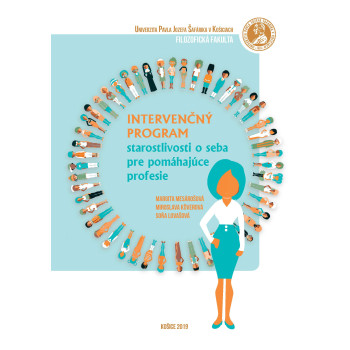
Intervenčný program starostlivosti o seba pre pomáhajúce profesie

Intervenčný program starostlivosti o seba pre...

E-book

E-book

Margita MesárošováMiroslava KöverováSoňa Lovašová

Intervention Program for Supporting Self-Care in Helping Professions: "How Do I Take Care of Myself?" The intervention program "How Do I Take Care of Myself?" was developed as part of the research project APVV14-0921, "Self-Care as a Factor in Coping with the Negative Consequences of Engaging in Helping Professions." Its uniqueness lies in being created based on specific research outputs from the program's authors and project.

In the first chapter, the authors offer insights into the preparation of the intervention program, justifying its theoretical foundations, methods, and specifics of the program participants. They also provide an overview of research on the effectiveness of various intervention programs aimed at reducing the negative consequences of helping and enhancing self-care and other positive effects of engaging in helping professions. Subsequent chapters focus on a detailed analysis and evaluation of the effectiveness of the intervention program "How Do I Take Care of Myself?" and its comparison with the effectiveness of other programs, which were differently focused, targeted at different populations of helping professionals, and had different theoretical and practical orientations and foundations. Most of these studies demonstrated positive changes only in isolated cases, due to various methodological shortcomings often related to practical application.

What differentiates the intervention program presented in this monograph is the participation of helping professionals actively practicing in the social field, unlike most intervention programs compiled and validated for students of these professions. The student population, being more accessible to researchers, allows for better methodology, including a larger number of participants, as well as experimental manipulation and group balancing. In the case of participants in the validation of the program "How Do I Take Care of Myself?", it involved practitioners who are engaged in the daily work process and completed training during their work breaks, which placed high demands on balancing their work and personal tasks. We believe that the effects we discovered during the validation of the effectiveness of the presented intervention program were not always clearly mathematically graspable but were evident from individual feedback.

We present the text of this monograph to the professional public with the aim of highlighting the benefits, limitations of the intervention program, as well as inspiring researchers and practitioners to further work in this area.

Authors

Download the e-book for free (pdf)

English for Chemists

English for Chemists

E-book

E-book

Božena Velebná

The following material has been created during the two years of teaching English for Chemists at the Faculty of Science of the Pavol Jozef Šafárik University and is therefore designed to meet the needs of this course. The main motivation was the lack of appropriate materials, especially as the groups generally comprise students with a very diverse level of English. This diversity therefore became the main criterion determining both the form and the content of this text.

In the ten units that provide material for a one semester course, the emphasis is put on teaching the students vocabulary and terminology, which is introduced via authentic texts, depending on the topic of each unit. Students are encouraged to learn the meaning of new words in context. Grammar is included too, with the aim of demonstrating and explaining grammatical rules by means of examples taken directly from the texts. For the more advanced students, grammatical exercises in this material can serve for revision while the beginners might need more supplementary materials.

I hope that this material, the preparation of which has been a challenging as well as enjoyable experience will be useful for future teachers and the students of this course.

Download the e-book for free (pdf)

This website uses cookies to ensure you get the best experience on our website