 English
 Slovenčina


Katalóg
Subcategories
There are 73 products.
Active filters
- Year of publication:: 2009
- Year of publication:: 2011
- Year of publication:: 2018
- Year of publication:: 2018
- Year of publication:: 2018
- Year of publication:: 2018
- Year of publication:: 2020
- Year of publication:: 2022
- Year of publication:: 2022
- Year of publication:: 2022
- Year of publication:: 2022
- Year of publication:: 2022
- Year of publication:: 2025
- Year of publication:: 2025
- Faculty:: Prírodovedecká fakulta
- Faculty:: Prírodovedecká fakulta
Prehľad dejín biológie, lekárstva a farmácie
E-book
E-book
Martin Bačkor - Miriam Bačkorová
The proposed text focuses on the history of studying biology, medicine, and pharmacy as scientific disciplines from prehistoric times through antiquity, the Middle Ages, and the modern era. The text chronologically organizes the most significant figures in the history of biological scientific disciplines, outlines key characteristics of major historical discoveries, and reevaluates their significance from the perspective of 21st-century science.
The educational text is chronologically divided into the most significant periods of civilization development. The last two completed centuries—the 19th and 20th—are subdivided into major life science fields due to the unprecedented growth of biological disciplines and the resulting volume of acquired information.
Since it can sometimes be challenging in science to define what constitutes the past versus the present of a particular discipline, we have excluded significant biological discoveries from the early 21st century, which are typically regarded as the “present” of biology.
Cvičenia z biochémie mikroorganizmov
E-book
E-book
These university textbooks are intended for first-year master's degree students at the Faculty of Natural Sciences of UPJŠ in Košice. The scope and content of the works included in these scripts are primarily based on time and spatial constraints, taking into account the material demands of the tasks.
The aim of these scripts is to teach students basic microbiological techniques and to show them the importance of microorganisms in everyday life and their crucial role in nature. The exercises are designed to enhance students' technical skills and teach them to work according to safety principles.
The text is divided into 13 parts. Each part begins with an introduction to the theory related to the practice topic. The appendix includes a proposal for the preparation of protocols for individual exercises.
Vybrané kapitoly z koloidnej chémie
E-book
E-book
Working with this study text requires adequate knowledge of physical chemistry, physics, and biology, as navigating the presented material becomes challenging without this foundation. A solid grasp of mathematics is essential and aids in understanding colloidal chemistry problems. The textbook, structured into individual chapters, first addresses optical and molecular-kinetic properties after classifying and characterizing disperse systems.
This university-level textbook is primarily intended for students in chemical and ecological disciplines at the Faculty of Science, Pavol Jozef Šafárik University in Košice. It does not aim to exhaustively cover every detail of the subject, as comprehensive treatments are already available in specialized monographs on colloid and macromolecular chemistry, as well as in foundational physical chemistry textbooks.
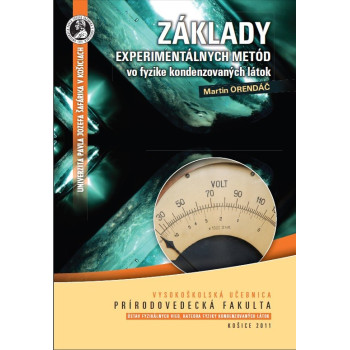
Základy experimentálnych metód vo fyzike...
E-book
E-book
The textbook is designed to prepare students who will engage in the experimental study of the properties of condensed matter. It demonstrates that a contemporary experimental physicist must not only possess sufficiently detailed knowledge of the physical processes occurring within the object under study but also understand the methods for creating the experimental conditions in which the experiment is conducted. Active knowledge of the functioning of the entire experimental setup can be of fundamental importance in the implementation or potential modification of the measurement methodology used.
Jadrová chémia
E-book
E-book
The discovery of radioactivity at the turn of the 19th and 20th centuries stimulated the rapid development of nuclear sciences. At the interface between nuclear physics and chemistry, disciplines such as radiochemistry, radiation chemistry and nuclear chemistry were formed.
The aim of the Nuclear Chemistry course which is taught at the PF UPJŠ is to provide basic knowledge, with an emphasis on the general value of the subject. It is important to make available the basics of various methods, techniques and their specifics in the application of nuclear phenomena in chemistry and related fields. Emphasis is also placed on the use of correct terminology, knowledge of the context of relationships and basic principles, supplemented by illustrative concrete cases.
The choice of material is rather difficult, but we count on additional monographs and textbooks to fill in the gaps of these teaching texts.
Cytológia pracovný zošit na praktické cvičenia
€10.50
Availability:
34 In Stock
Ján Kleban a kolektív
Predkladaný pracovný zošit na praktické cvičenia z cytológie je určený poslucháčom 1. ročníka bakalárskeho štúdia biológie a 1. ročníka bakalárskeho medziodborového štúdia v kombinácii s biológiou na Prírodovedeckej fakulte Univerzity Pavla Jozefa Šafárika v Košiciach. Slúži ako návod, ktorý má študentom uľahčiť prácu a umožniť rýchlejšiu orientáciu v zadanej úlohe. Úprava pracovného zošita do formy protokolov umožňuje študentom zakresliť vlastné pozorovanie a tým stimuluje študentov k presnejšiemu a trvalejšiemu zapamätaniu si precvičovanej úlohy a zároveň umožňuje spätnú kontrolu pedagógom. Počas cvičení sa študenti postupne oboznámia so základnými pojmami optiky, s aplikáciami využívajúcimi mikroskopickú techniku, ale aj so základnými rozdielmi medzi štruktúrou rastlinnej a živočíšnej bunky a ich organelami.
Vybrané kapitoly z biogeografie pre geografov
E-book
E-book
Dušan Barabas - Alena Labunová
These study materials aim to provide basic information about biogeographical issues from a geographical perspective, i.e., a perspective focused primarily on the aspect of spatial differentiation of the biosphere. The basis for the division of the biosphere is its historical development, during which individual taxa and communities were formed.
The historical development of the biosphere did not occur under stable, constant conditions, but rather in ever-changing conditions caused by the position of our planet within the solar system, the position of the Earth's axis relative to the ecliptic, and also the position of the solar system within the galaxy. All changes in the Earth's position, together with the movement of continents (drift) and climate changes, created the prerequisites for the spatial expansion of the biosphere. The historical development of the biosphere, various perspectives, the hierarchical level of differentiation, and the causes of differentiation are incorporated in this study material, whose aim is to outline the basic principles of this division.
The goal is also to highlight certain differences in the understanding of terminology, as well as to point out some fundamental relationships operating within the landscape system in the broadest sense of the word. The section devoted to the ecological principles of the functioning and formation of the landscape system, according to MIČIAN and ZATKALÍK (1984), outlines the issues of understanding the terms ecosystem and geosystem. For this reason, the presented text includes chapters that attempt to explain the understanding and approach to some basic concepts.
These study materials are intended for students of single-subject, interdisciplinary, and supplementary studies as basic teaching material. By expanding the knowledge from this study material with further information, which is elaborated in more detail in the literature listed in the bibliography of this text, graduates will gain a comprehensive view of biogeographical issues.
Authors
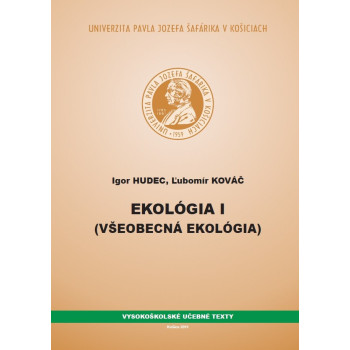
Ecology I (General Ecology)
€11.35
€1.00
-€10.35
Availability:
69 In Stock
The study course provides the basic knowledge on the fundamental parameters, relationships and processes in ecological sciences. Brief content: ecological factors and relations to environment (air, water, soil); influence of ecological factors upon organisms (morphological adaptations, behavioural responses); populations and communities (external and internal parameters of populations, population dynamics); ecosystems (impact assessment) and biomes (basic features and human impact); cycles (hydrologic, gaseous, sedimentation) of basic elements on Earth.
Authors