Filter By

Categories

Categories

Year of publication:

Year of publication:

Publication language:

Publication language:

Faculty:

Faculty:

UPJŠ Unit

UPJŠ Unit

Method of publication:

Method of publication:

Active filters

  • Year of publication:: 2021
  • Year of publication:: 2021
  • Year of publication:: 2021
  • Year of publication:: 2023
  • Year of publication:: 2023
  • Year of publication:: 2023
  • Year of publication:: 2025
  • Year of publication:: 2025
  • Publication language:: English
Basic Concepts of Morphology I.

Basic Concepts of Morphology I.

E-book

E-book

Renáta Panocová

The textbook Basic Concepts of Morphology is an introduction to morphology intended for undergraduate students of British and American Studies and students of English (and French/German) for European Institutions and Economy and other philology studies in Slovakia. The textbook gradually guides students from key terms to concepts and from there to theoretically more challenging phenomena. The textbook is primarily for Slovak students of English, which explains that the majority of the examples presented are English. As the textbook progresses, data from Slovak, German, French, Hungarian and sometimes from slightly more exotic languages are given. It is expected that such an approach will prepare students for carrying out morphological analysis independently.

Download the e-book for free (pdf)

Developing Academic English in Speaking and Writing

Developing Academic English in Speaking and...

E-book

E-book

Július RozenfeldSlávka Tomaščíková

The academic textbook entitled “Developing Academic English in Speaking and Writing responds to the need identified by the authors in their own teaching practice to integrate the enhancement of the academic skills of speaking and writing into a single coherent approach. Using complex methodologies of academic speaking and academic writing, the authors offer practical guidelines on how to broaden students’ knowledge of the discourse of Academic English and how to improve their academic competencies and productive language skills in speaking and writing in English.

The textbook is designed for university students of English philology, students of literary and cultural studies focusing on Anglophone areas, students of English translation and interpretation study programmes, but also for students who study in English and who are expected to engage in scientific inquiry, document their research in Bachelor and Master theses or in doctoral dissertations written in English, and to present their work to their academic community.

Download the e-book for free (pdf)

Examination methods and injection technique in orthopaedics

Examination methods and injection technique in...

E-book

E-book

Ahmad GharaibehMarek Lacko

Authors describe the clinical and paraclinical examination methods necessary for the diagnosis and treatment of orthopedic diseases in both children and adults.

The examination methods are categorized based on individual anatomical locations. A valuable chapter discusses joint aspirations, detailing their indications, techniques for performing them, and potential complications. The chapter showcasing patient documentation for students serves as a significant aid for practical exams before the state final examination in surgery.

This work appropriately complements the available educational literature required for international undergraduate students in general medicine, as well as for physicians in specialized training in orthopedics and related fields.

Download e-book for free (pdf)

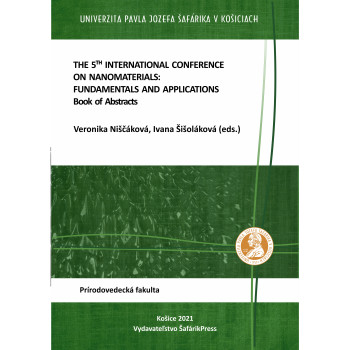
The 5th International Conference on Nanomaterials: Fundamentals and Applications

The 5th International Conference on...

E-book

E-book

Veronika NiščákováIvana Šišoláková (eds.)

Abstracts of the 5th Intemational Conference Nanomaterials: Fundamentals and Applications (NF A) 2021 is the contributions summary of the conference participants. The conference will feature four invited lectures and ten registered lectures. This conference is a tool for creating a dialogue between experts in the field of nanomaterials, their use and overall application in various fields.

Papers in the proceedings are thematically divided into 6 areas. All contributions are highly professional and interesting and can contribute to further creative scientific work.

Download the e-book for free  (pdf)

LEARNING HOW TO LEARN (Workbook)

LEARNING HOW TO LEARN (Workbook)

E-book

Zuzana Kožárová • Adriana Boleková

This workbook has been composed from the book by Assoc. prof. Adriana Boleková, MD, PhD. et al. How to study and not forget - the principles of brain-compatible learning. It will help students to identify their bad learning habits, while offering the opportunity to work actively to change their learning style, through various practical tips and exercises.

The workbook is divided into four parts:

  • • Means to enhance memory and learning,
  • • Motivation and time management,
  • • Learning styles
  • • Effective learning techniques

We hope this workbook will help students find out which activities prevent you from achieving better study results and then you will be able to replace them with effective ones.

Download the e-book for free (pdf)

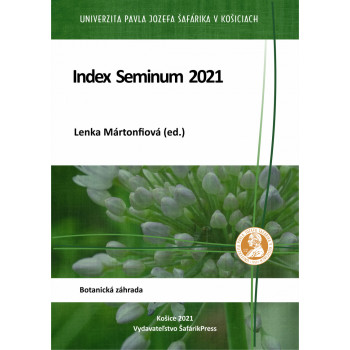
Index Seminum 2021

Index Seminum 2021

E-book

E-book

Lenka Mártonfiová

The Index Seminum 2021 of the Botanical Garden of the Pavol Jozef Šafárik University contains a list of 131 seed samples offered for the international exchange among botanical gardens on the world. It includes seeds collected from the wild plants in natural localities of Slovakia with a detailed description of the localities with coordinates and date of collection (72 samples) and seeds of plants grown in the Botanical Garden (5 samples) and seeds from Exposition of the Tatra Mountain Nature of the State Forests of Tatra National Park, Tatranská Lomnica (54 samples). The index includes a desiderata table that can be used when ordering seeds.

Download e-book for free (pdf)

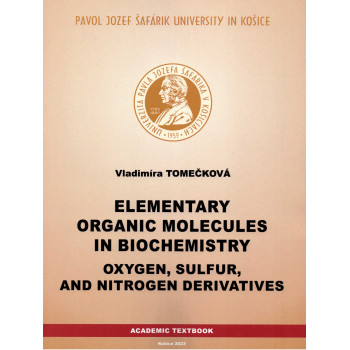
Elementary organic molecules in biochemistry

Elementary organic molecules in biochemistry

€22.00
Availability: 45 In Stock

Vladimíra Tomečková

Nature, as well as the human body, contains an abundant quantity of organic molecules. This textbook describes selected oxygen, sulfur, nitrogen derivatives of hydrocarbons, heterocyclic compounds of their reactions, which are important in the human body or are found in pharmaceutical active substances, poisons, foodstuffs and heat-treated food. The last part of the textbook describes the isomerism of organic compounds, which enables dynamic changes in the structure of molecules that have different properties. Nature is filled with different plants and animals and is the first laboratory to produce bioactive organic natural compounds. These compounds are compatible with human cells and are applicable as therapeutic medicine. There is an effort to reproduce natural molecules in chemical laboratories, but they cannot be as perfect as the natural ones. Synthetic molecules can serve as a model for multiple studies, but there still does not exist a magic panacea pill or a perfect copy of nature, for the treatment of various diseases. Knowledge about the regenerative and toxic effect of medicinal substances in dependence on their structure (type and number of substituents) is very important for the understanding of their role in modulation of health and disease in dependence on their concentration. Compounds can be used daily only in recommended doses (higher doses can be toxic), but still will not replace a healthy diet. People need a varied diet to be healthy, in which are all necessary nutrients, what Hippocrates demonstrated long ago “Let food be the medicine, and let medicine be the food.” This book is written for students who select bioorganic chemistry subject during the study of general medicine or dentistry as well as for motivated students who would like to practice their knowledge and wish to improve in this subject and for students who would like to learn simplified basic organic reactions with their future application in biochemistry. Learn the simple models mainly through creative simple instruction by using different colours, by repetition, practice by drawing of formulas by hand (at least three times) and memorization of common names of compounds and their reactions which have application in biochemistry. Thus, establishing simple educational methods how to distinguish organic molecules according to the colours of a functional group can promote universal learning for all students who thought that chemistry is a difficult subject, but hopefully they change their opinion after study of this book.

Keywords: organic molecules, oxygen, sulfur, nitrogen derivatives of hydrocarbons, heterocyclic compounds, chemical reactions, isomerism of organic compounds

This website uses cookies to ensure you get the best experience on our website