Filter By

Categories

Categories

Year of publication:

Year of publication:

Publication language:

Publication language:

Faculty:

Faculty:

UPJŠ Unit

UPJŠ Unit

Method of publication:

Method of publication:

Active filters

  • Year of publication:: 2018
  • Year of publication:: 2018
  • Year of publication:: 2018
  • Year of publication:: 2018
  • Year of publication:: 2019
  • Year of publication:: 2019
  • Year of publication:: 2019
  • Year of publication:: 2019
  • Year of publication:: 2019
  • Year of publication:: 2023
  • Year of publication:: 2023
  • Year of publication:: 2023
  • Year of publication:: 2025
  • Year of publication:: 2025
  • Publication language:: English
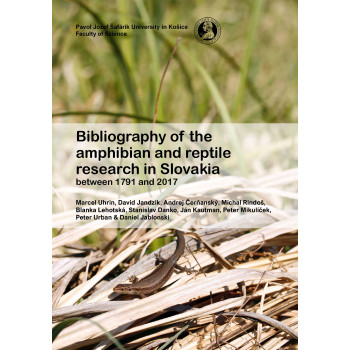
Bibliography of the amphibian and reptile research in Slovakia between 1791 and 2017

Bibliography of the amphibian and reptile...

E-book

E-book

Marcel UhrinDavid JandzikAndrej ČerňanskýMichal RindošBlanka LehotskáStanislav DankoJán KautmanPeter MikulíčekPeter UrbanDaniel Jablonski

Bibliographies provide basic scientific information, illustrate quality and intensity of research in a particular topic, area, or time, and thus help build a cultural-historical perspective of society’s appreciation of knowledge and education. Here we provide a bibliography of herpetological research in the region of Slovakia between the years 1791 and 2017. We collected 2,183 references authored by 1,453 different authors and covering all species of amphibians (18) and reptiles (13) occurring in Slovakia and, in addition, amphibian and reptile taxa occurring in 94 other countries.

Most of the contributions were published in popular magazines and non-indexed journals, while only about 12% of all references represent scientific articles from journals indexed in relevant scientific databases. The extensiveness of study on amphibians and reptiles has varied among different periods within the selected time frame. However, an obvious intensification in the field of herpetology can be observed, especially during the second half of the 20th century. While there have only been few professionals specialized in herpetology, an important role in promoting the research and conservation of amphibians and reptiles in Slovakia has been played by non-governmental organizations and hobbyists. The most frequent type of herpetological data in the referenced literature comes from faunistic research, followed by conservation and general information on herpetofauna, with the majority of published articles in indexed journals coming from the fields of palaeontology, phylogeography, and population genetics.

The presented bibliography is the first step towards building a solid base for future systematic herpetological research in the country and Central Europe.
Download the e-book for free (pdf)

Workshop on Quantum Magnetism: Theoretical Challenges and Future Perspectives

Workshop on Quantum Magnetism: Theoretical...

E-book

E-book

Jozef StrečkaHana ČenčarikováAndrej Gendiar (eds.)

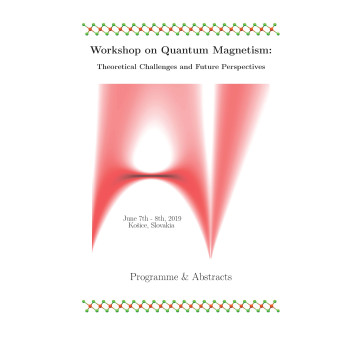
The proceeding involves programme and abstracts of Workshop on Quantum Magnetism: Theoretical Challenges and Future Perspectives, which was held on June 7th – June 8th, 2019, in Košice, Slovakia.

The workshop is organized by Faculty of Science of Pavol Jozef Šafárik University in Košice and Institute of Experimental Physics of Slovak Academy of Sciences in Košice under the financial support of Slovak Research and Development Agency.

The main conference topics are devoted to state-of-the-art problems of Quantum Theory of Magnetism inncluding molecular magnetism, highly frustrated magnetism, magnetic phase transitions, quantum spin liquids, strongly correlated systems, exotic quantum states, flat-band systems and quantum entanglement.

Download the e-book for free  (pdf)

Elementary organic molecules in biochemistry

Elementary organic molecules in biochemistry

€22.00
Availability: 45 In Stock

Vladimíra Tomečková

Nature, as well as the human body, contains an abundant quantity of organic molecules. This textbook describes selected oxygen, sulfur, nitrogen derivatives of hydrocarbons, heterocyclic compounds of their reactions, which are important in the human body or are found in pharmaceutical active substances, poisons, foodstuffs and heat-treated food. The last part of the textbook describes the isomerism of organic compounds, which enables dynamic changes in the structure of molecules that have different properties. Nature is filled with different plants and animals and is the first laboratory to produce bioactive organic natural compounds. These compounds are compatible with human cells and are applicable as therapeutic medicine. There is an effort to reproduce natural molecules in chemical laboratories, but they cannot be as perfect as the natural ones. Synthetic molecules can serve as a model for multiple studies, but there still does not exist a magic panacea pill or a perfect copy of nature, for the treatment of various diseases. Knowledge about the regenerative and toxic effect of medicinal substances in dependence on their structure (type and number of substituents) is very important for the understanding of their role in modulation of health and disease in dependence on their concentration. Compounds can be used daily only in recommended doses (higher doses can be toxic), but still will not replace a healthy diet. People need a varied diet to be healthy, in which are all necessary nutrients, what Hippocrates demonstrated long ago “Let food be the medicine, and let medicine be the food.” This book is written for students who select bioorganic chemistry subject during the study of general medicine or dentistry as well as for motivated students who would like to practice their knowledge and wish to improve in this subject and for students who would like to learn simplified basic organic reactions with their future application in biochemistry. Learn the simple models mainly through creative simple instruction by using different colours, by repetition, practice by drawing of formulas by hand (at least three times) and memorization of common names of compounds and their reactions which have application in biochemistry. Thus, establishing simple educational methods how to distinguish organic molecules according to the colours of a functional group can promote universal learning for all students who thought that chemistry is a difficult subject, but hopefully they change their opinion after study of this book.

Keywords: organic molecules, oxygen, sulfur, nitrogen derivatives of hydrocarbons, heterocyclic compounds, chemical reactions, isomerism of organic compounds

Selected Rheumatology Topics for Medical Students

Selected Rheumatology Topics for Medical Students

€11.50
Availability: 50 In Stock

Želmíra Macejová - Mundher Abdulkareem Salman Aljubouri

         Vysokoškolský učebný text: “ Selected  Rheumatology Topics for Medical Studentsje určený pre študentov lekárskych fakúlt študujúcich v anglickom jazyku v študijnom odbore: General medicine a Dental medicine. Rozsahom sú vhodné pre   pregraduálne štúdium predmetu  interná medicína 5.  Kapitoly uvedené v danom diele zahŕňajú základy reumatológie,  postačujúce  pre absolventov LF UPJŠ.

        Text je prehľadne rozčlenený na :  základné   vyšetrovacie metódy, rozdelenie chorôb na autoimunitné, infekčné artritídy, kryštálmi indukované artritídy,  nezápalové ochorenia v reumatológii, metabolické ochorenia kostí. Obsahom kapitol sú aj najnovšie liečebné možnosti daných ochorení.  V závere je obrazová príloha k ochoreniam spomínaným v samotnom texte.

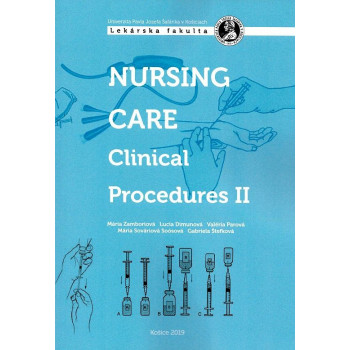
Nursing Care Clinical Procedures ll

Nursing Care Clinical Procedures ll

€16.50
Availability: 9 In Stock

Mária Zamboriová - Lucia Dimunová - Valéria Parová 

Mária Sováriová Soósová - Gabriela Štefková

Healthcare professionals are expected to provide quality, evidence-based health care with an emphasis
on patient safety. Nursing Care - Clinica/ Procedures II is a guidebook of practical procedures for
nurses and medical students and practitioners working in health care setting. This book reflects
changes in nursing, professional, and national guidelines. It should help you to achieve essential
knowledge, abilities and skills in area of vital signs monitoring, reduced mobility care, nutrition and
hydration care, medicine management, blood transfusion management, blood sampling,and care of elimination. To provide clear structure, each topic begins with brief introduction, continues with description of indications, contraindications and possible complications of procedure, necessary equipment and step-by-step procedure implementation supported by illustrations and additional information. 

Od zdravotníckych pracovníkov sa očakáva poskytovanie kvalitnej zdravotnej starostlivosti založenej na dôkazoch s dôrazom na bezpečnosť pacientov. Ošetrovateľská starostlivosť - Klinické postupy ll je príručka praktických postupov pre sestry a študentov medicíny a lekárov pracujúcich v zdravotníckom prostredí. Táto učebnica odráža zmeny v ošetrovateľských, odborných a národných smerniciach.Učebnica má za cieľ pomôcť dosiahnuť základné vedomosti, schopnosti a zručnosti v oblasti monitorovania vitálnych funkcií, starostlivosti o zníženú pohyblivosť, starostlivosti o výživu a
hydratáciu, manažment aplikácie liekov, manažment podávania transfúzie krvi, odberu krvi a
starostlivosti o elimináciu. Aby sa zabezpečila jasná štruktúra, každá téma sa začína krátkym úvodom, pokračuje opisom indikácií, kontraindikácií a možných komplikácií postupu, potrebného vybavenia a zavedenia postupu krok za krokom, podporeného ilustráciami a ďalšími informáciami. 

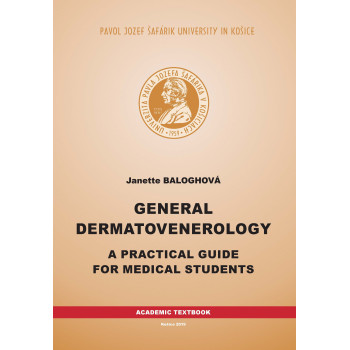
General dermatovenerology

General dermatovenerology

€12.00
Availability: 200 In Stock

Janette Baloghová

Všeobecná dermatovenerológia je nosnou časťou dermatovenerológie. Morfológia, popis a charakteristika jednotlivých eflorescencií sú kľúčové v diagnostike a diferenciácii kožných ochorení spolu s dobre odobratou anamnézou. Snahou bolo vytvoriť vysokoškolský učebný text, ktorý tvorí praktický návod ako vyšetrovať pacienta s kožným ochorením. Cieľom jednotlivých kapitol je dokonale si osvojiť dermatologickú terminológiu, fyzikálnym vyšetrením vnímať špeciálne kožné znaky a zmeny, vedieť sa orientovať v algoritme pomocných vyšetrovacích metód a testov a pochopiť rozdielne vlastnosti a charakteristiku kože vzhľadom na vek pacienta, vznik, priebeh a trvanie kožných prejavov. Posledná kapitola predstavuje praktickú topografiu kožných ochorení v tabuľkách. Dermatovenerológia patrí k interdisciplinárnym odborom, preto všeobecná dermatológia bude určite dobrým sprievodcom pri diagnostike kožných ochorení nielen študentov medicíny, ale aj lekárov prvého kontaktu a styčných odborov.

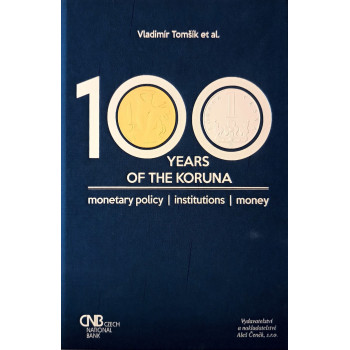
100 years of the koruna

100 years of the koruna

€30.69
Availability: 1 In Stock

Vladimír Tomšík et al.

The book was prepared to mark an important anniversary – one hundred years of our national currency. It was written by a team of Czech National Bank experts headed by CNB Vice-Governor, Professor Vladimír Tomšík. This publication charts the monetary policy history of our central bank (or, to use older terminology, the bank of issue) and describes its institutional development and the banknotes it has issued over time. It covers the period from the establishment of the independent Czechoslovak state in October 1918 and its currency in February 1919 to the present. We have therefore named the publication 100 years of the koruna. Given the twists and turns of history, however, part of the narrative relates to the joint Czechoslovak state, part to the occupied Protectorate and part to the independent Czech Republic. As a result, the original joint Czechoslovak currency was divided temporarily in 1939–1945 and then again – this time for good – in 1993. From that point on, the currencies of the two successor states went their own ways, the Czech koruna continuing to the present day and the Slovak koruna until it was replaced by the single European currency in 2009.

This website uses cookies to ensure you get the best experience on our website