 English
 Slovenčina


English
There are 74 products.
Active filters
- Year of publication:: 2010
- Year of publication:: 2010
- Year of publication:: 2011
- Year of publication:: 2015
- Year of publication:: 2017
- Year of publication:: 2017
- Year of publication:: 2017
- Year of publication:: 2018
- Year of publication:: 2018
- Year of publication:: 2018
- Year of publication:: 2018
- Year of publication:: 2018
- Year of publication:: 2018
- Year of publication:: 2019
- Year of publication:: 2019
- Year of publication:: 2019
- Year of publication:: 2019
- Year of publication:: 2019
- Year of publication:: 2019
- Year of publication:: 2020
- Year of publication:: 2020
- Year of publication:: 2020
- Year of publication:: 2020
- Year of publication:: 2021
- Year of publication:: 2021
- Year of publication:: 2021
- Year of publication:: 2021

Biology - Sample Questions for Entrance Exam
€15.00
Availability:
4 In Stock
H.Mičková - V.Habalová - J.Židzik - E.Slabá
Realism, Modernism, Postmodernism: Five Modern...
E-book
E-book
This textbook has been designed as supporting material for the postgraduate course on modern trends in European literature. It focuses on the presentation of five modern literary modes of writing: the realistic mode which was brought to its prominence by the nineteenth-century Realist movement; the stream-of-consciousness and ‘absurdist’ modes which were developed in the context of modernism; and the magical realist and metafictional modes which are associated mainly with postmodernist literary trends. Each mode is represented by a well-known text which demonstrates the formal aspects of each mode and deals with the thematic concerns typical of the literary movement that influenced its production.
The textbook adopts an interdisciplinary approach, placing the chosen literary texts into the historical, philosophical and cultural contexts that shaped their characters, and thereby providing the background knowledge necessary for a deeper understanding of their formal and thematic aspects.
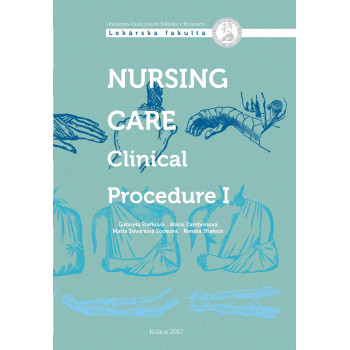
Nursing care - clinical procedure I
€14.60
Availability:
10 In Stock
Gabriela Štefková - Mária Zamboriová - Mária Sováriová Soósová - Renáta Shafout
We would like to introduce the study material/textbook Nursing Care Clinical Procedures I, which was developed to cover the curriculum of Nursing Care 1 for medical students. Clinical procedures are an essential component of nursing practice. The textbook contains four main chapters. Each chapter begins with a general explanation of the topic, followed by detailed method description of procedures to help students deliver high - quality care to patients. Some chapters also include appendi xes in order to pick up some special examples from clinical practice. The textbook strongly describes bandages because a carelessly or improperly applied bandage can cause discomfort to the patient, in many cases it may expose the wound to the danger of infection. To the best of wound knowledge, these procedures reflect currently accepted clinical practice and up-to-date information. The textbook can be easily integrated into an educational programme and can be used in the laboratory as well as in clinical practice. During the preparation of this textbook the information, facts, notes, publications, books and literature presented in the references section were also used. The publication include DVD, which is concentrated on applying bandages from head to lower extremity. DVD was developed in cooperation during IRES project. The student can also find additional information to study by following references. The reading level of Nursing Care Clinical Procedures I is designed to be comprehensible to as many students as possible, including those for whom Engl ish is a second language. We hope that this textbook will be useful to all readers. The authors take no personal responsibility for applying this information to a particular clinical practice
situation.
Gender perspectives in slovak literature of the...
E-book
E-book
The development of this bilingual coursebook evolved as part of project KEGA Nr. 020UPJŠ-4/2013 headed by prof. PhDr. Ján Gbúr, CSc., and emerged from earlier research which had successfully analysed realist and modernist Slovak literature from a gender perspective. Based on initial interpretations which drew from philosophical, sociological and historiographical approaches, we were able to anticipate the issues which could be raised in other texts and thus establish a hypothesis for the subsequent literaryscientific research. Our research has also been influenced by the continually evolving nature of gender studies, and we have therefore decided to adopt a somewhat unusual approach in this coursebook and briefly examine some contemporary texts thereby creating an intentional shift in our timeline. The modern works of Z.Kepplová and U. Kovalyk have raised a number of interesting issues, and a study of the interwar work of M. Urban reveals further interpretations on the basis of gender. After this brief overview, we return to the main focus of the study: gender approaches to Slovak literature of the late 19th and early 20th centuries.
The study focuses on the complexity of male-female relationships in the work of both male and female authors of realist and modernist literature at the end of the 19th and the beginning of the 20th century. Works by the founding generation of realism and late realism were analysed, with particular attention being paid to the fiction of M. Kukučín, J. Čajak, J. G. Tajovský, J. Jesenský, E. M. Šoltésová, T. Vansová, Ľ. Podjavorinská and B. S. Timrava. The works of H. Gregorová and Ľ. Groeblová were also studied as prime examples of Slovak literary modernism.
We hope that this bilingual coursebook will allow realist and modernist Slovak fiction, and the Slovak national literary tradition in general, to receive wider critical renown beyond the borders of Slovakia and also to demonstrate its place in contemporary literary theory.
Essentials of Language Typology
E-book
E-book
This university textbook explains to students enrolled in the course Linguistic Typology and Universals the basic terminology, theoretical approaches, and research methods. The textbook is divided into eleven chapters. Each chapter presents theoretical knowledge in an accessible manner, along with practical exercises aimed at developing students’ skills in the respective area.
The textbook covers the following topics: the subject and nature of linguistic typology, a brief history of this linguistic discipline, genealogical classification of languages, various approaches and main objectives of typology across different linguistic levels (phonology, morphology, syntax, and lexicon), as well as areal typology, complex issues of language universals, and the nature and essence of typologists’ work. Given the extensive research activities of linguists from the Department of British and American Studies at Pavol Jozef Šafárik University in Košice, the textbook also introduces students to the results achieved by these scholars in this rapidly developing field of linguistics.
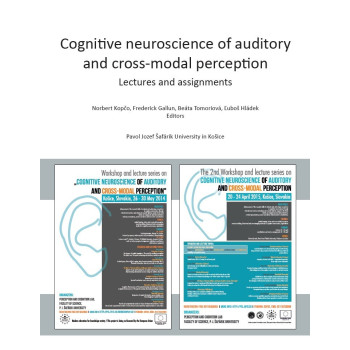
Cognitive neuroscience of auditory and...
E-book
Norbert Kopčo - Frederick Gallun - Beáta Tomoriová - Ľuboš Hládek(eds.)
Cognitive neuroscience is a fast developing scientific field which aims at uncovering the neural basis of human perception and cognition. To achieve this goal, cognitive neuroscience uses a variety of tools and approaches ranging from non-invasive brain imaging to psychophysics and neural modeling. Mastering such tools requires skills and knowledge from multiple scientific domains, including neurophysiology, cognitive psychology, and several computational fields.
Access on request via email: kogneuro (@) gmail.com
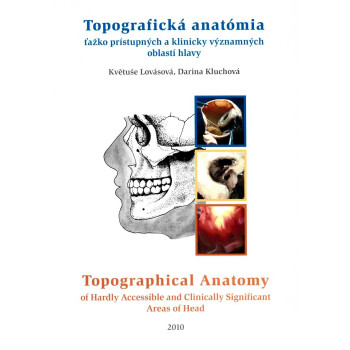
Topografická anatómia ťažko prístupných a...
€27.70
Availability:
6 In Stock
Květuše Lovásová - Darina Kluchová
The surgical practice starts with detailed knowledge of anatomy. Even if anatomy of human body has not changed over the time, perfection and precision of surgical practice require precise knowledge of anatomical structures, their location, and topographical relationships. Everyone should be aware of the occurrence of possible variations as well.
A prospective medical doctor should not rely on knowledge gained by studying models, schemes, and pictures, but should combine two types of learning: visual and didactic. Wide array of the visual learning development, considering vision alone, and a detailed and realistic approach to difficult access to structures of the human body are important precursors that create sufficient and quality knowledge needed for clinical practice and appropriate professional development.
This publication maps all of the clinically significant and difficult approached areas of the head that are not normally prepared for practical exercises in anatomy because of the time and difficulties with the preparation. The colorful, detailed photodocumentation enriched by schemes and followed by procedure guide provides a view of structures until now only poorly documented. We sincerely hope that this monograph will fill the gap in medical literature offered in the market at present time.
Biology practical lessons
€9.60
Availability:
108 In Stock
Helena Mičková a kol.
Skriptá sú určené pre zahraničných študentov Lekárskej fakulty UPJŠ v Košiciach, a sú písané v anglickom jazyku.
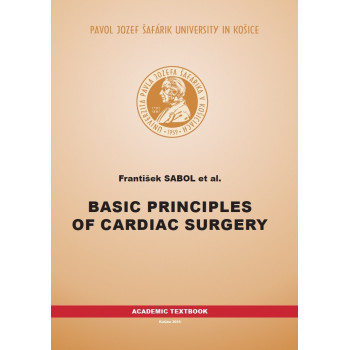
Basic Principles of Cardiac Surgery
€13.16
Availability:
29 In Stock
František Sabola kol.
Although we are not really sure if “Love is coming from the Heart” and nor we know where “the Residence of Soul” is, we are still overwhelmed by its unprecedented effort to keep us alive. Our lives are nowadays fulfilled with enormous chances to satisfy our needs and wishes. Hand in hand is changing our way of life, the intake of calories is growing and the amount of physical activity decreasing. We live longer and maybe happier but our hearts
and vessels are like mirrors showing us how we live. Diseases of the Heart and vessels have become the number one cause of death in highly developed countries including our homeland.
Prevention of cardiovascular diseases has become and an important social and health care system issue. The knowledge requirement of basic principles of cardiology and heart surgery is increasing. Without an understanding of basic principles a good clinical practice is hardly possible.
Together with my Colleagues of Heart surgery department of VÚSCH and LF UPJŠ we prepared this short overview of basic knowledge about surgery of the human heart. We hope that reading it will be more an adventure than a painful journey. If you find some answers to your unanswered questions our effort was not a waste of time.
Authors