 English
 Slovenčina


Slovak studies (e-books)
There are 5 products.
Active filters
VARIA XXXI
E-book
E-book
Katarína Gajdošová - Lucia Jasinská
Book of Abstracts from the XXXI Colloquium of Young Linguists (Danišovce, November 30 – December 1, 2022)
In the present book of abstracts from the 31st Colloquium of Young Linguists, VARIA XXXI, we offer readers an overview of the current research efforts of its participants. The volume contains 23 thematically and methodologically diverse contributions by 24 authors from Slovak as well as Czech linguistic institutions. From the perspective of language components, the book includes abstracts from the fields of corpus linguistics, onomastics, morphology, dialectology, syntax, stylistics, lexicology, phraseology, didactics, and also with overlaps into literary texts.
Download e-book for free (pdf)
e-Slovenčina pre zubárov v praxi – kazuistiky
E-book
E-book
Beáta Jurečková - Lívia Barnišinová
The e-Slovak textbook for dentists in practice - case studies is intended for foreign students of dentistry. It is primarily intended for students of the Slovak language as a foreign language, but the knowledge of the grammatical and lexical basics of the Slovak language at the A1, A2 level is needed.
The textbook consists of eight lessons, which are focused on listening comprehension (audio recordings), vocabulary expansion, systematisation of grammar and development of speech skills (case studies). The two lessons consist of repetitive, concluding exercises. The primary goal of the textbook is to connect language training with professional dental practice.
Duchovnosť v (re)interpretácii diel slovenskej...
E-book
E-book
The collection of studies included in the monographic publication Spirituality in the (Re)interpretation of Works of Slovak Literature was created and matured gradually, over the course of more than ten years (2003–2015).
Some of the studies were part of the defended dissertation Compositional and Semantic Specifics of Slovak Interwar Prose (Prešov 2005), others originated within scientific research (grant) projects, but all were refined against the background of specifying selected methodological approaches. The studies were gradually published in academic journals and scientific anthologies both in Slovakia and abroad (precise details are provided in the footnotes as well as in the editorial note).
In the monograph, they are arranged according to the period of their creation, not publication, in order to preserve the genesis of the author’s scientific research profile. Their arrangement also secondarily respects the analytical-interpretative intersections into the poetics of specific texts. This is why the works on Slovak interwar literature are presented first, followed by those focused on the works of Slovak realists.
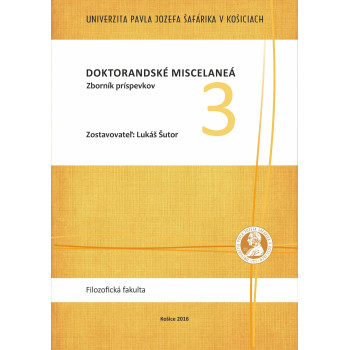
Doktorandské Miscelaneá 3
E-book
E-book
Lukáš Šutor (ed.)
Contributions in the field of psychology address current issues such as normative beliefs and attitudes regarding alcohol consumption, the characteristics of loneliness, questions of pupil personality and the perception of teachers’ interaction styles. They also consider hyperexcitability (excessive psychological excitability), research theorems on injustice, and fundamental concepts and their theoretical connections in the field of self-regulation research within the context of executive functions.
In philosophy, the authors focus on selected aspects of works belonging to major currents of world philosophy (Heidegger, Wittgenstein, Plotinus, Descartes, Patočka).
In literary studies (Slovak studies), the topics include modeling the theme of death in prose texts, the depiction of technological progress in space science fiction films, and the translation work of K. Strmeň, Návštevy (Anthology of World Lyric Poetry).
In the field of social work, the authors present contributions on current trends in preventing burnout syndrome in helping professions, the use of logotherapy in foster care, certain factors enabling the emergence, development, and spread of socially pathological phenomena (“cyberbullying”), religiosity and the value of human life, and an empirical analysis of the competencies of social workers in institutional care for people with intellectual disabilities.
The political science contribution analyzes selected institutions and documents within the European system of human rights protection, while the British and American studies paper examines the relationship between metaphor and metonymy in the interpretation of the meaning of new English compounds.