Active filters

  • Year of publication:: 2022
  • Year of publication:: 2022
  • Year of publication:: 2022
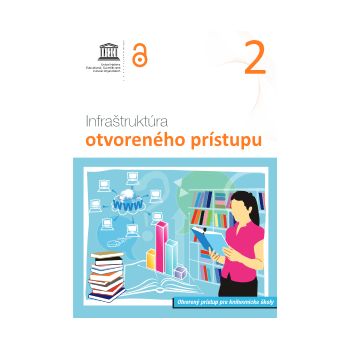
Infraštruktúra otvoreného prístupu

Infraštruktúra otvoreného prístupu

E-book

E-book

Ľubica Jamborová et al.

Textbook from Module 2 "Open Access Infrastructure." This module deals with open access resources across all types, their characteristics, nature, features, planning, execution, selection of appropriate technical standards, establishment of basic procedures, and sustainability practices.

All stakeholders are addressed, including institutions, sponsors, users, and future content creators. Emphasis is placed on e-journals and e-repositories, as well as new trends in open access.

Download the e-book for free

Cesta k otvorenej vede

Cesta k otvorenej vede

E-book

E-book

Johann Berti et al.

The manual is part of the collection Path to Open Science by the French Ministry of Higher Education and Research. It is designed to guide postgraduate students at every step of their research, from planning the scientific approach to publishing the research results.

It provides a set of tools and best practices that can be directly implemented in research across any discipline.

We hope this manual will motivate doctoral students and equip them with the tools to realize their ambitions in open science through sharing findings and data with the broadest possible audience.

Download the e-book for free

A guide to the didactics of biology

A guide to the didactics of biology

E-book

E-book

Katarína Kimáková

The textbook is intended for university students who are preparing for the profession of biology teacher. The structure of the book is similar to an encyclopedia, with one page devoted to each content item, but the topics of the chapters and subchapters follow each other.

The explanatory text on the page illustrates the diagram and there are notes and links to other sources of information. For better orientation, the content of the textbook is divided into 8 sections, which cover several chapters. It follows the general didactics, which it connects with the teaching of biological content. The book provides a basic orientation in the approaches to learning this subject, and also explains the relationship between biology as a science and the didactics of biology. It deals with teaching standards and curricula, advises on how to master biological concepts and understanding, how to communicate with students in biology classes, when and why are effective visual and practical methods. It acquaints the reader with the issue of setting goals for biological education in the cognitive, psychomotor and affective areas in relation to formative and summative assessment.

Hopeful as well as experienced teachers will find in this publication not only a look into the history of teaching biology, but also a look into the future. Current trends in biology teaching, the connection of teaching with digital technologies, the virtual learning environment and interactive simulations and models belong to science lessons today.

Download the e-book for free (pdf)

Pohyb ku kognitívnym adaptačným štúdiám. Adaptácia ako hra

Pohyb ku kognitívnym adaptačným štúdiám....

E-book

E-book

Peter Getlík

The main goal of the monograph "Moving Towards Cognitive Adaptation Studies: Adaptation as Play" was to orient current research in adaptation studies towards the empirically responsible cognitive branch of non-radical constructivism.

This intention results from the rapid progressive differentiation of adaptation studies research, which has mainly manifested itself in this area in the last two decades. With the model of adaptation as play in a cognitive-scientific perspective, author provides the possibility of predicting the nature (also in a broader sense) of the experience of adaptation. Since the form of this experience significantly shapes the products of the adaptation process into their final form, the model of adaptation as play can be applied even in the interpretation of individual adaptations. In the monograph, the author synthesized the model of adaptation as play based on the knowledge of various disciplines. In the field of cognitive sciences, he saw help from the starting points of philosophy, linguistics, informatics, psychology, anthropology, biology and neuroscience – especially affective neuroscience, which also deals with the emotional dimension of the play.

In the intersection with the essential interdisciplinary components of adaptation research, he also used the knowledge of classical and cognitive variations of literary science, film science (also theatrology) and media studies to a large extent. Consistent with other similar results of cognitive sciences, it turns out that even seemingly serious adaptations, like in many aspects of our culture, have a ludic base.

Download the e-book for free  (pdf)

This website uses cookies to ensure you get the best experience on our website