Filter By

Year of publication:

Year of publication:

Publication language:

Publication language:

Active filters

  • Publication language:: English
  • Publication language:: slovenčina, angličtina
Political System of the Slovak Republic for Foreign Students

Political System of the Slovak Republic for...

E-book

E-book

Jana Šutajová Alexander Onufrák

This university textbook, „Political System of the Slovak Republic for Foreign Students“, is designed to introduce Erasmus students and other international students to basic information regarding the historical and political development of Slovakia and the political system of the Slovak Republic. It focuses on political developments since 1918.

It introduces foreign students to pivotal historical events that influenced political developments in Slovakia (the establishment of the First Czechoslovak Republic, the Munich Agreement and the Vienna Arbitration, the Slovak State, postwar developments and the Košice Government Program, the 1946 elections, February 1948, the Prague Spring of 1968, normalization, the Velvet Revolution of 1989, the dissolution of the Czechoslovak Federal Republic, the establishment of the Slovak Republic, and its integration into the European Union and the North Atlantic Treaty Organization) and with the political system of the Slovak Republic (constitutional institutions, the party system, the electoral system). 
Download the e-book for free (pdf)

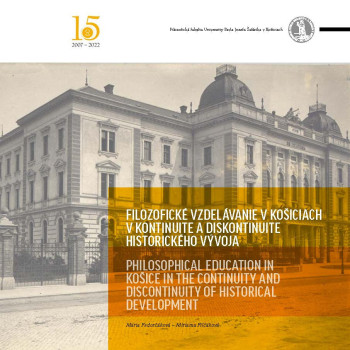
Philosophical Education in Košice in the Continuity and Discontinuity of Historical Development

Philosophical Education in Košice in the...

E-book

E-book

Mária Fedorčáková - Miriama Filčáková

Current publication is dealing with the history of philosophical education in Košice since the beginning to the foundation of the Faculty of Arts at Pavol Jozef Šafárik University in Košice in 2007. Beginnings of philosophical education in Košice are connected to the fundation of the University of Košice in 1657, which was originally founded as Jesuit university with two faculties – Faculty of Theology and Faculy of Arts.

The publication is dealing with the philosophy teaching in the Faculty of Arts and examines the philosophy teachers and students. Another interest is given to decline of philosophy teaching caused by transformation of the University into the Royal Academy and the Academy of Law at the end of the 18 and during 19 century. The second part of the publication is dealing with the history of higher education after the second world war and the foundation of the University of Pavol Jozef Šafárik in Košice.

The authoress focuses on circumstances of the foundation of the Faculty of Arts in Prešov and its history and later development after 1989, which included also division of the university in 1997. The last part of publication presents the history of the university buildings, in which the Faculty of Arts is situated.

Download the e-book for free  (pdf)

Prvé decénium Filozofickej fakulty Univerzity Pavla Jozefa Šafárika v Košiciach (2007 – 2016)

Prvé decénium Filozofickej fakulty Univerzity...

E-book

E-book

Iveta Bónová - Marián Gladiš (eds.)

The Foundation of the Faculty is a major “thing” created and developed by many personalities. The collected information, opinions, and critical judgements have led me to the conclusion that there exist among us plenty of narratives on the formation of this Faculty.

What is appealing about this fact is that from each party concerned, specifically teachers of Philosophy, Psychology and Education at the UPJŠ Faculty of Science, teachers of Psychology at the UPJŠ Faculty of Public Administration in Košice, teachers of the Department of Foreign Languages at UPJŠ, teachers at Prešov University who were approached with a bid to create the conditions of and opportunities for the development of their study branches at the new UPJŠ Faculty of Arts in Košice, there is a significant clue reflected in the inception of the new Faculty of this University.

It is necessary to say that it is a justifiable reflection, because without this, it would not be possible to develop exploration and offer the students courses in the field of Humanities, in social and behavioural sciences, educational sciences, and in the field of History and Ethnology.

Download the e-book for free (pdf)

Myths and Manipulation in Political Discourse

Myths and Manipulation in Political Discourse

E-book

E-book

Jaroslav Marcin - Viktória Marcinová a kol.

This little book started out in a way that probably many other scholarly publications do: When the five of us met as doctoral students and instructors in the Department of British and American Studies, we soon realized that our research overlapped on a number of points. Most prominent among those was our interest in political or politicallymotivated discourse and the study of myths and manipulation that it employed. 

In the end, we decided to pool the results of our research together in order to create a more complex picture, providing a variety of perspectives and voices. In our endeavor, we were greatly aided by the financial support we received from a grant offered by the Šafárik University. The outcome of these efforts is the five chapters of this brief, but hopefully informative and insightful monograph.

In Chapter 1, Viktória Marcinová deals with the impact of totalitarian ideology on the translation of so-called “capitalist” drama during the first stage of normalization in Slovakia (1948-1968). In Chapter 2, the focus shifts to political discourse and manipulation in a democracy, as Jaroslav Marcin takes a closer look at the wartime rhetoric of American presidents. USA remains the focus also in Chapter 3, but this time the question, addressed by Martina Martausová, will be one of the myth of the American Dream and its presentation in post-9/11 United States. A similar idea, though in a different geographical-cultural context, is dealt with in Chapter 4, where Božena Velebná identifies myths of Scottish identity as portrayed in historic films. Finally, in Chapter 5, Eduard Soták will take a look at the role of the mass media within the topic of politically-motivated discourse and spread of political ideology.

Download the e-book for free (pdf)

This website uses cookies to ensure you get the best experience on our website