Slovenčina


E-book
Jana Šutajová Alexander Onufrák
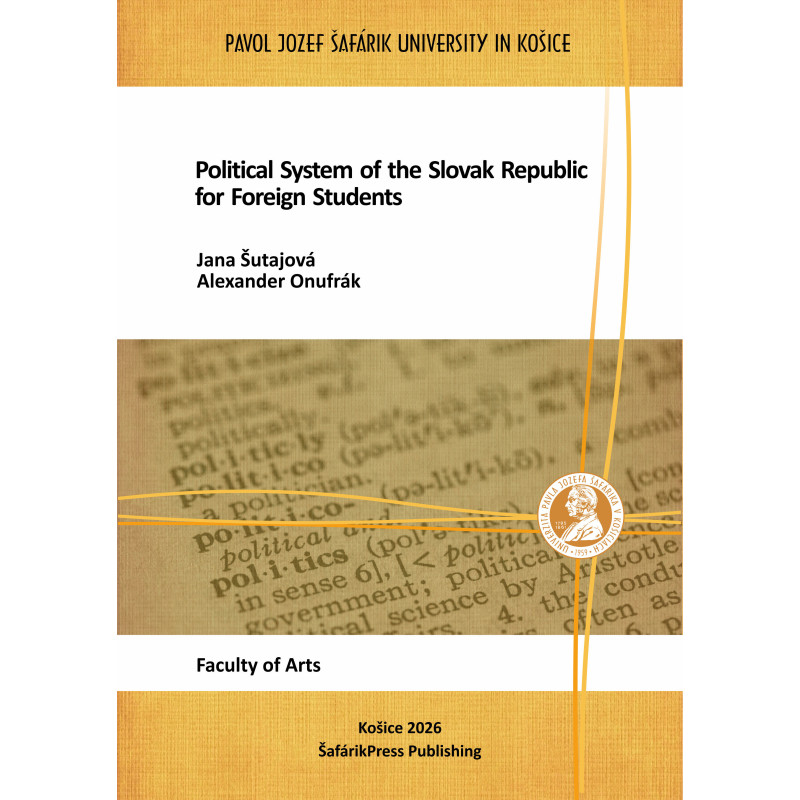
This university textbook, „Political System of the Slovak Republic for Foreign Students“, is designed to introduce Erasmus students and other international students to basic information regarding the historical and political development of Slovakia and the political system of the Slovak Republic. It focuses on political developments since 1918.
It introduces foreign students to pivotal historical events that influenced political developments in Slovakia (the establishment of the First Czechoslovak Republic, the Munich Agreement and the Vienna Arbitration, the Slovak State, postwar developments and the Košice Government Program, the 1946 elections, February 1948, the Prague Spring of 1968, normalization, the Velvet Revolution of 1989, the dissolution of the Czechoslovak Federal Republic, the establishment of the Slovak Republic, and its integration into the European Union and the North Atlantic Treaty Organization) and with the political system of the Slovak Republic (constitutional institutions, the party system, the electoral system).
This university textbook, „Political System of the Slovak Republic for Foreign Students“, is designed to introduce Erasmus students and other international students to basic information regarding the historical and political development of Slovakia and the political system of the Slovak Republic. It focuses on political developments since 1918. It introduces foreign students to pivotal historical events that influenced political developments in Slovakia (the establishment of the First Czechoslovak Republic, the Munich Agreement and the Vienna Arbitration, the Slovak State, postwar developments and the Košice Government Program, the 1946 elections, February 1948, the Prague Spring of 1968, normalization, the Velvet Revolution of 1989, the dissolution of the Czechoslovak Federal Republic, the establishment of the Slovak Republic, and its integration into the European Union and the North Atlantic Treaty Organization) and with the political system of the Slovak Republic (constitutional institutions, the party system, the electoral system).
This university textbook is intended primarily for political scientists. In addition to a brief overview of political developments in individual periods, it devotes particular attention to the status of the legislative power, the executive power, the electoral system, and the political party system in each period, as well as the relationships between them. The university textbook consists of eight parts that follow one another logically and chronologically. This publication was produced as part of the KEGA project No. 014UPJŠ-4/2025, “Internationalisation, Innovation and Modernisation of Modular Education in Political Science.”

Data sheet
E-book
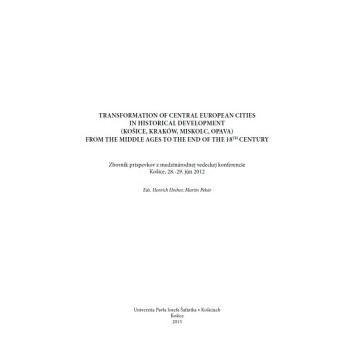
Henrich Hrehor - Martin Pekár (eds.)
(Košice, Kraków, Miskolc, Opava) : From the Middle Ages to the End of the 18th Century.
Proceedings of the International Scientific Conference, Košice, June 28–29, 2012
E-book
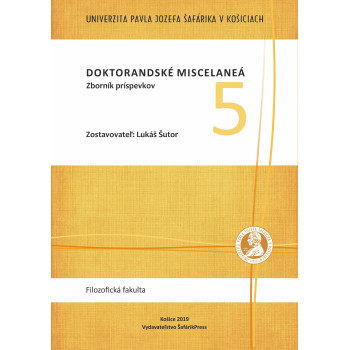
Lukáš Šutor (ed.)
The fifth volume of Doctoral Miscellanea was created as a conference proceedings, returning to the original idea of the entire project: to establish a publication space for contributions from emerging scientists.
The first two issues of Doctoral Miscellanea consisted of outputs from departmental seminars, which involved internal discussions. Compared to direct publication, it proved more beneficial for doctoral students to verify their initial research results in multiple stages and present them in diverse ways (reaching more listeners and readers). The length of the texts in the first two issues was adapted to the duration of the presentations, but this practice was slightly disrupted by the omission of seminars in previous issues. In the current issue, the scope of the studies is somewhat more uniform.
An added value of the fifth volume was the meeting of all contributors at a joint conference, the Autumn School for Doctoral Students of the Faculty of Arts at UPJŠ in Košice, which took place on October 17, 2018, and October 18, 2018, in Danišovce.
We believe that this unique experience—often the first for many—of actively presenting at a scientific event could contribute to a better final version of the submitted contributions. At the same time, it allowed doctoral students to broaden their horizons within the humanities and social sciences, at least within the scope of the currently addressed dissertation research.
Lukáš Šutor
E-book
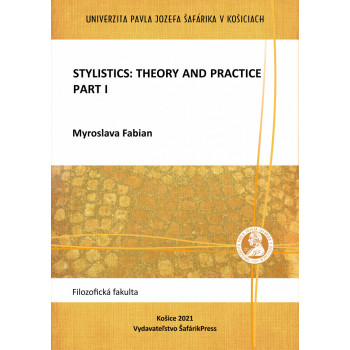
The academic textbook entitled “Stylistics: Theory and Practice, Part I” responds to the need identified by the author in her own teaching practice to supply the students with both theoretical and practical materials to the lecture and seminar course of contemporary English Stylistics.
Taking into account the richness and variety of English stylistic means of communication, the author dwells on basic notions of the academic course in question, describes stylistic semasiology as well as phonetic, syntactic expressive means and stylistic devices, offers practical help to stylistically identify, classify and describe the elements of language used in speech.
The textbook is designed for university students of English philology, students of English translation and interpretation study programmes, and also for students majoring in other disciplines combined with English language studies, as well as for those who study in English are expected to engage in scientific inquiry, document their research in Bachelor and Master theses or in doctoral dissertations written in English, and to present their work to their academic community.
E-book
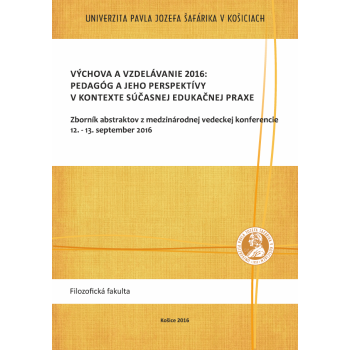
Renáta Orosová - Zuzana Boberová - Emília Marcinová (eds.)
Proceedings of Abstracts from the International Scientific Conference, 12–13 September 2016
The international scientific conference is focused on issues of education and upbringing within primary, secondary, and higher education, as well as school institutions, from the perspective of the educator. Emphasis is placed on the current state and prospects of educators in educational practice, pedagogical and sociological aspects of upbringing in fundamental educational and upbringing institutions, as well as current aspects of pre-service teacher training.
The conference is intended for researchers, young university teachers, doctoral students, as well as professional and pedagogical staff, with the aim of presenting the educator-teacher, social pedagogue, and special pedagogue-from a contemporary perspective, highlighting their essential cooperation in relation to education, and stimulating discussion on current issues in the presented areas of upbringing and education within the context of the present situation in the school system.