

Filter By

Year of publication:

Year of publication:

Publication language:

Publication language:

Active filters

  • Year of publication:: 2011
  • Year of publication:: 2012
  • Year of publication:: 2014
  • Year of publication:: 2026
Sprievodca seminárom Danteho Peklo

Sprievodca seminárom Danteho Peklo

E-book

E-book

Ján Hreško

This teaching guide is intended for teachers and instructors who are introducing new readers to Dante’s Divine Comedy, in particular the first cantica, Inferno, offering support and a grounding in the cultural background of one of the most important works of European medieval literature. Rather than forming yet another academic contribution to the study of Dante and his work, the guide focuses on using a guided seminar reading method within study groups and fostering meaningful discussions about the central themes and issues of the Inferno. Under the guidance of a teacher, students are encouraged to engage actively with the motifs and moral universe of this classic literary work – a primary source that cannot be replaced by any retelling. The proposed interpretations draw on established scholarly commentaries to deepen the readers’ understanding of the text, and each lesson is accompanied by a selected bibliography. The guide includes thematic introductions presenting Dante Alighieri as both author and protagonist within the Divine Comedy. It also offers carefully selected questions designed to foster textual comprehension and stimulate discussion during seminar readings of selected cantos of the Inferno. In addition, the publication includes special lessons on associated literary and artistic works. The guide features a wealth of original illustrations and an extensive range of visual materials. The course thus builds upon the traditional practice of seminar-based readings of works by the great authors, an approach which continues to form part of the curriculum at many liberal arts colleges, by integrating innovative techniques into this established educational method.

Download the e-book for free (pdf)

Leibniz a Heidegger – veta o (dostatočnom) dôvode

Leibniz a Heidegger – veta o (dostatočnom) dôvode

E-book

E-book

Martin Škára

Philosophy is interwoven throughout its history with several principles that bring light and order to this kind of thinking, whether it is a systematic or a non-systematic form of philosophizing.

Each of the principles represents in its own way the origin (ἀρχή) of all deductive reasoning, but not all philosophical statements and conceptions are obliged to proceed in the same way, for not all philosophical statements and conceptions are calculus. Actually, such a form of rationalist philosophizing is really a minority in the history of philosophy. But in spite of its minority presence, it will always attract attention to some extent, whether by becoming a pillar of thought itself and finding a permanent place in its foundations, or by becoming an indispensable mainstay of philosophical reasoning. In fact, there are not many principles in the history of philosophical thought.

The state of affairs is primarily due to the heterogeneous and in many cases irrationalist nature of philosophical thinking.

Download the e-book for free (pdf)

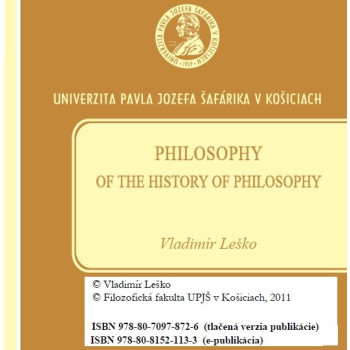
Philosophy of the history of philosophy

Philosophy of the history of philosophy

E-book

E-book

Vladimír Leško

The book is the result of long-term contemplation on the relationships between the history of philosophy and its reflection in more or less systematic, or non-systematic forms of philosophizing of the most significant philosophical teachings of the 19th and 20th centuries (Hegel, Schelling, Marx, Nietzsche, Husserl, Heidegger, Fink, Patočka, and Gadamer).

The primary goal of the work is to present the most significant historical-philosophical teachings of the 19th and 20th centuries in the formation and fulfillment of strong and weak models of the philosophy of the history of philosophy in the concepts of Hegel, Schelling, Marx, Nietzsche, Husserl, Heidegger, Fink, Patočka, and Gadamer.

The results of the philosophy of the history of philosophy are presented here as a metatheoretical movement within historical-philosophical thinking, whose aim is not to empirically describe the historical-philosophical process, but to understand and explain it as an inseparable part of the most significant philosophical problems – what is philosophy, what is metaphysics, and the question of being.

Download the e-book for free (pdf)


THE FUNCTION OF METAPHOR IN MEDIEVAL NEOPLATONISM

THE FUNCTION OF METAPHOR IN MEDIEVAL NEOPLATONISM

E-book

E-book

Mária Mičaninová - Ivica Hajdučeková (eds.)

In the framework of the project VEGA of the Ministry of Education, Science, Research and Sport of the Slovak Republic 1/0330/12 The Function of Metaphor in the Philosophy of Shlomo ben Yehuda ibn Gabirol and Shihab al-Din Yahya al-Suhrawardi, project leader Assoc. Prof. Mária Mičaninová, CSc., under the patronage of the rector of Pavol Jozef Šafárik University in Košice, The Slovak Republic, Prof. MUDr. Ladislav Mirossay, DrSc., and of The Department of Philosophy and History of Philosophy of the Faculty of Arts of the same University, took place on 4th – 5th October 2013 an International conference on The Function of Metaphor in Medieval Neoplatonism. Two days´conference was opened by Dean of the Faculty of Arts of P. J. Šafárik University, Prof. PhDr. Ján Gbúr, CSc.,in the presence of Prof. PhDr. Vladimír Leško, CSc., Head of The Department of Philosophy and History of Philosophy, and of foreign guests and students of the University.

Download the e-book for free (pdf)

This website uses cookies to ensure you get the best experience on our website