Slovenčina




E-book
This teaching guide is intended for teachers and instructors who are introducing new readers to Dante’s Divine Comedy, in particular the first cantica, Inferno, offering support and a grounding in the cultural background of one of the most important works of European medieval literature. Rather than forming yet another academic contribution to the study of Dante and his work, the guide focuses on using a guided seminar reading method within study groups and fostering meaningful discussions about the central themes and issues of the Inferno. Under the guidance of a teacher, students are encouraged to engage actively with the motifs and moral universe of this classic literary work – a primary source that cannot be replaced by any retelling. The proposed interpretations draw on established scholarly commentaries to deepen the readers’ understanding of the text, and each lesson is accompanied by a selected bibliography. The guide includes thematic introductions presenting Dante Alighieri as both author and protagonist within the Divine Comedy. It also offers carefully selected questions designed to foster textual comprehension and stimulate discussion during seminar readings of selected cantos of the Inferno. In addition, the publication includes special lessons on associated literary and artistic works. The guide features a wealth of original illustrations and an extensive range of visual materials. The course thus builds upon the traditional practice of seminar-based readings of works by the great authors, an approach which continues to form part of the curriculum at many liberal arts colleges, by integrating innovative techniques into this established educational method.
Data sheet
E-book
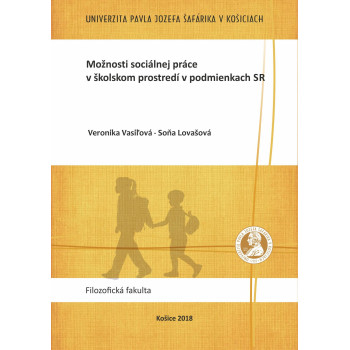
Veronika Vasiľová - Soňa Lovašová
The formation of social work as a scientific discipline is not a completed process because of with changes in society also change social problems that need to be identified and analyzed with the intention to develop methodological solutions aimed at preventing and interventing these social problems.For this reason, the field of social work as such is constantly expanding, as its dynamic nature makes it possible to respond to emerging social problems and react to the needs of society.
Social work in the school environment is a functioning science field abroad.In the conditions of the Slovak Republic, this area of social work is still missing.Therefore, the monograph deals with the possibilities of social work in the school environment in Slovakia.
The monograph is primarily intended for the professionals working in the field of social work and in the third sector with children and youth.
E-book
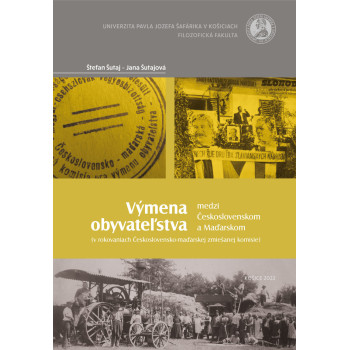
The population exchange between Czechoslovakia and Hungary was carried out on the basis of the Agreement on the Exchange of Populations between Czechoslovakia and Hungary, which was signed on February 27, 1946. Its adoption was not only part of Czechoslovak solutions to the status of national minorities, but also part of the strategic concept of building a state of Czechs and Slovaks without Germans and Hungarians.
The agreement was part of the postwar resolution of mutual disputes and misunderstandings and was intended to be one of the solutions that, in the postwar period, would eliminate a factor which, according to Czechoslovak political leaders, had caused the war conflict.
The population exchange between Czechoslovakia and Hungary was therefore not an isolated historical event, but part of migratory movements that had begun in Europe already after the First World War, and can be seen as a continuation of previous developments as part of migration patterns in Europe.
Download e-book for free (pdf)
E-book
Magdaléna Halachová - Vladimír Lichner - Katarína Šiňanská (eds.)
Proceedings of Contributions from the Scientific Conference Held on April 25, 2013, in Košice
The proceedings of contributions from the scientific conference were created as part of the national round of the Student Scientific and Professional Activities event in the field of study 3.1.14 Social Work, which took place on April 25, 2013, in Košice.
The central theme of the proceedings focuses on addressing various problem areas within social work as both an academic discipline and a practical activity. These contributions were prepared by students and young researchers under the guidance of experienced professionals. The topics covered in the proceedings include issues such as social services, field social work, school social work, and similar areas. Additionally, they highlight the dangers of socio-pathological phenomena such as truancy, drug addiction, poverty, bullying, and more.
The presented results clearly demonstrate the importance of social work and other helping professions in working with specific client groups.
E-book
The university textbook "Theories of Intercultural Communication" is primarily intended for master's degree students of translation and interpreting, as well as doctoral students of British and American Studies.
The goal of the textbook is to familiarize students with key theories in the field of intercultural communication. Eight chapters cover a selection of current theories focused on defining cultural dimensions, identity management and negotiation, accommodation and adaptation, anxiety and uncertainty management, and current research on the Sapir-Whorf hypothesis.
The final chapter provides a historical overview of intercultural communication theories and outlines key research questions for the future.