Filter By

Year of publication:

Year of publication:

Publication language:

Publication language:

Active filters

  • Year of publication:: 2010
  • Year of publication:: 2011
  • Year of publication:: 2013
  • Year of publication:: 2019
Základy filozofickej antropológie I.

Základy filozofickej antropológie I.

E-book

E-book

Kristína Bosáková

The textbook for the course of Philosophical Anthropology should help the students of philosophy in major subject as much as of philosophy as minor in combination with other study programs in social sciences and STEM disciplines, to develop their own ideas and opinions about the question of human being in the philosophy. Its aim is to make a short introduction into the field of philosophical anthropology and to educate the students in the most important topics of the discipline.

Every chapter consist of the theoretical part and of the practical analysis of the text, which is followed by three questions at the end of each chapter. Students, who will later become the philosophy teachers, shall learn how to discuss and teach several topics from the philosophical anthropology in their future classes. Therefore, the textbook is suitable as much for the pedagogical as for the non-pedagogical study programs.
Download the e-book for free (pdf)

Doktorandské miscelaneá 5

Doktorandské miscelaneá 5

E-book

E-book

Lukáš Šutor (ed.)

The fifth volume of Doctoral Miscellanea was created as a conference proceedings, returning to the original idea of the entire project: to establish a publication space for contributions from emerging scientists.

The first two issues of Doctoral Miscellanea consisted of outputs from departmental seminars, which involved internal discussions. Compared to direct publication, it proved more beneficial for doctoral students to verify their initial research results in multiple stages and present them in diverse ways (reaching more listeners and readers). The length of the texts in the first two issues was adapted to the duration of the presentations, but this practice was slightly disrupted by the omission of seminars in previous issues. In the current issue, the scope of the studies is somewhat more uniform.

An added value of the fifth volume was the meeting of all contributors at a joint conference, the Autumn School for Doctoral Students of the Faculty of Arts at UPJŠ in Košice, which took place on October 17, 2018, and October 18, 2018, in Danišovce.

We believe that this unique experience—often the first for many—of actively presenting at a scientific event could contribute to a better final version of the submitted contributions. At the same time, it allowed doctoral students to broaden their horizons within the humanities and social sciences, at least within the scope of the currently addressed dissertation research.

Lukáš Šutor

Download the e-book for free  (pdf)

Patočka o vzniku matematickej prírodovedy

Patočka o vzniku matematickej prírodovedy

E-book

E-book

Pavol Tholt

The work presented in the following text is an attempt to analyze Patočka's perspective on the emergence and essence of mathematical natural science in the 17th century. During this period, Patočka's attention was particularly drawn to Descartes' philosophy and Cartesianism, as well as the philosophies of Galileo, Bacon, and Leibniz.

Patočka himself devoted continuous and exceptional attention to these questions, as evidenced by several monographic works and numerous articles and studies he wrote on the subject.

Download the e-book for free (pdf)

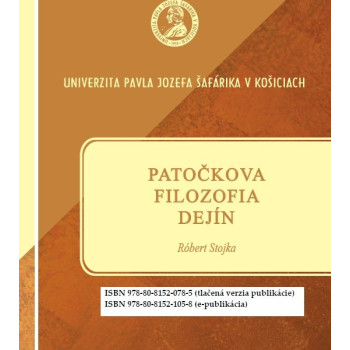
Patočkova filozofia dejín

Patočkova filozofia dejín

E-book

E-book

Róbert Stojka

The aim of the presented monograph is primarily to introduce Patočka's concept of the philosophy of history as comprehensively as possible, although I am aware that this is by no means an easy task. This difficulty arises not only because, as already mentioned, there is currently no extensive and exhaustive work on this topic.

While there is a relatively large number of studies devoted to Patočka's concept of the philosophy of history, none of them, however, examine this concept from a comprehensive perspective as a unified whole – most focus on specific partial issues (and there are many) stemming from this concept. This fact, incidentally, serves as clear evidence to me that this is undoubtedly a highly demanding topic.

Download the e-book for free (pdf)

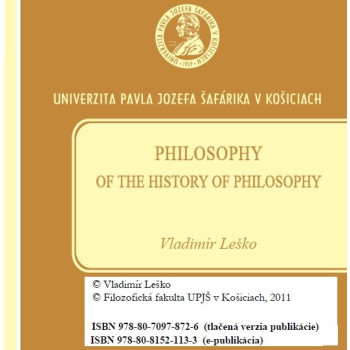
Philosophy of the history of philosophy

Philosophy of the history of philosophy

E-book

E-book

Vladimír Leško

The book is the result of long-term contemplation on the relationships between the history of philosophy and its reflection in more or less systematic, or non-systematic forms of philosophizing of the most significant philosophical teachings of the 19th and 20th centuries (Hegel, Schelling, Marx, Nietzsche, Husserl, Heidegger, Fink, Patočka, and Gadamer).

The primary goal of the work is to present the most significant historical-philosophical teachings of the 19th and 20th centuries in the formation and fulfillment of strong and weak models of the philosophy of the history of philosophy in the concepts of Hegel, Schelling, Marx, Nietzsche, Husserl, Heidegger, Fink, Patočka, and Gadamer.

The results of the philosophy of the history of philosophy are presented here as a metatheoretical movement within historical-philosophical thinking, whose aim is not to empirically describe the historical-philosophical process, but to understand and explain it as an inseparable part of the most significant philosophical problems – what is philosophy, what is metaphysics, and the question of being.

Download the e-book for free (pdf)


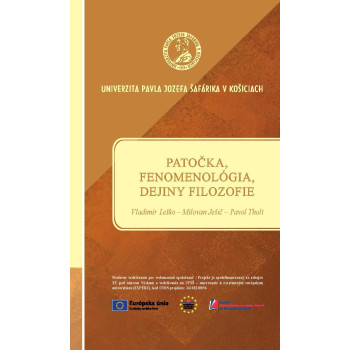
Patočka, fenomenológia a dejiny filozofie

Patočka, fenomenológia a dejiny filozofie

E-book

E-book

Vladimír Leško - Milovan Ješič - Pavol Tholt

The philosophical work of the most significant Czech philosopher of the 20th century, Jan Patočka (1907–1977), stands out for its unique intellectual originality.

Even at the time of its creation, it significantly transcended the narrow boundaries of the contemporary Czechoslovak spiritual space and uniquely connected our country with the most advanced philosophical teachings of Western thought, in which Husserl's phenomenology and Heidegger's fundamental ontology played a dominant role. Certainly, it would be a great mistake to reduce the decisive position of Patočka's philosophical work merely to the reception and critical-creative elaboration of Husserl's and Heidegger's philosophy.

In this context, we cannot overlook the decisive contribution of Eugen Fink, who introduced Patočka to the intricacies of Husserl's and Heidegger's philosophy. Both thinkers then continued in a lifelong creative philosophical dialogue. However, it is also necessary to mention Patočka's intense interest in the works of Scheler, Ingarden, Landgrebe, as well as Sartre and others.

Download the e-book for free (pdf)

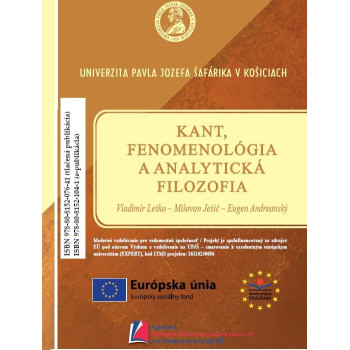
Kant, fenomenológia a analytická filozofia

Kant, fenomenológia a analytická filozofia

E-book

E-book

Vladimír Leško - Milovan Ješič - Eugen Andreanský

The philosophical work of Immanuel Kant, the founder of German classical idealism, is one of those which, by the strength of its theoretical legacy, is permanently inspiring even in contemporary philosophical activities. This is an indisputable fact that cannot be seriously objected to. The philosophical teachings of Edmund Husserl, the founder of phenomenology, his successor Martin Heidegger, as well as several representatives of analytic philosophy, are proof of this fact. The above fact led the authors of this work to the idea of devoting a separate collective monograph to the indicated problem. 

Download the e-book for free (pdf)

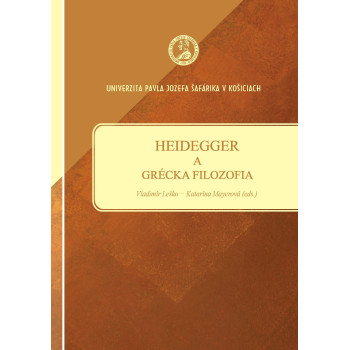
Heidegger a grécka filozofia

Heidegger a grécka filozofia

E-book

E-kniha

Vladimír Leško - Katarína Mayerová (eds.)


The main aim of the present work is to try to capture the decisive mode of Heidegger's philosophical understanding of the central problem of Greek philosophy, the problem of being, in the teachings of Anaximander, Heracleitus, Parmenides, Plato, and Aristotle. The authors of each section present their own understanding of Heidegger and his distinctive philosophical reception of Greek philosophy. In this context, it should be noted that the authors themselves sought their own point of view. With Heidegger's work in general, it is almost impossible to find the same interpretive consonance. This is also true for his reception of the Greek heritage. However, it is all the more professionally provoking for further philosophical investigations.

Download the e-book for free (pdf)

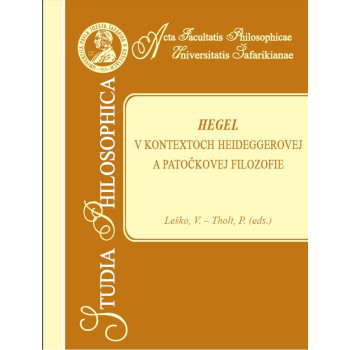
Hegel v kontextoch Heideggerovej a Patočkovej filozofie

Hegel v kontextoch Heideggerovej a Patočkovej...

E-book

E-book

Vladimír Leško - Pavol Tholt (eds.)

Proceedings of the Third International Philosophical Conference Hegel in the Contexts of Heidegger's and Patoček's Philosophy, held on 1-2 October 2009.

The Philosophical Proceedings is a presentation of the results of the work of the research teams of the research projects VEGA 1/0650/08 - Heidegger and the History of Philosophy and VEGA 1/4679/07 - Jan Patočka's Asubjective Phenomenology and the History of Philosophy solved at the Department of Philosophy and the History of Philosophy of the Faculty of Philosophy of the University of Applied Sciences in Košice.

Download the e-book for free (pdf)

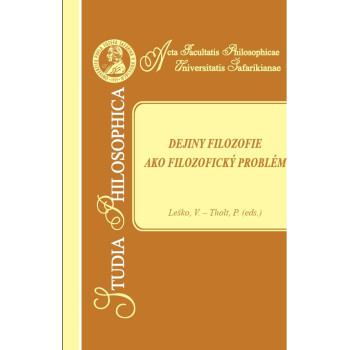
Dejiny filozofie ako filozofický problém

Dejiny filozofie ako filozofický problém

E-book

E-book

Vladimír Leško - Pavol Tholt (eds.)

Proceedings of the Fourth International Philosophical Symposium History of Philosophy as a Philosophical Problem, held on 14-15 October 2010

The Philosophical Proceedings is the final presentation of the results of the work of the research teams of the research projects VEGA 1/0650/08 - Heidegger and the History of Philosophy and VEGA 1/4679/07 - Jan Patočka's Asubjective Phenomenology and the History of Philosophy solved at the Department of Philosophy and the History of Philosophy of the Faculty of Philosophy of the University of Applied Sciences in Košice.

Download the e-book for free (pdf)

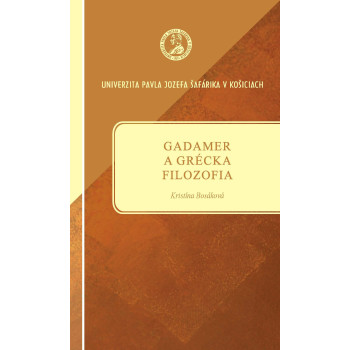
Gadamer a grécka filozofia

Gadamer a grécka filozofia

E-book

E-book

Kristína Bosáková

Attempting to confront Gadamer's teachings not only with the giants of Greek philosophy but also with Hegel and Heidegger is no easy task. However, Gadamer's entire historical-philosophical work is most prominently associated with these ancient thinkers and the two geniuses of German philosophical thought. Therefore, there is no avoiding it. Without this confrontation, all my efforts would be, in a certain sense, futile. Whether and how I succeed is another question. Every reader will surely form their own judgment.

Download the e-book for free (pdf)

Možné svety z pohľadu logickej sémantiky a analytickej filozofie

Možné svety z pohľadu logickej sémantiky a...

E-book

E-book

Eugen Andreanský

The presented monograph aims to critically map the understanding of the concept of possible worlds.

The first chapter describes the formation of the semantics of possible worlds, along with indicating some problems it brings, which were incisively revealed primarily by W. V. O. Quine. In the next two chapters, the work focuses on more modern views on the nature of possible worlds, with the main attention given to the dichotomy between the possibilist and actualist approach to the question of modalities, alongside which it is necessary to assess other distinctions (essentialism - anti-essentialism, realism - reductionism (or ersatzism or fictionalism), naturalism - non-naturalism, etc.). Increased attention in the work is specifically devoted to the possibilism of D. Lewis and the actualist concepts of S. Kripke, A. Plantinga, R. M. Adams, N. Rescher, D. Armstrong, and J. Hintikka.

An unconventional approach to the issue of possible worlds is captured in the fourth chapter. It is primarily dedicated to the significant concept of Jaakko Hintikka, which works with the notion of epistemic possible worlds and documents the inclination towards the modification and relativization of modal discourse. The conclusion provides an evaluation of the discussion that touches on the main problems associated with considerations of possible worlds.

In the presented monograph, some representative concepts of possible worlds, or possible individuals, are clarified, and the overall process is indicated from assessing possible worlds as ideal logical constructs through their relativization by separate domains of individuals for individual worlds and further through the relationship of attainability to financial, impossible, and non-standard possible worlds.

Download the e-book for free (pdf)

This website uses cookies to ensure you get the best experience on our website