 English
 Slovenčina


Ethics (e-books)
There are 3 products.

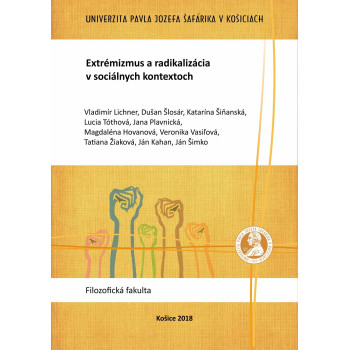
Extrémizmus a radikalizácia v sociálnych...
E-book
E-book
Vladimír Lichner - Dušan Šlosár et al.
It is very difficult to refer to any act of extremism or action having extremist characteristics, or to exclude it unambiguously. The boundary between extremism and accepted, conformal behavior is very broad and vaguely worded. Each company tends to set certain criteria to determine what can be considered as unwanted, violent, radical or extreme, or what signs of such a manifestation do not have. Therefore, when comparing the individual countries of the European Union in this area, we come across a different definition of what is or is not considered to be radical or extremist. In essence, the level of tolerance to some of the manifestations and the setting of indicators for the evaluation of the proceedings as extremist.
The presented monograph aims to present the basic social contexts of extremism and radicalization in the form of their philosophical and theoretical backgrounds, influencing the factors, the basic directions. In the author's work, the authors focus on the target group of adolescents, which they consider to be one of the most endangered groups in society in terms of development of the radicalization process. At the conclusion of the monograph is also offered the criminal level of these phenomena, which is not unavoidable in terms of complex analysis.

Evolučná etika – vybrané problémy a výzvy
E-book
E-book
The present monograph titled Evolutionary Ethics: Selected Issues and Challenges discusses a range of problems, theoretical concepts, and beliefs from the perspective of evolutionary ethics. The term evolution has become one of the central terms in contemporary science and philosophy.
In social sciences in general, and in socio-biology and evolutionary psychology in particular, evolution has had great impact on our understanding of the genesis of culture. Evolutionary theories play a similar role within the theory of consciousness and of the mind (evolutionary epistemology). The interrelation between our evolutionary past and our sense of good and evil is also a subject of heightened interest in ethics; it has in fact become one of its challenges. The concept of evolution challenges the way we create thought patterns through which we understand, or hope to understand, ourselves and the world around us.
This monograph represents a general summary of selected issues in evolutionary ethics, touching upon various aspects of current research into evolutionary ethics and the related domains of evolution, science, ethics, and morals. Evolutionary ethics has become a project which presupposes that in order to understand the essence and basis of morals one must turn to the process of evolution of thought, and to the theories put forth by evolutionists, specifically evolutionary biologists.
The structure of this monograph, as well as its potential usefulness for research and education clearly show that the analysis of the problems discussed here has significant implications for domains far removed from the purely theoretical parts of moral philosophy or biology. The advantage of such discourse is that it enables the implementation of evolutionary ethics in social and ethical issues of public interest (for example Sex Literacy, Sex Education), and this should be recognised and welcome.