Filter By

Year of publication:

Year of publication:

Publication language:

Publication language:

Active filters

  • Year of publication:: 2015
  • Year of publication:: 2019
  • Year of publication:: 2022
Počítačová fyzika II

Počítačová fyzika II

E-book

E-book

Milan Žukovič

This textbook is intended for master's degree students and is a follow-up to the Computational Physics I course studied at the bachelor's level. The content of the textbook Computational Physics II focuses on stochastic methods of solving physical problems, mainly on Monte Carlo (MC) simulation of many-particle systems.

The focus on this computationally intensive approach is motivated by the gradual increase in the computing capacities of ordinary computers as well as the introduction of high-performance computing clusters. This has led to significant progress in the development of new simulation techniques, thanks to which MC simulations have found application in various areas of research and application practice. Considering the main research focus of the department, this text is particularly devoted to the presentation of basic and more advanced MC simulation techniques applied to a simple Ising spin model in order to investigate its magnetic, thermodynamic and critical properties.

The next part is devoted to MC simulations of random processes. It focuses on the simplest but also the most basic random walk process and demonstrates its applications in financial analysis and the solution of a quantum system described by the time-dependent Schrödinger equation. The last part is dedicated to the basics of molecular dynamics, applied to simulating the classical movement of atoms in a given force field. By mastering the problems addressed in this course, students will obtain a potential tool for working out of their diploma theses, or a methodology useful for their further scientific and research practice in the field of investigating of complex systems.

The lectured topic is subsequently exercised in the form of preparing projects implemented in the freely distributable software Octave, which is easy on the user's programming skills and which students have the opportunity to familiarize themselves with in the previous study.

Download e-book for free (pdf)
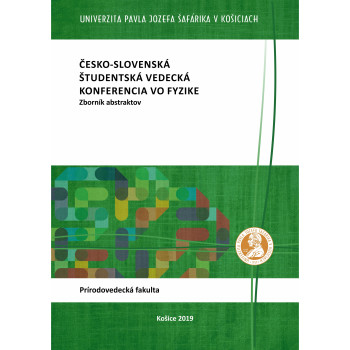
Študentská vedecká konferencia PF UPJŠ 2019

Študentská vedecká konferencia PF UPJŠ 2019

E-book

E-book

Katarína Cechlárová (ed.)

This year, the Student Scientific Conference was held on April 24, 2019, across 17 sections in disciplines such as biology and ecology, chemistry, physics, geography, mathematics, informatics, and their didactics. Bachelor’s and master’s students presented a total of 124 contributions. The most successful participants advanced to national or traditional Czech-Slovak student scientific showcases in fields like physics, chemistry, mathematics, informatics, and mathematics didactics.

In addition to faculty students, 10 high school students participated outside the competition. They were invited based on their achievements in subject-specific Olympiads or because they were already engaged with the faculty under the guidance of dedicated teachers in laboratory work as part of their preparation for future studies. The day also featured a programming competition with 23 participants, an IHRA contest involving 16 teams of high school students and 15 teams from elementary schools, and a new Puzzle section where 72 high school students from the region competed.

The abstracts from the Student Scientific Conference demonstrate that our faculty's students not only absorb theoretical knowledge delivered in lectures but also actively engage in solving partial scientific problems that align with research objectives at the institutes of PF UPJŠ. This collection serves as both a record of scientific activity at the faculty and a dignified presentation for the broader public.

Prof. RNDr. Katarína Cechlárová, DrSc.

Vice-Dean for Education

Doc. RNDr. Gabriel Semanišin, PhD.

Dean of the Faculty

Download the e-book for free  (pdf)

Počítačová fyzika I

Počítačová fyzika I

E-book

E-book

Milan Žukovič

The textbook Computational Physics I covers the topics taught in the course of the same name at the bachelor's level of the Physics study program, as well as in the course Application of Numerical Methods at the bachelor's level of the Applied Informatics study program.

The text builds upon the basic course in numerical methods, focusing on explaining the fundamental principles of computer-based solutions to some typical physics problems. It includes both the area of deterministic methods for solving problems modeled by ordinary and partial differential equations, as well as the area of stochastic Monte Carlo simulations. The course Computational Physics I lays the foundation for further study of more advanced computational methods taught at the master's level in the subject Computational Physics II. Nowadays, the use of computers as a tool for solving real physics problems, and for students as a tool for preparing their final bachelor's or master's theses, is almost indispensable.

This has led to the creation of numerous user-oriented software packages in various environments for solving a wide range of problems. However, without a thorough understanding of how individual computational techniques work, these programs become black boxes with many pitfalls and risks in their use. Therefore, this text emphasizes understanding both the strengths and weaknesses of individual methods and the assumptions for their successful application.

Download the e-book for free (pdf)

Študentská vedecká konferencia PF UPJŠ 2015

Študentská vedecká konferencia PF UPJŠ 2015

E-book

E-book

Vladimír Zeleňák(ed.)

The proceedings contain abstracts of contributions from participants of the Student Scientific Conference of the Faculty of Science, Pavol Jozef Šafárik University in Košice, which took place on April 22, 2015.

The Student Scientific Conference (SSC) enjoys long-term popularity among the faculty's students and teachers, and we are pleased that this was no different this year, with 128 contributions submitted to the SSC.

The contributions were organized into 19 sections, additionally complemented by an open programming competition and the final of the IHRA contest. For many students, presenting at the SSC is one of the first opportunities to gain experience in presenting their results before a professional audience. Considering the number of submitted contributions, along with the members of the expert juries from the faculty's teaching staff and the audience who came to support their classmates' presentations, the SSC is an event where a large part of the student and academic community of the faculty meets at one place and time. Many abstracts presented in this proceedings were developed as part of students' work on partial tasks that are components of research projects at the departments of the Faculty of Science, Pavol Jozef Šafárik University.

The abstracts represent, in a way, an overview of research topics at the individual workplaces of the faculty. The SSC proceedings thus serve as a useful tool that students and faculty teachers can use to present the faculty externally to partners, employers, and potential collaborators. Partners from practice have shown interest in cooperating in organizing the SSC for a long time. Since 2005, the association of IT companies has awarded a Prize for the Most Original Work and a Prize for the Work with the Best Prospects for Practical Application.

Download the e-book for free (pdf)

This website uses cookies to ensure you get the best experience on our website