Študentská vedecká konferencia PF UPJŠ 2014
E-book
Vladimír Zeleňák (ed.)
The proceedings contain contributions from participants of the Student Scientific Conference of the Faculty of Science at UPJŠ in Košice, which took place on April 24, 2014.
There are 6 products.
E-book
Vladimír Zeleňák (ed.)
The proceedings contain contributions from participants of the Student Scientific Conference of the Faculty of Science at UPJŠ in Košice, which took place on April 24, 2014.
E-book
The movement of domain walls in ferromagnetic materials is utilized in various magnetic devices for storing, processing, or transmitting signals and information. This mainly includes transformer cores, various sensors, memory devices (e.g., HDDs in PCs), as well as modern spintronic devices such as Racetrack memories, domain wall motion-based electronics, and so on.
This book is intended to serve as a textbook for advanced courses in the field of magnetic materials. It is primarily aimed at students interested in studying magnetic materials, as well as professionals from various fields who wish to understand the basics of domain structure and its changes. It is divided into nine chapters. The first chapter deals with a brief history of the study of domain structure in magnetic materials. The second chapter provides an introduction to the causes and manifestations of magnetic anisotropies. The third and fourth chapters are devoted to the causes of domain structure formation and domain walls. The fifth chapter discusses the structure of domain walls, their potential, and the critical field required for domain wall movement. The sixth chapter is dedicated to magnetization processes, one of which - domain wall movement - is discussed in detail in chapter 7. The eighth chapter contains a theoretical solution for domain wall movement. The final ninth chapter presents a modern method of domain wall movement induced by electric current.
The presented work assumes that the reader has at least basic knowledge in the field of magnetism. Otherwise, the author refers the reader to basic literature (e.g., [2.1 - 2.6]).
E-book
The presented work provides basic knowledge of astronomy and astrophysics in a completely new multimedia format. The scope of the knowledge presented is mainly focused on stellar astrophysics and supplemented by cosmology beyond the title of the work.
A new approach in this work is the large proportion of visual materials, graphs, and video clips, contrasted with the brevity of the accompanying text. Such a form of presenting knowledge in this field is unprecedented in Slovakia, and therefore this work can be considered a completely innovative piece. It should be emphasized that the engaging form of the presented knowledge does not come at the expense of its content. The work contains all the necessary information that a physics student, especially one with a pedagogical focus, should master. The work can also be an invaluable aid to teachers in secondary and even primary schools, as well as professional astronomers in popularizing astronomical knowledge.
This suggests that the work covers a relatively wide range of needs at various institutions dealing with astronomy, from universities, through faculties of education and grammar schools, to observatories, planetariums, and astronomy clubs.
E-book
The collection of exercises summarises and supplements the exercises realised at the Pavol Jozef Šafárik in Košice within the lecture course Elementary Particle Physics. The collection is intended for the master students of the Nuclear and Subnuclear Physics subject, but it could be beneficial also for other physics subjects or even for interdisciplinary study.
The division of chapters roughly copies the order of lectures. At the beginning, students will briefly familiarize themselves with the basics of special relativity and its practical use in particle physics.
E-book
Photonics is an application-oriented discipline at the interface of optics, opto-electronics and quantum optics. It includes classical optics extended by the description of physical phenomena and optical devices that rely on quantum (photon) nature of light.
The main objective of the Photonics course is to provide a comprehensive overview of essential optical and photonic phenomena routinely applied in experimental scientific research while working with various light sources (e.g. in the field of biophotonics). The first chapters are devoted to the description of light at different levels. The logical order of subsections in this part corresponds to the structure of the textbook: B. E. A. Saleh, M. C. Teich, Fundamentals of Photonics. The following chapters contain a description of laser operation and an overview of selected optical instruments and their applications.
The body text is complemented by practical notes on the use of theoretical knowledge during daily work in the laboratory. The course of Photonics requires a basic knowledge of mathematics, electromagnetism and optics, and thus it is recommended to students who previously passed through the courses of the Bachelor's program in Physics.
E-book
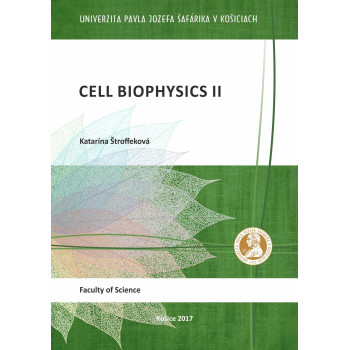
Cell Biophysics II is the one semester comprehensive course textbook for PhD students. It encompasses basic principles and mechanisms underlying cell physiology and biophysics with aims:
• General knowledge of the principles of cellular function, including membrane, cytoplasmic and nuclear roles in normal and abnormal conditions.
• In-depth understanding of the mechanisms underlying the cell functions at the molecular and subcellular level.
• Awareness of cell pathologies that lead to specific disease symptoms and phenotypes.
• The ability to apply learned principles to solve new problems (analysis & synthesis).