Filter By

Categories

Categories

Year of publication:

Year of publication:

Publication language:

Publication language:

Faculty:

Faculty:

Active filters

  • Year of publication:: 2015
  • Publication language:: English
  • Publication language:: Slovak
  • Faculty:: Faculty of Arts
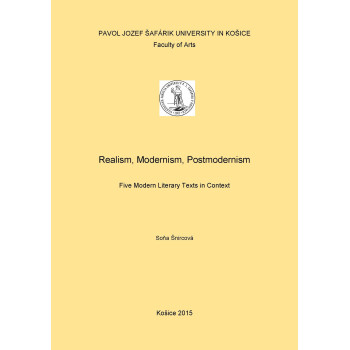
Realism, Modernism, Postmodernism: Five Modern Literary Texts in Context

Realism, Modernism, Postmodernism: Five Modern...

E-book

E-book

Soňa Šnircová

This textbook has been designed as supporting material for the postgraduate course on modern trends in European literature. It focuses on the presentation of five modern literary modes of writing: the realistic mode which was brought to its prominence by the nineteenth-century Realist movement; the stream-of-consciousness and ‘absurdist’ modes which were developed in the context of modernism; and the magical realist and metafictional modes which are associated mainly with postmodernist literary trends. Each mode is represented by a well-known text which demonstrates the formal aspects of each mode and deals with the thematic concerns typical of the literary movement that influenced its production.

The textbook adopts an interdisciplinary approach, placing the chosen literary texts into the historical, philosophical and cultural contexts that shaped their characters, and thereby providing the background knowledge necessary for a deeper understanding of their formal and thematic aspects.
Download the e-book for free(pdf)

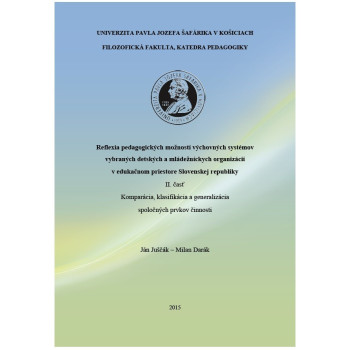
Reflexia pedagogických možností vých. systémov vybraných detských a mládež. organizácií  v edukačnom priestore SR

Reflexia pedagogických možností vých. systémov...

E-book

E-book

Ján Juščák - Milan Darák

The aim of the monograph was to analyze the pedagogical possibilities of educational systems within children's and youth organizations, with an emphasis on those targeting the age group of children up to 15 years.

The starting point was an analysis of the current state of theory and practice in children's and youth organizations, with the intention of describing prevailing trends in their development and activities. This publication closely follows the previous monograph (Juščák, J. – Darák, M.: 2015), in which we processed, according to a unified methodology and using generally accepted pedagogical terminology, the collected available materials on the educational systems of selected (most representative) children's and youth organizations in Slovakia. Through a subsequent comparison of the obtained empirical data on educational systems, we aimed to identify their similar (identical) as well as specific (distinct) elements as a basis for establishing categorization criteria for their classification.

The culmination of our efforts was an attempt to characterize a children's organization as an educational institution, describing its characteristic features, functions, aims, content, principles, and educational methodology.

Download the e-book for free (pdf)

Reflexia pedagogických možností vých. systémov vybraných detských a mládež. organizácií  v edukačnom priestore SR

Reflexia pedagogických možností vých. systémov...

E-book

E-book

Ján Juščák - Milan Darák

 The aim of the monograph was to analyze and address the issue of educational systems within children's and youth organizations, with an emphasis on those focused on the age category of children up to 15 years.

The starting point was an analysis of the current state of the educational environment in terms of the systemic nature of education and the basic categories of the educational system. The collected available materials on the educational systems of selected (most representative) children's and youth organizations in the Slovak Republic were subsequently processed according to a unified methodology and using generally accepted pedagogical terminology.

Download the e-book for free (pdf)

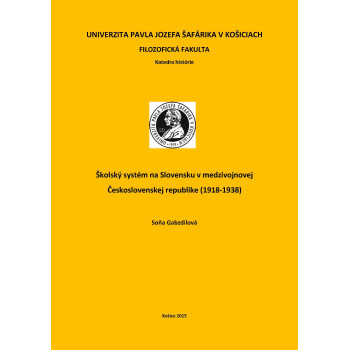
Školský systém na Slovensku v medzivojnovej Československej republike (1918 - 1938)

Školský systém na Slovensku v medzivojnovej...

E-book

E-book

Soňa Gabzdilová

The educational system (schooling) is one of the most effective tools for shaping the young generation in any advanced society. Schools not only create the knowledge base necessary for fulfilling the demands of the economy and the social sphere, but they also shape the national and ideological identity of each member of society. The school plays a decisive role in forming positive values, but it can also become a breeding ground for xenophobia and racist attitudes. The school has an irreplaceable role in creating national consciousness, identification with one's own nation, its history, the heroic deeds of ancestors, and the meaning of its existence.

After the dissolution of Austria-Hungary, there were fundamental geopolitical changes in Central Europe. One of these was the creation of Czechoslovakia, a state founded on radically different principles than pre-war Hungary. The founders of the Czechoslovak Republic (CSR), the personalities who decisively determined the character of the political system in the newly established republic, did not belong to the privileged classes of the previous regime. Unlike Hungary, where political power was controlled almost without exception by the nobility, the elite in Czechoslovakia consisted of men who were radical critics of Austria-Hungary.

A fitting example was the most influential figure of interwar Czechoslovakia, President Tomáš Garrigue Masaryk. Despite his origins, Masaryk was perceived by both Czechs and Slovaks as the founder of the state, a legendary figure whose political and social influence far exceeded the powers of the presidential office.

Download the e-book for free (pdf)

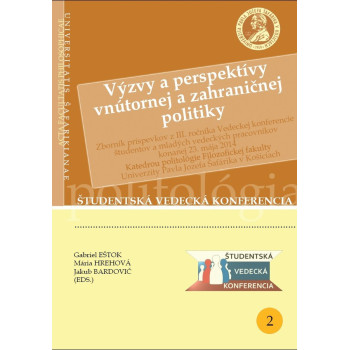
Výzvy a perspektívy vnútornej a zahraničnej politiky

Výzvy a perspektívy vnútornej a zahraničnej...

E-book

E-book

Gabriel Eštok- Mária Hrehová- Jakub Bardovič (eds.)

Proceedings of the 3rd Annual Scientific Conference of Students and Young Researchers held on May 23, 2014, by the Department of Political Science, Faculty of Arts, Pavol Jozef Šafárik University in Košice

On May 23, 2014, the Department of Political Science at the Faculty of Arts, Pavol Jozef Šafárik University in Košice hosted a conference entitled “Challenges and Perspectives of Domestic and Foreign Policy.” This was the third conference for students and young researchers organized by the Department of Political Science in cooperation with the civic association Res Publica. The event featured numerous young people interested in contemporary political issues, each presenting on a topic related to domestic or foreign policy. It can be stated that these presentations were of a high professional standard and stimulated discussion on the topics and problems raised.

The publication you are holding is a collection of scholarly works by students and young experts who focused on a variety of subjects. Some authors addressed issues of foreign policy, particularly the analysis of selected countries’ policies (Slovak Republic, USA), examined the Iranian nuclear program, or explored the possibilities of federalizing Ukraine as a solution to the emerging situation. Another contribution offered a perspective on foreign policy from the viewpoint of Slovak emigrants in Australia. Despite the wide range of topics addressed in the individual contributions, a common denominator can be found: the effort to highlight a particular problem or propose its solution, thereby contributing to the fulfillment of the ideal of democracy, the improvement of policy-making and functioning, and, above all, making the world a better place for all of us.

Editors

Download the e-book for free(pdf)

This website uses cookies to ensure you get the best experience on our website