Filter By

Categories

Categories

Selections

Selections

Year of publication:

Year of publication:

Publication language:

Publication language:

Faculty:

Faculty:

UPJŠ Unit

UPJŠ Unit

Method of publication:

Method of publication:

Active filters

  • Year of publication:: 2003
  • Year of publication:: 2010
  • Year of publication:: 2010
  • Year of publication:: 2010
  • Year of publication:: 2010
  • Year of publication:: 2023
  • Year of publication:: 2023
  • Year of publication:: 2023
  • Year of publication:: 2023
  • Year of publication:: 2023
  • Year of publication:: 2023
  • Year of publication:: 2023
  • Year of publication:: 2023
  • Year of publication:: 2023
  • Year of publication:: 2023
  • Year of publication:: 2023
  • Year of publication:: 2023
  • Year of publication:: 2023
  • Year of publication:: 2023
  • Year of publication:: 2023
  • Year of publication:: 2023
  • Year of publication:: 2023
  • Year of publication:: 2023
  • Year of publication:: 2023
  • Year of publication:: 2023
  • Year of publication:: 2023
  • Year of publication:: 2023
  • Year of publication:: 2023
  • Year of publication:: 2023
  • Year of publication:: 2023
  • Year of publication:: 2023
  • Year of publication:: 2023
  • Year of publication:: 2023
  • Year of publication:: 2023
  • Year of publication:: 2023
  • Year of publication:: 2023
  • Year of publication:: 2023
  • Year of publication:: 2023
  • Year of publication:: 2023
  • Year of publication:: 2023
  • Year of publication:: 2023
  • Year of publication:: 2023
  • Year of publication:: 2023
  • Year of publication:: 2023
  • Year of publication:: 2023
  • Year of publication:: 2023
  • Year of publication:: 2023
  • Year of publication:: 2023
  • Year of publication:: 2023
  • Year of publication:: 2023
  • Year of publication:: 2023
  • Year of publication:: 2023
  • Year of publication:: 2023
  • Year of publication:: 2023
  • Year of publication:: 2023
  • Year of publication:: 2023
  • Year of publication:: 2023
  • Year of publication:: 2023
  • Year of publication:: 2023
  • Year of publication:: 2023
  • Year of publication:: 2023
  • Year of publication:: 2023
  • Year of publication:: 2023
  • Year of publication:: 2023
  • Year of publication:: 2023
  • Year of publication:: 2023
  • Year of publication:: 2023
  • Year of publication:: 2023
  • Year of publication:: 2023
  • Year of publication:: 2023
  • Year of publication:: 2023
  • Year of publication:: 2023
  • Year of publication:: 2023
  • Year of publication:: 2023
  • Year of publication:: 2023
  • Year of publication:: 2023
  • Year of publication:: 2023
  • Year of publication:: 2023
  • Year of publication:: 2023
  • Year of publication:: 2023
  • Year of publication:: 2023
  • Year of publication:: 2026
  • Year of publication:: 2026
  • Year of publication:: 2026
  • Year of publication:: 2026
  • Year of publication:: 2026
  • Year of publication:: 2026
  • Year of publication:: 2026
  • Year of publication:: 2026
  • Year of publication:: 2026
  • Year of publication:: 2026
  • Year of publication:: 2026
  • Year of publication:: 2026
  • Year of publication:: 2026
  • Year of publication:: 2026
  • Year of publication:: 2026
  • Year of publication:: 2026
  • Year of publication:: 2026
  • Year of publication:: 2026
  • Year of publication:: 2026
  • Year of publication:: 2026
  • Year of publication:: 2026
  • Year of publication:: 2026
  • Year of publication:: 2026
  • Year of publication:: 2026
  • Year of publication:: 2026
  • Year of publication:: 2026
  • Year of publication:: 2026
  • Year of publication:: 2026
  • Year of publication:: 2026
  • Year of publication:: 2026
  • Year of publication:: 2026
  • Year of publication:: 2026
  • Year of publication:: 2026
  • Year of publication:: 2026
  • Year of publication:: 2026
  • Year of publication:: 2026
  • Year of publication:: 2026
Dejiny filozofie ako filozofický problém

Dejiny filozofie ako filozofický problém

E-book

E-book

Vladimír Leško - Pavol Tholt (eds.)

Proceedings of the Fourth International Philosophical Symposium History of Philosophy as a Philosophical Problem, held on 14-15 October 2010

The Philosophical Proceedings is the final presentation of the results of the work of the research teams of the research projects VEGA 1/0650/08 - Heidegger and the History of Philosophy and VEGA 1/4679/07 - Jan Patočka's Asubjective Phenomenology and the History of Philosophy solved at the Department of Philosophy and the History of Philosophy of the Faculty of Philosophy of the University of Applied Sciences in Košice.

Download the e-book for free (pdf)

Možné svety z pohľadu logickej sémantiky a analytickej filozofie

Možné svety z pohľadu logickej sémantiky a...

E-book

E-book

Eugen Andreanský

The presented monograph aims to critically map the understanding of the concept of possible worlds.

The first chapter describes the formation of the semantics of possible worlds, along with indicating some problems it brings, which were incisively revealed primarily by W. V. O. Quine. In the next two chapters, the work focuses on more modern views on the nature of possible worlds, with the main attention given to the dichotomy between the possibilist and actualist approach to the question of modalities, alongside which it is necessary to assess other distinctions (essentialism - anti-essentialism, realism - reductionism (or ersatzism or fictionalism), naturalism - non-naturalism, etc.). Increased attention in the work is specifically devoted to the possibilism of D. Lewis and the actualist concepts of S. Kripke, A. Plantinga, R. M. Adams, N. Rescher, D. Armstrong, and J. Hintikka.

An unconventional approach to the issue of possible worlds is captured in the fourth chapter. It is primarily dedicated to the significant concept of Jaakko Hintikka, which works with the notion of epistemic possible worlds and documents the inclination towards the modification and relativization of modal discourse. The conclusion provides an evaluation of the discussion that touches on the main problems associated with considerations of possible worlds.

In the presented monograph, some representative concepts of possible worlds, or possible individuals, are clarified, and the overall process is indicated from assessing possible worlds as ideal logical constructs through their relativization by separate domains of individuals for individual worlds and further through the relationship of attainability to financial, impossible, and non-standard possible worlds.

Download the e-book for free (pdf)

Malý atlas liečivých rastlín

Malý atlas liečivých rastlín

€15.00
Availability: 2 In Stock

Ľ. Thurzová - J. Kresánek - Š. Mareček - K. Mika

Predchádzajúce vydanie Malého atlasu liečivých rastlín, okrem desiatok zahraničných vydaní, bolo roku 1983. Základ tohto záslužného diela ostal nezmenený. V biochemickom a vo farmakodynamickom výskume sa však za posledné roky udiali závažné zmeny, ktoré skorigovali niektoré zaužívané dogmy. Tieto zmeny bolo treba rešpektovať vo fytoterapeutickej aplikácii.
V minulosti veľmi populárna a obľúbená publikácia chce opäť poskytnúť užitočné vedomosti všetkým, ktorí sa zaujímajú o fytoterapiu, aspoň z najfrekventovanejších druhov liečivých rastlín.

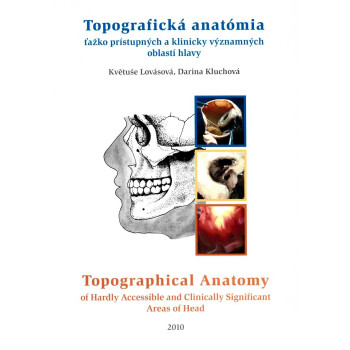
Topografická anatómia ťažko prístupných a klinicky významných oblastí hlavy

Topografická anatómia ťažko prístupných a...

€27.70
Availability: 6 In Stock

Květuše Lovásová - Darina Kluchová

The surgical practice starts with detailed knowledge of anatomy. Even if anatomy of human body has not changed over the time, perfection and precision of surgical practice require precise knowledge of anatomical structures, their location, and topographical relationships. Everyone should be aware of the occurrence of possible variations as well. 

A prospective medical doctor should not rely on knowledge gained by studying models, schemes, and pictures, but should combine two types of learning: visual and didactic. Wide array of the visual learning development, considering vision alone, and a detailed and realistic approach to difficult access to structures of the human body are important precursors that create sufficient and quality knowledge needed for clinical practice and appropriate professional development. 

This publication maps all of the clinically significant and difficult approached areas of the head that are not normally prepared for practical exercises in anatomy because of the time and difficulties with the preparation. The colorful, detailed photodocumentation enriched by schemes and followed by procedure guide provides a view of structures until now only poorly documented. We sincerely hope that this monograph will fill the gap in medical literature offered in the market at present time.

This website uses cookies to ensure you get the best experience on our website