Filter By

Categories

Categories

Selections

Selections

Year of publication:

Year of publication:

Publication language:

Publication language:

Faculty:

Faculty:

Method of publication:

Method of publication:

Active filters

  • Year of publication:: 2012
  • Year of publication:: 2019
  • Year of publication:: 2019
  • Year of publication:: 2019
  • Year of publication:: 2019
  • Year of publication:: 2019
  • Year of publication:: 2019
  • Year of publication:: 2019
  • Year of publication:: 2019
  • Year of publication:: 2019
  • Year of publication:: 2019
  • Year of publication:: 2019
  • Year of publication:: 2019
  • Year of publication:: 2019
  • Year of publication:: 2020
  • Year of publication:: 2020
  • Year of publication:: 2020
  • Year of publication:: 2023
  • Year of publication:: 2023
  • Year of publication:: 2023
  • Year of publication:: 2023
  • Year of publication:: 2023
  • Year of publication:: 2023
  • Year of publication:: 2023
  • Year of publication:: 2023
  • Year of publication:: 2023
  • Faculty:: Faculty of Arts
  • Faculty:: Prírodovedecká fakulta
  • Faculty:: Prírodovedecká fakulta
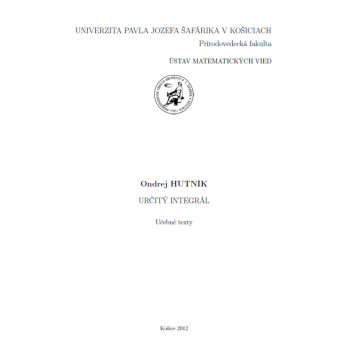
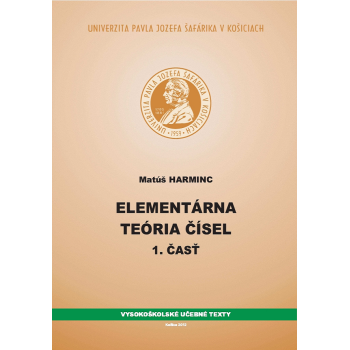
Určitý integrál

Určitý integrál

E-book

E-book

Ondrej Hutník

The concept of the integral is one of the most significant concepts in mathematics as a whole. In its most primitive form, it was already used by the ancient Greeks in the creation of Euclidean geometry. However, it was only after Descartes' work on analytical geometry in 1637 that mathematicians could begin to consider the integral as a subject of analysis. Descartes' work laid the groundwork for the discovery of infinitesimal calculus by Leibniz and Newton around 1665. At that time, a great dispute arose over the priority of this discovery, dividing scholars of Germany and England into two opposing camps, each favoring their own champion. Today, we know that Newton's work on fluxions and fluents was somewhat earlier, but Leibniz's notation and approach have gained more acceptance in the mathematical world, and the symbols ∫ ∫ and d d are still used today. A brief overview of the history of the integral will be presented in Chapter 1.

Today, there is a plethora of scripts, textbooks, and books dedicated to explaining the concept of the integral. Therefore, every potential author faces the initial question of whether to write another text on this topic. Our affirmative answer to this question was driven by the students' request to find the subject matter of a part of the winter semester of the second year presented in a coherent form. The second motivation is a slightly different approach to the topic. If we consider the methods typically used in solving problems and gaining routine with a certain integral, it mainly involves the Newton-Leibniz formula, and often there is little time left to compute the definite (Riemann) integral using its definition. Therefore, we included a discussion of the Newton integral in Chapter 2, which reflects this fact and is directly related to the indefinite integral, whose various calculation methods receive relatively much attention in the previous semester. Only after that, in Chapter 3, do we build the theory of the Riemann integral, present criteria for its existence, classes of integrable functions, basic properties, and finally its relationship with the Newton integral. Questions primarily concerning geometric applications are addressed in Chapter 4, and in the final chapter, we focus on extending the Riemann integral to unbounded functions and unbounded intervals.
Download the e-book for free (pdf)

Úvod do psychológie rozhodovania

Úvod do psychológie rozhodovania

E-book

E-book

Jozef Bavoľár

Decision-making is an everyday activity for us, whether it involves decisions about routine matters such as what to have for breakfast or more significant choices like selecting a career after finishing school. Due to the far-reaching consequences that a single decision can have on our entire lives, this area has received considerable attention in psychology. After all, the classic goals of psychology—describing, explaining, and predicting human behavior—are essentially attempts to understand decision-making and identify and describe the factors influencing it. Fundamental psychological disciplines such as the psychology of emotions and motivation, cognitive psychology, social psychology, and personality psychology all strive to achieve this understanding.

The presented text primarily adopts a cognitive approach, focusing on the processes of information processing and utilization. Since there are very few events in the future we can be completely certain about, key concepts include terms expressing uncertainty about the future, such as uncertainty, risk, objective probability, and subjective probability.

The central question thus lies in processing information from the environment and utilizing it in the decision-making process.

Download the e-book for free (pdf)

Národy juhovýchodnej Európy v siločiarach medzinárodnej politiky 1856-1913

Národy juhovýchodnej Európy v siločiarach...

€11.00
Availability: 4 In Stock

Maroš Melichárek

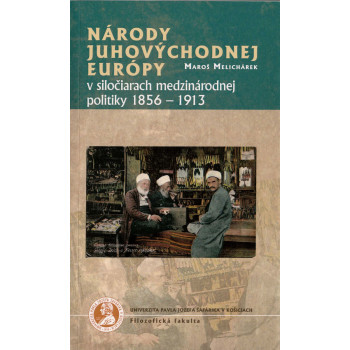
Prvá kapitola monografie nesie názov Veľká východná kríza v rokoch 1875-1878 – súperenie veľmocí na Balkáne. Veľká východná kríza, ktorá vyvrcholia rusko-osmanským konfliktom a následným Berlínskym kongresom dala do pohybu mnoho procesov. Dôležitosť Berlínskeho kongresu a jeho fungovanie je v práci vykreslené z pohľadu jedného zúčastneného balkánskeho štátu a to Srbska. Kapitoly 2 až 5 zhŕňajú medzinárodný kontext a vnútorné predpoklady vytvorenia moderného bulharského a čiernohorského štátu, rovnako i detailný popis emancipácie Macedóncov a Albáncov (Albánske národné hnutie a vytvorenie nezávislého Albánska v roku 1912, Macedónska otázka na konci novoveku a možnosti jej riešenia zo strany veľmocí). Kapitola Konflikt Osmanskej ríše a Talianska o Lýbiu v rokoch  1911-1912 je popisuje vojenský stret medzi veľmocami s globálnymi následkami, ktoré de facto znamenali i pád Osmanskej ríše na európskom kontinente.Kapitola Definitívny pád Osmanskej ríše na európskom kontinente: prvá a druhá balkánska vojna predstavuje chronologický záver monografie a prináša pohľad na najdôležitejšie udalosti balkánskych vojen, armády i fenomény, ktoré doteraz boli v rámci tejto otázky vnímané iba okrajovo (etnické čistky, mobilizácia, propaganda a i.).  Záver práce a kapitola Zahraničná politika Srbska a problematika Bosny a Hercegoviny pred vypuknutím 1. svetovej vojny sa zameriava na hodnotenie srbských ašpirácií (či už ideologických alebo reálnych) smerom k priestoru Bosny a Hercegoviny.

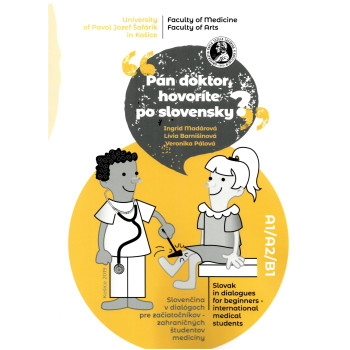
Pán doktor, hovoríte po slovensky?

Pán doktor, hovoríte po slovensky?

€14.00
Availability: 19 In Stock

Ingrid Madárová - Lívia Barnišinová - Veronika Pálová

Táto učebnica je určená pre zahraničných študentov medicíny – začiatočníkov – ako slovenčina na špecifický účel výučby. Jej cieľom je pomôcť zahraničným študentom, ktorí (1) študujú medicínu (2) v cudzom jazyku (anglický jazyk) a (3) v zahraničí (Slovensko) zvládnuť výzvu pri príprave na praktickú časť ich štúdia – konverzácia s pacientom v Slovenskom jazyku.Zámerom je poskytnúť študentom krok za krokom najfrekventovanejšie slovné spojenia a výrazy potrebné pri komunikácii s pacientom. Lekcie sa zameriavajú hlavne na slovnú zásobu týkajúcu sa častí ľudského tela a na základné symptómy a príznaky chorôb.Dôraz je kladený na krátke dialógy medzi lekárom a pacientom. Pri precvičovaní dialógov sú študenti vedení k nácviku komunikácie so zreteľom na porozumenie, bez prípadných obáv o gramatickú správnosť. Gramatické javy sú predstavované postupne, cez jednoduché  pomôcky – „tipy“.V prípade potreby si môžu študenti nájsť a doplniť si „chýbajúce časti gramatiky“ prostredníctvom odkazov na odporúčanú literatúru. Cieľom tejto knihy je uľahčiť a zefektívniť celý proces štúdia/osvojenia si (lekárskej) slovenčiny.

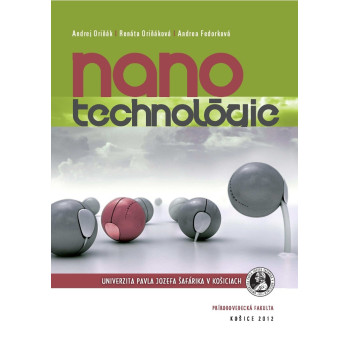
Nanotechnology

Nanotechnology

€17.68
Availability: 58 In Stock

 Andrej Oriňak - Renáta Oriňaková - Andrea Fedorková

Nanotechnology represent the fastest developing science in the present. They are based on the technologies that enable the matter manipulation at atomic level. Nanotechnology offer prepartion of the new materials with unknown and very specific properties and functions.Recent nanotechnology still stay in formative phase of their development. But more and more they are visible with nano-specific phenomenons in the fundamental control of the properties as well mater behaviour. This is quite possible that without nanotechnology will not work any science to the future, moreover that science will not exist anymore. Nanotechnolgy will give a chance and force to transform world to more environmental and comfortable. Expected is expansion of the nanotechnolgy to molecular nanosystems – heterogenous nets, in which molecules and supramolecules work as the nanodevices. The computers and robots will be reduced to the small and ultrasmall dimensions. In medicine will foremost the application of nanotechnology in genetic therapy and elimination of ageing. Nanosurgery will work at molecular level, cancer cells will be identified early and filtered , then substituted with healthy and unchanged. It is necessary to inform university or high school students  about principles of nanotechnolgy, preparation of the nanostructures, functionality of them and to offer full representation about molecular systems and nanodevices; the methods of nanostructures characterization and about application in miniaturized systems. 

Authors

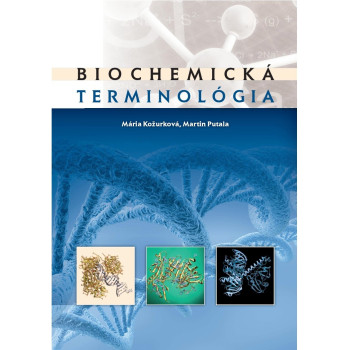
Biochemická terminológia

Biochemická terminológia

€11.60
Availability: 43 In Stock

 Mária KožurkováMartin Putala 

Cieľom tejto knihy je spracovať názvoslovné zásady a pravidlá, podľa ktorých sa tvoria slovenské názvy biochemických zlúčenín. Táto monografia je po dlhšom čase prvým pokusom o spracovanie tohto problému, a preto dúfame, že bude pomôckou a prínosom nielen pre študentov a učiteľov ale aj vedeckých pracovníkov. Poslúži aj študentom stredných škôl, ktorí majú záujem o biochémiu a molekulovú biológiu. Kniha obsahuje najnovšie názvoslovie, zásady a pravidlá pri tvorbe názvov biochemických zlúčenín. Kniha plne aplikuje odporúčania spoločnej komisie Medzinárodnej únie pre teoretickú a aplikovanú chémiu (IUPAC) a Medzinárodnej únie pre biochémiu a molekulárnu biológiu (IUBMB) so zahrnutím aktuálnych úprav názvoslovia, stereochémie a grafického znázornenia štruktúr podľa IUPAC. 

Autori

This website uses cookies to ensure you get the best experience on our website