Filter By

Categories

Categories

Year of publication:

Year of publication:

Publication language:

Publication language:

Faculty:

Faculty:

UPJŠ Unit

UPJŠ Unit

Method of publication:

Method of publication:

Active filters

  • Year of publication:: 2013
  • Year of publication:: 2019
  • Year of publication:: 2019
  • Year of publication:: 2019
  • Year of publication:: 2019
  • Year of publication:: 2019
  • Year of publication:: 2019
  • Year of publication:: 2019
  • Year of publication:: 2019
  • Year of publication:: 2019
  • Year of publication:: 2019
  • Year of publication:: 2019
  • Year of publication:: 2019
  • Year of publication:: 2019
  • Year of publication:: 2019
  • Year of publication:: 2019
  • Year of publication:: 2019
  • Year of publication:: 2019
  • Year of publication:: 2019
  • Year of publication:: 2019
  • Year of publication:: 2019
  • Year of publication:: 2019
  • Year of publication:: 2019
  • Method of publication:: E-book (pdf)
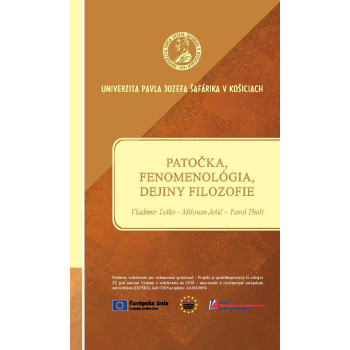
Patočka, fenomenológia a dejiny filozofie

Patočka, fenomenológia a dejiny filozofie

E-book

E-book

Vladimír Leško - Milovan Ješič - Pavol Tholt

The philosophical work of the most significant Czech philosopher of the 20th century, Jan Patočka (1907–1977), stands out for its unique intellectual originality.

Even at the time of its creation, it significantly transcended the narrow boundaries of the contemporary Czechoslovak spiritual space and uniquely connected our country with the most advanced philosophical teachings of Western thought, in which Husserl's phenomenology and Heidegger's fundamental ontology played a dominant role. Certainly, it would be a great mistake to reduce the decisive position of Patočka's philosophical work merely to the reception and critical-creative elaboration of Husserl's and Heidegger's philosophy.

In this context, we cannot overlook the decisive contribution of Eugen Fink, who introduced Patočka to the intricacies of Husserl's and Heidegger's philosophy. Both thinkers then continued in a lifelong creative philosophical dialogue. However, it is also necessary to mention Patočka's intense interest in the works of Scheler, Ingarden, Landgrebe, as well as Sartre and others.
Download the e-book for free (pdf)

Kant, fenomenológia a analytická filozofia

Kant, fenomenológia a analytická filozofia

E-book

E-book

Vladimír Leško - Milovan Ješič - Eugen Andreanský

The philosophical work of Immanuel Kant, the founder of German classical idealism, is one of those which, by the strength of its theoretical legacy, is permanently inspiring even in contemporary philosophical activities. This is an indisputable fact that cannot be seriously objected to. The philosophical teachings of Edmund Husserl, the founder of phenomenology, his successor Martin Heidegger, as well as several representatives of analytic philosophy, are proof of this fact. The above fact led the authors of this work to the idea of devoting a separate collective monograph to the indicated problem. 

Download the e-book for free (pdf)

Heidegger a grécka filozofia

Heidegger a grécka filozofia

E-book

E-kniha

Vladimír Leško - Katarína Mayerová (eds.)


The main aim of the present work is to try to capture the decisive mode of Heidegger's philosophical understanding of the central problem of Greek philosophy, the problem of being, in the teachings of Anaximander, Heracleitus, Parmenides, Plato, and Aristotle. The authors of each section present their own understanding of Heidegger and his distinctive philosophical reception of Greek philosophy. In this context, it should be noted that the authors themselves sought their own point of view. With Heidegger's work in general, it is almost impossible to find the same interpretive consonance. This is also true for his reception of the Greek heritage. However, it is all the more professionally provoking for further philosophical investigations.

Download the e-book for free (pdf)

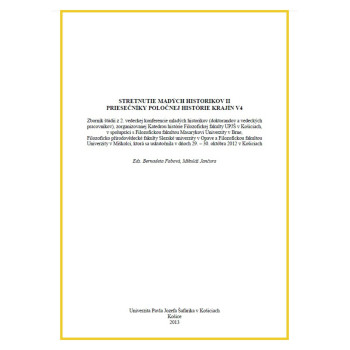
Stretnutie mladých historikov II. Priesečníky spoločnej histórie krajín V4

Stretnutie mladých historikov II. Priesečníky...

E-book

E-book

Bernadeta Fabová - MikulአJančura (eds.)

Collection of Studies from the 2nd Scientific Conference of Young Historians (Doctoral Students and Researchers), organized by the Department of History of the Faculty of Arts at Pavol Jozef Šafárik University in Košice, in cooperation with the Faculty of Arts at Masaryk University in Brno, the Faculty of Arts and Sciences at Silesian University in Opava, and the Faculty of Arts at the University of Miskolc, held on October 29-30, 2012 in Košice.

The collection is the output of the second annual scientific conference of young historians (doctoral students and researchers), organized at Pavol Jozef Šafárik University in Košice. The central theme of the event was the focus on intersections of shared history. The ten studies map various intersections of the history of the V4 countries, as well as the broader Central European region, in the time span from the 13th to the 20th century. The individual studies cover a wide range of areas from the medieval road network, military and urban history, through economy, education, issues of national identity, the relationship between the state and the church, to demographic questions.

Download the e-book for free (pdf)

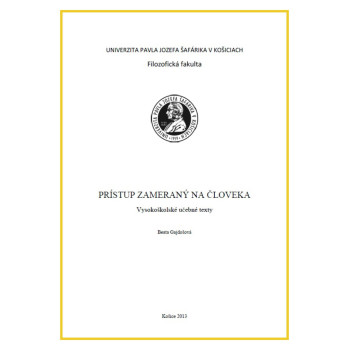
Prístup zameraný na človeka

Prístup zameraný na človeka

E-book

E-book

Beata Gajdošová

It is impossible to be in contact with a person-centered approach and not be influenced by it. Carl Random Rogers was and is still perceived as one of the most influential psychologists of the 20th century (Cook, et al., 2009).

He was the first psychologist to be awarded twice by the American Psychological Association during his lifetime; in 1957 for his contributions to psychotherapy research and in 1973 for distinguished professional contributions. He developed his own psychotherapeutic approach, client-centered therapy, where unlike existing psychotherapeutic approaches, the healing power lies in the relationship between the client and the therapist, not in the applied method.

Rogers and his colleagues were the first to record, transcribe, and publish complete cases of therapeutic conversations and initiated systematic research in the field of psychotherapy. By using the term client instead of patient and seeking sources of change within the person, he created a non-medical model of help as part of the helping professions (Capuzzi, Gross, 2001). The self-theory created by Rogers is a theory that is included in many contemporary psychology texts (Cloninger, 2003; Feist, Feist, 2001; Ryckman, 2004).

Download the e-book for free (pdf)

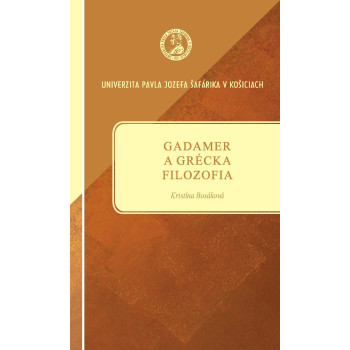
Gadamer a grécka filozofia

Gadamer a grécka filozofia

E-book

E-book

Kristína Bosáková

Attempting to confront Gadamer's teachings not only with the giants of Greek philosophy but also with Hegel and Heidegger is no easy task. However, Gadamer's entire historical-philosophical work is most prominently associated with these ancient thinkers and the two geniuses of German philosophical thought. Therefore, there is no avoiding it. Without this confrontation, all my efforts would be, in a certain sense, futile. Whether and how I succeed is another question. Every reader will surely form their own judgment.

Download the e-book for free (pdf)

Slovenčina pre cudzincov (Pracovné listy)

Slovenčina pre cudzincov (Pracovné listy)

E-book

E-book

Marianna Sedláková a kol. 

The worksheets, based on the direct specific needs of teaching medical students in Košice, respect the real situation of teaching Slovak as a foreign language at UPJŠ.

They also reflect the relatively high number of Slavic students, especially from neighboring countries, who, although just beginning with the Slovak language, are at a higher communicative level compared to students from non-Slavic countries. Therefore, a special part of the worksheets with exercises is dedicated to them, which includes special exercises and dictionaries aimed at eliminating Slovak-Polish or Slovak-Ukrainian interference phenomena. Since some non-Slavic students come from the Czech language environment, we also add a glossary of the most common different expressions in Slovak, Czech, and, for the aforementioned reasons, Polish and Ukrainian. In the part intended for all students, both Slavic and non-Slavic, communicatively focused exercises for practicing grammatical phenomena predominantly at the A1 and A2 communication skill levels (according to the Common European Framework of Reference) prevail, and last but not least, exercises thematically focused on medicine and healthcare.

The texts from the thematic area are, of course, supplemented with realia of the city of Košice. As a functional supplement in the working material, we also publish test samples.

Download the e-book for free (pdf)

This website uses cookies to ensure you get the best experience on our website