Filter By

Categories

Categories

Year of publication:

Year of publication:

Publication language:

Publication language:

Faculty:

Faculty:

Method of publication:

Method of publication:

Active filters

  • Year of publication:: 2010
  • Year of publication:: 2017
  • Year of publication:: 2017
  • Year of publication:: 2017
  • Year of publication:: 2024
  • Year of publication:: 2024
  • Year of publication:: 2024
  • Year of publication:: 2024
  • Year of publication:: 2024
  • Faculty:: Faculty of Arts
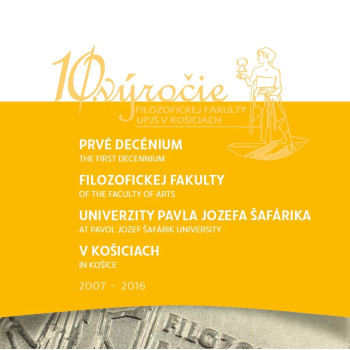
Prvé decénium Filozofickej fakulty Univerzity Pavla Jozefa Šafárika v Košiciach (2007 – 2016)

Prvé decénium Filozofickej fakulty Univerzity...

E-book

E-book

Iveta Bónová - Marián Gladiš (eds.)

The Foundation of the Faculty is a major “thing” created and developed by many personalities. The collected information, opinions, and critical judgements have led me to the conclusion that there exist among us plenty of narratives on the formation of this Faculty.

What is appealing about this fact is that from each party concerned, specifically teachers of Philosophy, Psychology and Education at the UPJŠ Faculty of Science, teachers of Psychology at the UPJŠ Faculty of Public Administration in Košice, teachers of the Department of Foreign Languages at UPJŠ, teachers at Prešov University who were approached with a bid to create the conditions of and opportunities for the development of their study branches at the new UPJŠ Faculty of Arts in Košice, there is a significant clue reflected in the inception of the new Faculty of this University.

It is necessary to say that it is a justifiable reflection, because without this, it would not be possible to develop exploration and offer the students courses in the field of Humanities, in social and behavioural sciences, educational sciences, and in the field of History and Ethnology.
Download the e-book for free (pdf)

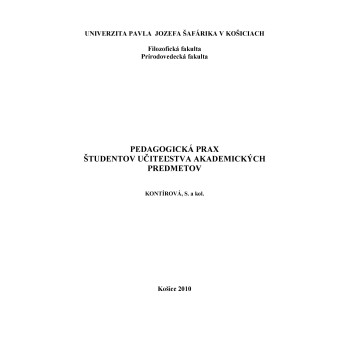
Pedagogická prax študentov učiteľstva akademických predmetov

Pedagogická prax študentov učiteľstva...

E-book

E-book

Silvia Kontírová a kol.

Pedagogical practice is an organizational form of higher education training for prospective teachers, implemented through mandatory pedagogical practice subjects.

These subjects have an integrative and practical-training character, building upon the theoretical and practical instruction provided to students at the faculty. They are conducted within the scope defined by curricula in the conditions of specialized workplaces (training schools) and under the supervision of qualified professionals (training teachers). Unlike other higher education subjects, pedagogical practice primarily provides students with opportunities for independent creative teaching in real school environments.

The practical activities of students in training schools are characterized as supervised, monitored, and evaluated by designated entities.

Download the e-book for free (pdf)

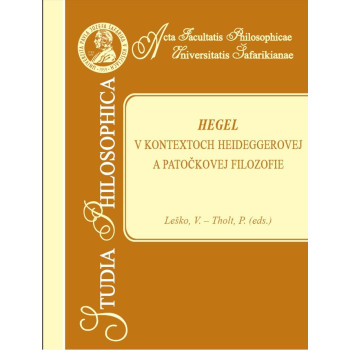
Hegel v kontextoch Heideggerovej a Patočkovej filozofie

Hegel v kontextoch Heideggerovej a Patočkovej...

E-book

E-book

Vladimír Leško - Pavol Tholt (eds.)

Proceedings of the Third International Philosophical Conference Hegel in the Contexts of Heidegger's and Patoček's Philosophy, held on 1-2 October 2009.

The Philosophical Proceedings is a presentation of the results of the work of the research teams of the research projects VEGA 1/0650/08 - Heidegger and the History of Philosophy and VEGA 1/4679/07 - Jan Patočka's Asubjective Phenomenology and the History of Philosophy solved at the Department of Philosophy and the History of Philosophy of the Faculty of Philosophy of the University of Applied Sciences in Košice.

Download the e-book for free (pdf)

Dejiny filozofie ako filozofický problém

Dejiny filozofie ako filozofický problém

E-book

E-book

Vladimír Leško - Pavol Tholt (eds.)

Proceedings of the Fourth International Philosophical Symposium History of Philosophy as a Philosophical Problem, held on 14-15 October 2010

The Philosophical Proceedings is the final presentation of the results of the work of the research teams of the research projects VEGA 1/0650/08 - Heidegger and the History of Philosophy and VEGA 1/4679/07 - Jan Patočka's Asubjective Phenomenology and the History of Philosophy solved at the Department of Philosophy and the History of Philosophy of the Faculty of Philosophy of the University of Applied Sciences in Košice.

Download the e-book for free (pdf)

Možné svety z pohľadu logickej sémantiky a analytickej filozofie

Možné svety z pohľadu logickej sémantiky a...

E-book

E-book

Eugen Andreanský

The presented monograph aims to critically map the understanding of the concept of possible worlds.

The first chapter describes the formation of the semantics of possible worlds, along with indicating some problems it brings, which were incisively revealed primarily by W. V. O. Quine. In the next two chapters, the work focuses on more modern views on the nature of possible worlds, with the main attention given to the dichotomy between the possibilist and actualist approach to the question of modalities, alongside which it is necessary to assess other distinctions (essentialism - anti-essentialism, realism - reductionism (or ersatzism or fictionalism), naturalism - non-naturalism, etc.). Increased attention in the work is specifically devoted to the possibilism of D. Lewis and the actualist concepts of S. Kripke, A. Plantinga, R. M. Adams, N. Rescher, D. Armstrong, and J. Hintikka.

An unconventional approach to the issue of possible worlds is captured in the fourth chapter. It is primarily dedicated to the significant concept of Jaakko Hintikka, which works with the notion of epistemic possible worlds and documents the inclination towards the modification and relativization of modal discourse. The conclusion provides an evaluation of the discussion that touches on the main problems associated with considerations of possible worlds.

In the presented monograph, some representative concepts of possible worlds, or possible individuals, are clarified, and the overall process is indicated from assessing possible worlds as ideal logical constructs through their relativization by separate domains of individuals for individual worlds and further through the relationship of attainability to financial, impossible, and non-standard possible worlds.

Download the e-book for free (pdf)

Začínajúci učiteľ a školská legislatíva I.

Začínajúci učiteľ a školská legislatíva I.

E-book

E-book

Zuzana Boberová

The aim of this university textbook is primarily to provide a comprehensive and systematic overview of the basic legislative documents related to pedagogical activities and the educational work of teachers in school practice. The textbook is primarily intended for students of academic teacher training programs, as well as recent graduates of teacher education who are beginning their teaching careers.

This publication is unique in that it does not focus on specific legislative documents and their descriptions, but rather presents the meaning and wording of various legislative documents in the context of key concepts of educational activities and typical school situations. The publication does not include the full text of cited paragraphs from laws, decrees, and ministerial guidelines, but only excerpts that are relevant to the focus and needs of the textbook.

In this way, we aim to help teacher training students and beginning teachers orient themselves regarding their rights and responsibilities as defined and delineated by school legislation, and especially to help them understand the basic legislative requirements placed on every teacher in school practice. This includes participation in the preparation of the school educational program, understanding the professional development of teachers, student assessment, approaches to students with special needs, as well as handling common school situations such as disciplinary measures, school accidents, ski training, or school events.

Given the scope of these areas, we have divided the topics into two publications according to their thematic focus.

Download the e-book for free (pdf)

Essentials of Language Typology

Essentials of Language Typology

E-book

E-book

Lívia Körtvélyessy

This university textbook explains to students enrolled in the course Linguistic Typology and Universals the basic terminology, theoretical approaches, and research methods. The textbook is divided into eleven chapters. Each chapter presents theoretical knowledge in an accessible manner, along with practical exercises aimed at developing students’ skills in the respective area.

The textbook covers the following topics: the subject and nature of linguistic typology, a brief history of this linguistic discipline, genealogical classification of languages, various approaches and main objectives of typology across different linguistic levels (phonology, morphology, syntax, and lexicon), as well as areal typology, complex issues of language universals, and the nature and essence of typologists’ work. Given the extensive research activities of linguists from the Department of British and American Studies at Pavol Jozef Šafárik University in Košice, the textbook also introduces students to the results achieved by these scholars in this rapidly developing field of linguistics.

Download the e-book for free (pdf)

This website uses cookies to ensure you get the best experience on our website