Filter By

Year of publication:

Year of publication:

Publication language:

Publication language:

Faculty:

Faculty:

Active filters

  • Year of publication:: 2011
  • Year of publication:: 2021
  • Year of publication:: 2021
  • Publication language:: English
  • Faculty:: Faculty of Arts
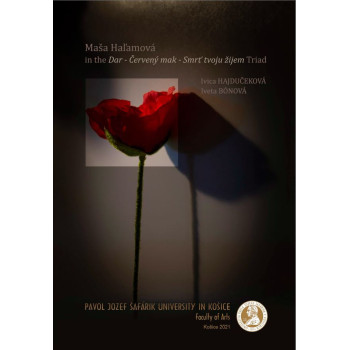
Maša Haľamová in the Dar – Červený mak – Smrť tvoju žijem Triad

Maša Haľamová in the Dar – Červený mak – Smrť...

E-book

E-book

Ivica HajdučekováIveta Bónová

The monograph Maša Haľamová in the triad Dar – červený mak – Smrť tvoju žijem was created as part of the project APVV-19-0244 (Methodological Approaches in Literary Research with an Impact on the Media Environment) in collaboration between Ivica Hajdučeková and Iveta Bónová.

In two parts – Personal History and (Re)interpretation of Maša Haľamová's Poetry, and Phonetic-Rhythmic Embodiment of Maša Haľamová's Poetry – it presents the results of archival research (reconstruction of life events, notes on poetic inspiration, consensus in the opinions of literary critics of the 20th and 21st centuries), (re)interpretations of three poetic collections focusing on the spiritual dimension and the process of spiritualization, and an in-depth analysis of the phonetic-rhythmic qualities of verse structure.

In conclusion, the authors suggest that the Slovak poet Maša Haľamová can be considered a representative of spiritual poetry, which in the Slovak interwar literature follows a specific type of confessional (Protestant) tradition, and at the level of phonetic embodiment, her sound-rhythmic potential acts in the name of subtlety of expression.
Download the e-book for free  (pdf)

Stylistics: Theory and Practice, Part I

Stylistics: Theory and Practice, Part I

E-book

E-book

Myroslava Fabian

The academic textbook entitled “Stylistics: Theory and Practice, Part I responds to the need identified by the author in her own teaching practice to supply the students with both theoretical and practical materials to the lecture and seminar course of contemporary English Stylistics.

Taking into account the richness and variety of English stylistic means of communication, the author dwells on basic notions of the academic course in question, describes stylistic semasiology as well as phonetic, syntactic expressive means and stylistic devices, offers practical help to stylistically identify, classify and describe the elements of language used in speech.

The textbook is designed for university students of English philology, students of English translation and interpretation study programmes, and also for students majoring in other disciplines combined with English language studies, as well as for those who study in English are expected to engage in scientific inquiry, document their research in Bachelor and Master theses or in doctoral dissertations written in English, and to present their work to their academic community.

Download the e-book for free (pdf)

Basic Concepts of Morphology I.

Basic Concepts of Morphology I.

E-book

E-book

Renáta Panocová

The textbook Basic Concepts of Morphology is an introduction to morphology intended for undergraduate students of British and American Studies and students of English (and French/German) for European Institutions and Economy and other philology studies in Slovakia. The textbook gradually guides students from key terms to concepts and from there to theoretically more challenging phenomena. The textbook is primarily for Slovak students of English, which explains that the majority of the examples presented are English. As the textbook progresses, data from Slovak, German, French, Hungarian and sometimes from slightly more exotic languages are given. It is expected that such an approach will prepare students for carrying out morphological analysis independently.

Download the e-book for free (pdf)

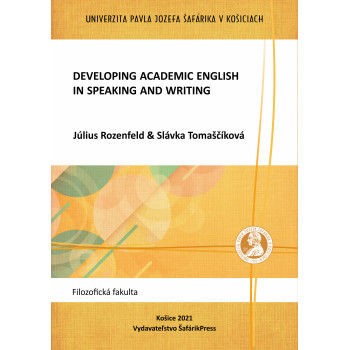
Developing Academic English in Speaking and Writing

Developing Academic English in Speaking and...

E-book

E-book

Július RozenfeldSlávka Tomaščíková

The academic textbook entitled “Developing Academic English in Speaking and Writing responds to the need identified by the authors in their own teaching practice to integrate the enhancement of the academic skills of speaking and writing into a single coherent approach. Using complex methodologies of academic speaking and academic writing, the authors offer practical guidelines on how to broaden students’ knowledge of the discourse of Academic English and how to improve their academic competencies and productive language skills in speaking and writing in English.

The textbook is designed for university students of English philology, students of literary and cultural studies focusing on Anglophone areas, students of English translation and interpretation study programmes, but also for students who study in English and who are expected to engage in scientific inquiry, document their research in Bachelor and Master theses or in doctoral dissertations written in English, and to present their work to their academic community.

Download the e-book for free (pdf)

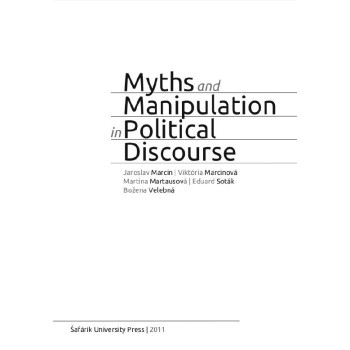
Myths and Manipulation in Political Discourse

Myths and Manipulation in Political Discourse

E-book

E-book

Jaroslav Marcin - Viktória Marcinová a kol.

This little book started out in a way that probably many other scholarly publications do: When the five of us met as doctoral students and instructors in the Department of British and American Studies, we soon realized that our research overlapped on a number of points. Most prominent among those was our interest in political or politicallymotivated discourse and the study of myths and manipulation that it employed. 

In the end, we decided to pool the results of our research together in order to create a more complex picture, providing a variety of perspectives and voices. In our endeavor, we were greatly aided by the financial support we received from a grant offered by the Šafárik University. The outcome of these efforts is the five chapters of this brief, but hopefully informative and insightful monograph.

In Chapter 1, Viktória Marcinová deals with the impact of totalitarian ideology on the translation of so-called “capitalist” drama during the first stage of normalization in Slovakia (1948-1968). In Chapter 2, the focus shifts to political discourse and manipulation in a democracy, as Jaroslav Marcin takes a closer look at the wartime rhetoric of American presidents. USA remains the focus also in Chapter 3, but this time the question, addressed by Martina Martausová, will be one of the myth of the American Dream and its presentation in post-9/11 United States. A similar idea, though in a different geographical-cultural context, is dealt with in Chapter 4, where Božena Velebná identifies myths of Scottish identity as portrayed in historic films. Finally, in Chapter 5, Eduard Soták will take a look at the role of the mass media within the topic of politically-motivated discourse and spread of political ideology.

Download the e-book for free (pdf)

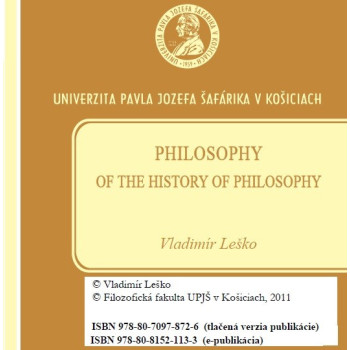
Philosophy of the history of philosophy

Philosophy of the history of philosophy

E-book

E-book

Vladimír Leško

The book is the result of long-term contemplation on the relationships between the history of philosophy and its reflection in more or less systematic, or non-systematic forms of philosophizing of the most significant philosophical teachings of the 19th and 20th centuries (Hegel, Schelling, Marx, Nietzsche, Husserl, Heidegger, Fink, Patočka, and Gadamer).

The primary goal of the work is to present the most significant historical-philosophical teachings of the 19th and 20th centuries in the formation and fulfillment of strong and weak models of the philosophy of the history of philosophy in the concepts of Hegel, Schelling, Marx, Nietzsche, Husserl, Heidegger, Fink, Patočka, and Gadamer.

The results of the philosophy of the history of philosophy are presented here as a metatheoretical movement within historical-philosophical thinking, whose aim is not to empirically describe the historical-philosophical process, but to understand and explain it as an inseparable part of the most significant philosophical problems – what is philosophy, what is metaphysics, and the question of being.

Download the e-book for free (pdf)


This website uses cookies to ensure you get the best experience on our website