Active filters

  • Year of publication:: 2013
  • Year of publication:: 2015
  • Year of publication:: 2021
  • Year of publication:: 2021
  • Publication language:: slovenčina, angličtina
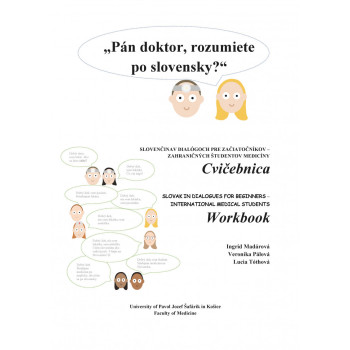
„Pán doktor, rozumiete po slovensky?“

„Pán doktor, rozumiete po slovensky?“

E-book

SLOVAK IN DIALOGUES FOR BEGINNERS – INTERNATIONAL MEDICAL STUDENTS - Workbook

E-book

Ingrid MadárováVeronika PálováLucia Tóthová

Audio attachments - format RAR

The audio-exercise workbook “Pán doktor, rozumiete po slovensky?”is a follow-up to the textbook “Pán doktor, hovoríte po slovensky?” (Madárová et al.)and is intended for international students of Slovak as a foreign language in the medical environment.

This workbook provides the students with an opportunity to practise and enhance mostly their listening skills and pronunciation through various short dialogues between doctors and patients in the Slovak language. Dialogues contain the vocabulary used in the textbook Pán doktorhovoríte po slovensky?.  Students are encouraged to build their confidence in speaking Slovak by practising these dialogues in the new workbook.

The audio-exercise workbook is comprised of 16 units. Each unit offers short dialogues and recordings

A number of dialogues enable its wide use for self-studying while the most frequent phrases related primarily to body parts, signs and symptoms of illnesses, diseases or various medical conditions are practised in different contexts in a variety of exercises.

Original illustrations enable students to understand dialogues more easily and the correct answers of the exercises and the scripts of the recordings can be found in the Answer key at the end of the workbook.
Download the e-book for free (pdf)

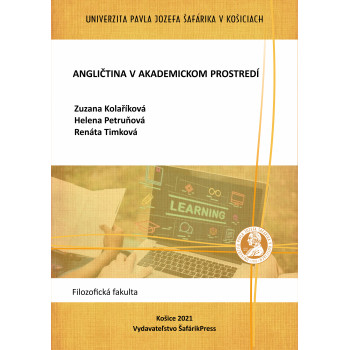
ANGLIČTINA V AKADEMICKOM PROSTREDÍ

ANGLIČTINA V AKADEMICKOM PROSTREDÍ

E-book

E-book

Zuzana KolaříkováHelena PetruňováRenáta Timková

English in the Academic Environment is intended primarily for those interested in improving their academic English and is primarily designed to fulfill the needs of university students and teachers who use English in their studies, in their work activities, and in their communication with foreign colleagues and professionals.

The publication offers selected phrases and sentence structures from the field of academic English, gives practical examples of the use of nominal, verbal and prepositional phrases, free and established collocations, idiomatic expressions, including translations of some selected phrases. It also highlights some common mistakes in the use of English in an academic environment, which are a manifestation of incorrect or insufficiently acquired linguistic resources and, last but not least, a consequence of the linguistic influence of Slovak.

Download the e-book for free  (pdf)

ANGLIČTINA V AKADEMICKOM PROSTREDÍ (cvičebnica). ENGLISH FOR DOCTORAL STUDENTS

ANGLIČTINA V AKADEMICKOM PROSTREDÍ...

E-book

E-book

Zuzana KolaříkováHelena PetruňováRenáta Timková

The publication contributes to an active acquisition and development of language skills in the area of academic English.

Individual lessons include tasks in which the user will find a lot of useful vocabulary in the form of collocations, phrases and sentences which can be applied in practice. The tasks are focused on the area of English pronunciation, grammar, word formation, vocabulary, improving communicative competence in written and verbal communication, improvement of professional skills of presentation, academic writing, etc.

The publication provides space for complementing and creating own database of vocabulary (topic pages).

Download the e-book for free  (pdf)

Zborník príspevkov z 11. Dní doktorandov experimentálnej biológie rastlín a 13. Konferencie experimentálnej biológie rastlín

Zborník príspevkov z 11. Dní doktorandov...

E-book

E-book

Martin Bačkor - Silvia Mihaličová (eds.)

Proceedings of the 11th Conference of Doctoral Students in Experimental Plant Biology and the 13th Conference on Experimental Plant Biology, Košice, September 9–13, 2013

13th Conference of Experimental Plant Biology (Sections)

  1. Cell Biology and Cytology: Michal Martinka
  2. Developmental Biology and Morphogenesis: Alexander Lux
  3. “Omics” – Genomics, Transcriptomics, and Proteomics: Boris Vyskot
  4. Hormonal Regulation of Plant Growth and Development: Jana Albrechtová
  5. Photosynthesis, Assimilate Production, and Transport: Jiří Šantrůček
  6. GMOs and Plant Biotechnology: Eva Čellárová
  7. Biophysical Signals and Optical Properties of Plants: Jan Nauš Stress
  8. Physiology: Ľudmila Slováková
  9. Plant Interactions with Organisms: Martin Bačkor
  10. Water and Mineral Nutrition of Plants: Miroslav Repčák
  11. Productive Biology of Plants and Agriculture: Václav Hejnák
  12. Ecological Plant Biology and Global Climate Change: Michal Marek

11th Days of Doctoral Students in Experimental Plant Biology (Sections)

  1. Molecular & Cell Genetics: Viktor Žárský
  2. Developmental Biology: Alexander Lux
  3. Biochemistry & Physiology: Jiří Šantrůček
  4. Systematics & Evolution: Jana Albrechtová
  5. Ecophysiology: Jana Albrechtová

Download the e-book for free (pdf)

Slovenčina pre cudzincov (Pracovné listy)

Slovenčina pre cudzincov (Pracovné listy)

E-book

E-book

Marianna Sedláková a kol. 

The worksheets, based on the direct specific needs of teaching medical students in Košice, respect the real situation of teaching Slovak as a foreign language at UPJŠ.

They also reflect the relatively high number of Slavic students, especially from neighboring countries, who, although just beginning with the Slovak language, are at a higher communicative level compared to students from non-Slavic countries. Therefore, a special part of the worksheets with exercises is dedicated to them, which includes special exercises and dictionaries aimed at eliminating Slovak-Polish or Slovak-Ukrainian interference phenomena. Since some non-Slavic students come from the Czech language environment, we also add a glossary of the most common different expressions in Slovak, Czech, and, for the aforementioned reasons, Polish and Ukrainian. In the part intended for all students, both Slavic and non-Slavic, communicatively focused exercises for practicing grammatical phenomena predominantly at the A1 and A2 communication skill levels (according to the Common European Framework of Reference) prevail, and last but not least, exercises thematically focused on medicine and healthcare.

The texts from the thematic area are, of course, supplemented with realia of the city of Košice. As a functional supplement in the working material, we also publish test samples.

Download the e-book for free (pdf)

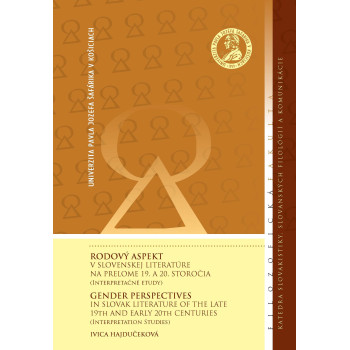
Gender perspectives in slovak literature of the late 19th and early 20th centuries (Interpretation Studies)

Gender perspectives in slovak literature of the...

E-book

E-book

Ivica Hajdučeková

The development of this bilingual coursebook evolved as part of project KEGA Nr. 020UPJŠ-4/2013 headed by prof. PhDr. Ján Gbúr, CSc., and emerged from earlier research which had successfully analysed realist and modernist Slovak literature from a gender perspective. Based on initial interpretations which drew from philosophical, sociological and historiographical approaches, we were able to anticipate the issues which could be raised in other texts and thus establish a hypothesis for the subsequent literaryscientific research. Our research has also been influenced by the continually evolving nature of gender studies, and we have therefore decided to adopt a somewhat unusual approach in this coursebook and briefly examine some contemporary texts thereby creating an intentional shift in our timeline. The modern works of Z.Kepplová and U. Kovalyk have raised a number of interesting issues, and a study of the interwar work of M. Urban reveals further interpretations on the basis of gender. After this brief overview, we return to the main focus of the study: gender approaches to Slovak literature of the late 19th and early 20th centuries.

The study focuses on the complexity of male-female relationships in the work of both male and female authors of realist and modernist literature at the end of the 19th and the beginning of the 20th century. Works by the founding generation of realism and late realism were analysed, with particular attention being paid to the fiction of M. Kukučín, J. Čajak, J. G. Tajovský, J. Jesenský, E. M. Šoltésová, T. Vansová, Ľ. Podjavorinská and B. S. Timrava. The works of H. Gregorová and Ľ. Groeblová were also studied as prime examples of Slovak literary modernism. 

We hope that this bilingual coursebook will allow realist and modernist Slovak fiction, and the Slovak national literary tradition in general, to receive wider critical renown beyond the borders of Slovakia and also to demonstrate its place in contemporary literary theory.

Download the e-book for free (pdf)

This website uses cookies to ensure you get the best experience on our website