Filter By

Year of publication:

Year of publication:

Publication language:

Publication language:

Active filters

  • Year of publication:: 2013
  • Year of publication:: 2015
  • Year of publication:: 2018
  • Year of publication:: 2018
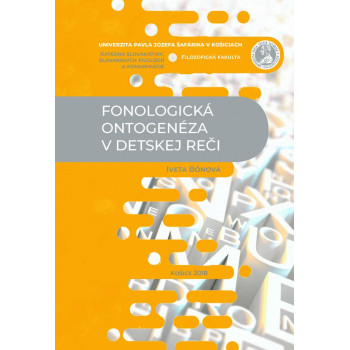
Fonologická ontogenéza detskej reči

Fonologická ontogenéza detskej reči

E-book

E-book

Iveta Bónová

The foundations of the presented work were developed alongside the emerging research on child language in Slovakia. An enthusiastic team of individuals from several scientific fields—psychology (Marína Mikulajová), speech therapy (Svetlana Kapalková), and linguistics (Daniela Slančová, Jana Kesselová, Zuzana Ondráčková, Stanislava Zajacová, Iveta Bónová)—met regularly, discussed, and sought ways to mobilize efforts to achieve their set goals: conducting research on the language of intact (healthily developing) children based on actual longitudinal observation.

I am very pleased and grateful to have been part of the team at the beginning of systematic research in the field of child language acquisition in Slovakia. As a member of this team and a co-researcher on several projects in this area, I had the opportunity to participate in research on child language, which is no longer "on the fringes" of scientific interest. It has become a serious, exact study supported by quantitative and qualitative data, conducted systematically "at an excellent scientific level" (Průcha, 2011, p. 14).

The research itself was naturally preceded by data collection. The technologies of the late 20th century enabled the replacement of the outdated diary recording method with what is now the most commonly applied approach to material collection—audio-visual recordings. The synthesis of analyzed data collected over time, its explanation, generalization, and integration into a broader interdisciplinary research context is all the more interesting and beneficial as it contributes to speech therapy practice. Thanks to the results of the latest research, intervention possibilities in speech therapy are expanding, and methods for (early) diagnosis and stimulation are being developed and refined.
Download the e-book for free (pdf)

Metodologické inšpirácie v literárnovednom výskume II

Metodologické inšpirácie v literárnovednom...

E-book

E-book

Ivica Hajdučeková et al.  

The four-year grant project VEGA No. 1/0736/15, titled Methodological Approaches to the (Re)Interpretation of Works of Slovak and World Literature (led by Prof. PhDr. Ján Gbúr, CSc.), conducted at the Department of Slovak Studies, Slavonic Philologies, and Communication at the Faculty of Arts, Pavol Jozef Šafárik University in Košice between 2015 and 2018, yielded several outputs during its duration. In addition to individual scientific studies published in journals both domestically and internationally, the project resulted in: A proceedings volume from the international scientific conference Text in Contexts: Text in Interdisciplinary Interpretations (2018). A scientific monograph titled Spirituality in the (Re)Interpretation of Slovak Literary Works (2016). The collaboration culminated in two key complementary publications forming an interconnected whole:

Methodological Inspirations in Literary Research I (a collection of selected lectures and abstracts).

Methodological Inspirations in Literary Research II (a monograph).

An electronic collection of abstracts and video recordings from ongoing lecture colloquia—featuring notable figures from Slovak and Czech academia—and the scientific monograph were conceptually aligned, as evidenced by their shared titles differentiated numerically. This approach adhered to the project's aim of continuing a tradition of precision in literary research while emphasizing methodological pluralism. It also sought to promote contemporary, generationally diverse research within the academic environment of Eastern Slovakia, historically linked to Pavol Jozef Šafárik University in Košice.

Download the e-book for free (pdf)

Methodological Inspirations in the Research of Literary Science I.

Methodological Inspirations in the Research of...

E-book

E-book

Ivica HajdučekováPeter Getlík (eds.)

Proceedings of Selected Lectures and Abstracts

Grant project VEGA No. 1/0736/15 Methodological Basis of Literary (re)interpretation in Slovak and World Literature (the head of the project: prof. PhDr. Ján Gbúr, CSc.), whose realization lasted for four years (2015 – 2018) at the Department of Slovak Studies, Slavonic Philologies and Communication of Faculty of Arts of Pavol Jozef Šafárik University in Košice, brought several lecture events with the participation of experts from Slovak and Czech academical space. The original and progressively accomplishing project goal was to continue the tradition of exactness and support its implementation into our everyday scientific thinking and literary-scientific exploration. Each of fourteen invited lectures was a unique, professionally inspiring and humanly enriching meeting.

On that account there is a nontraditional project output: the proceedings of selected lectures and abstracts (abstracts were translated into English language by Mgr. Dominika Petáková, internal postgraduate student of literary science at Department of Slovak Studies, Slavonic Philologies and Communication) titled Methodological Inspirations in the Research of Literary Science I., which is intended for academical and study purposes at universities. The topics of the lectures were completed successively according to interest and demands of research team and current scientific research of invited guests.

Download the e-book for free (pdf)

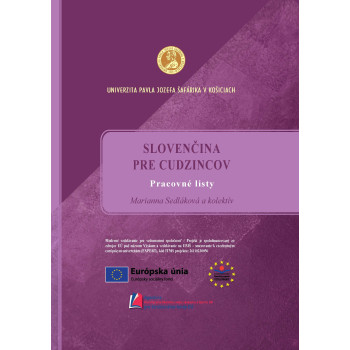
Slovenčina pre cudzincov (Pracovné listy)

Slovenčina pre cudzincov (Pracovné listy)

E-book

E-book

Marianna Sedláková a kol. 

The worksheets, based on the direct specific needs of teaching medical students in Košice, respect the real situation of teaching Slovak as a foreign language at UPJŠ.

They also reflect the relatively high number of Slavic students, especially from neighboring countries, who, although just beginning with the Slovak language, are at a higher communicative level compared to students from non-Slavic countries. Therefore, a special part of the worksheets with exercises is dedicated to them, which includes special exercises and dictionaries aimed at eliminating Slovak-Polish or Slovak-Ukrainian interference phenomena. Since some non-Slavic students come from the Czech language environment, we also add a glossary of the most common different expressions in Slovak, Czech, and, for the aforementioned reasons, Polish and Ukrainian. In the part intended for all students, both Slavic and non-Slavic, communicatively focused exercises for practicing grammatical phenomena predominantly at the A1 and A2 communication skill levels (according to the Common European Framework of Reference) prevail, and last but not least, exercises thematically focused on medicine and healthcare.

The texts from the thematic area are, of course, supplemented with realia of the city of Košice. As a functional supplement in the working material, we also publish test samples.

Download the e-book for free (pdf)

Realism, Modernism, Postmodernism: Five Modern Literary Texts in Context

Realism, Modernism, Postmodernism: Five Modern...

E-book

E-book

Soňa Šnircová

This textbook has been designed as supporting material for the postgraduate course on modern trends in European literature. It focuses on the presentation of five modern literary modes of writing: the realistic mode which was brought to its prominence by the nineteenth-century Realist movement; the stream-of-consciousness and ‘absurdist’ modes which were developed in the context of modernism; and the magical realist and metafictional modes which are associated mainly with postmodernist literary trends. Each mode is represented by a well-known text which demonstrates the formal aspects of each mode and deals with the thematic concerns typical of the literary movement that influenced its production.

The textbook adopts an interdisciplinary approach, placing the chosen literary texts into the historical, philosophical and cultural contexts that shaped their characters, and thereby providing the background knowledge necessary for a deeper understanding of their formal and thematic aspects.

Download the e-book for free(pdf)

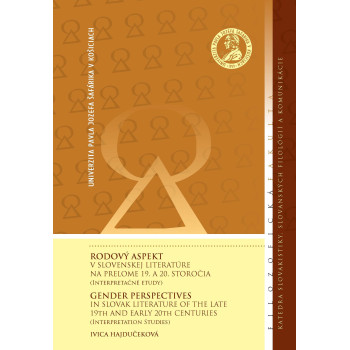
Gender perspectives in slovak literature of the late 19th and early 20th centuries (Interpretation Studies)

Gender perspectives in slovak literature of the...

E-book

E-book

Ivica Hajdučeková

The development of this bilingual coursebook evolved as part of project KEGA Nr. 020UPJŠ-4/2013 headed by prof. PhDr. Ján Gbúr, CSc., and emerged from earlier research which had successfully analysed realist and modernist Slovak literature from a gender perspective. Based on initial interpretations which drew from philosophical, sociological and historiographical approaches, we were able to anticipate the issues which could be raised in other texts and thus establish a hypothesis for the subsequent literaryscientific research. Our research has also been influenced by the continually evolving nature of gender studies, and we have therefore decided to adopt a somewhat unusual approach in this coursebook and briefly examine some contemporary texts thereby creating an intentional shift in our timeline. The modern works of Z.Kepplová and U. Kovalyk have raised a number of interesting issues, and a study of the interwar work of M. Urban reveals further interpretations on the basis of gender. After this brief overview, we return to the main focus of the study: gender approaches to Slovak literature of the late 19th and early 20th centuries.

The study focuses on the complexity of male-female relationships in the work of both male and female authors of realist and modernist literature at the end of the 19th and the beginning of the 20th century. Works by the founding generation of realism and late realism were analysed, with particular attention being paid to the fiction of M. Kukučín, J. Čajak, J. G. Tajovský, J. Jesenský, E. M. Šoltésová, T. Vansová, Ľ. Podjavorinská and B. S. Timrava. The works of H. Gregorová and Ľ. Groeblová were also studied as prime examples of Slovak literary modernism. 

We hope that this bilingual coursebook will allow realist and modernist Slovak fiction, and the Slovak national literary tradition in general, to receive wider critical renown beyond the borders of Slovakia and also to demonstrate its place in contemporary literary theory.

Download the e-book for free (pdf)

This website uses cookies to ensure you get the best experience on our website