Filter By

Year of publication:

Year of publication:

Publication language:

Publication language:

Faculty:

Faculty:

Active filters

  • Year of publication:: 2016
  • Publication language:: Slovak
Výskum v medicíne a etika

Výskum v medicíne a etika

E-book

E-book

Iveta Cimbolákováa kol.

The premise “today’s research shapes the healthcare of tomorrow” expresses the importance of medical research and the reason for its pursuit. Scientific research and advances in biomedical sciences, as well as their application in medical practice and in the process of delivering healthcare, nevertheless bring new problems in the area of ethics.

Biomedical research itself requires the precise definition of hypotheses, which are tested both under laboratory conditions and on experimental animals. Although clinical studies on human subjects are expected to benefit individual participants and to advance fundamental biomedical knowledge, they also entail certain risks depending on the nature of the research. These risks must be minimized, and the experiment should be conducted freely while also taking place within specific measures to protect all involved-not only the test subjects, but also the researchers themselves.

The presented publication provides an overview of the general conditions and ethical principles of research involving laboratory animals and human subjects, the issue of professional and ethical assessment of projects, as well as fraud and the publication of results. At present, we are witnessing tremendous progress in molecular biological sciences, which brings ethical dilemmas also in the field of genetics. For this reason, one of the chapters is devoted to the latest findings in this area.
Download the e-book for free (pdf)

Tanatológia a humánna tafonómia - etické a právne aspekty

Tanatológia a humánna tafonómia - etické a...

E-book

E-book

Nikita Bobrova kol.

The concept of medical ethics is interpreted as both applied and professional ethics. As a bioethical discipline, it consists of three normative parts: biogenesis, biotherapy, and thanatology. From an ethical perspective, medicine is part of clinical bioethics; however, at the current stage, “evidence-based ethics” is still lacking.

In the context of standardizing health care, there is an excessive development of certain components of bioethics (such as ethical codes and the concept of patient autonomy), but also a reduction, especially of its clinical component (such as communication, thanatology, euthanasia, dysthanasia, and futile treatment). Current legislative efforts are leading to a reduction in the rights of health care workers, particularly in terms of corporate autonomy.

The fundamental task of medical ethics is the cultivation of medical professionalism, which is defined as the professional alignment of expert, ethical, and legal reasoning, and as a starting point for thinking in terms of values, with reflection on the bioethical space in clinical and professional practice.

Since society declares health as its priority, this priority should positively influence the entire health care system, and its basic idea should be a health care system based on a humanistic ethical paradigm with social and professional application.

Download the e-book for free (pdf)

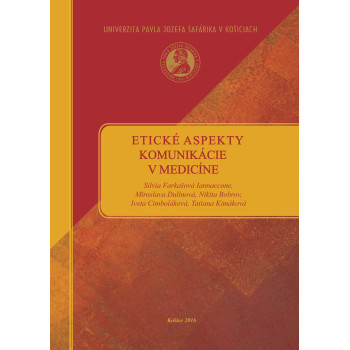
Etické aspekty komunikácie v medicíne

Etické aspekty komunikácie v medicíne

E-book

E-kniha

Silvia Farkašová Iannaccone a kol.

The history of ethics represents the search for a fundamental principle that would enable a person to distinguish between moral and immoral, good and evil, or right and wrong. The main issues are the motives, methods, and consequences of human actions.

The integrity of the medical profession emphasizes lifelong study and practice according to professional competence, and, last but not least, adherence to ethical principles and standards of medical ethics. Medical ethics and the related communication in the process of providing healthcare are becoming increasingly relevant topics. Communication between doctor and patient itself constitutes a very important part of the diagnostic process and treatment; it significantly contributes to the creation of a mutual relationship and, to a considerable extent, ensures patient cooperation.

The development of various information and network technologies allows for rapid communication even in medicine; however, a kind word and real contact with the patient, with an appropriate choice of verbal and nonverbal communication tools in personal contact, cannot be replaced by modern technology. The present era places demands on certain communication skills of the physician. Another ethical and legal issue is informed consent, which brings the patient’s active participation in the process of providing healthcare.

The presented publication provides basic information about medical ethics, communication in medicine in general, and communication skills in medical practice. Further chapters are devoted to the issue of informed consent, ethics, and the specifics of communication with selected groups of patients. We believe that this publication will clarify for the reader the basic ethical pillars and will be helpful for basic orientation in the issues of medical communication.

Download the e-book for free (pdf)

Environment a jeho etické aspekty

Environment a jeho etické aspekty

E-book

E-book

Tatiana Kimáková a kol.

Ethics, as the science of the proper realization of human potential in various areas of life, also extends into the environment. For understanding the ethical aspects in this field, a thorough knowledge of the individual components of the environment, as well as their impact not only on humans but on all living nature, is very important. Therefore, questions concerning the influence of the environment are increasingly at the forefront of interest from an ethical perspective, also in connection with existing legal norms.

The modern process of civilization is characterized by rapid development of science and technology. However, this development, while raising the standard of living on one hand, also brings negative side effects on the other. The result is the disruption of ecological, biological, and natural life conditions, especially in the areas of industrial centers. The development of individual branches of industry leads to the production of liquid, gaseous, and solid wastes, the emergence of harmful risk factors threatening various components of living nature, including humans. There may be increased bioaccumulation of hazardous chemical elements in organisms, which, through their effects, represent a potential risk also in terms of carcinogenesis and mutagenesis.

For this reason, an important role of society is to create conditions to prevent the release of emissions and to reduce their concentration to the lowest possible, socially and biologically acceptable level. The assessment of the biological effects of harmful substances is based on experimental and epidemiological studies. Knowledge of concentration and duration of exposure is crucial for applying dose-effect relationships and for determining the highest permissible concentrations of pollutants. The health of the population, as a universal value and a primary human right, represents a fundamental economic resource not only for the individual, but also for society as a whole.

Download the e-book for free (pdf)

Etika starostlivosti

Etika starostlivosti

E-book

E-book

Adriana Jesenková

The ethics of care offers inspiring ways to think about the relationships and connections we are part of. It provides a new and unconventional reading and understanding of human relationships, thereby enabling us to respond in new and appropriate ways to certain empirical challenges (Pettersen 2011, p. 51).

Just twenty-five years ago, thinking about care was associated with women’s decisions in the private sphere concerning their personal dilemmas and problems. Over the last two decades, advocates of the ethics of care have demonstrated that the ideal of care has the potential to regulate not only private behavior but also human interactions in general.

Today, ideas about care have the power to change how we evaluate personal relationships, professional conduct, public policy, international relations, and global issues. The relevance of the ethics of care in such a wide range of areas of life, many of which are characterized by mutual incompatibilities and conflicting interests, is conditioned by several factors. However, one of the most significant is the creativity and fruitfulness of the thinking of the representatives of the ethics of care, who develop ethical concepts, models, and methods capable of grasping and analyzing human relationships in all their diversity (Pettersen 2011, p. 52).

Compared to traditional ethical concepts and theories in moral philosophy, the ethics of care introduces radically different sets of models and normative concepts. Today, it is precisely feminist ethics of care that offers a critical reflection on care within the realm of moral philosophy, ethics, and social philosophy. The aim of this publication is to identify the concept, subject, approach, philosophical foundations and starting points, as well as the possibilities for applying the ethics of care as a specific moral approach and, at the same time, as a specific moral theory in the field of social science and humanities research.

Download the e-book for free (pdf)

Interdisciplinárne konotácie ekologicko-etických koncepcií

Interdisciplinárne konotácie...

E-book

E-book

Ľubov Vladyková

The university textbook presents a panorama of ecological-ethical concepts - ecological ethics, as a possibility of cultural development and indicates the continuing search for relationships with the aim to recognize the importance of ethics and its influence on our understanding and our relationship with the natural world, including scenarios adequately reflecting human-nature interaction in all their complexity.

Special attention is paid to the question of internal evaluation of nature, human and non-human life, both at individual and holistic levels (biocentrism) and the value of physical elements of ecosystems (ecocentrism).

Download the e-book for free(pdf)

This website uses cookies to ensure you get the best experience on our website