Filter By

Year of publication:

Year of publication:

Publication language:

Publication language:

Faculty:

Faculty:

Active filters

  • Year of publication:: 2015
  • Year of publication:: 2018
  • Year of publication:: 2018
  • Faculty:: Faculty of Law
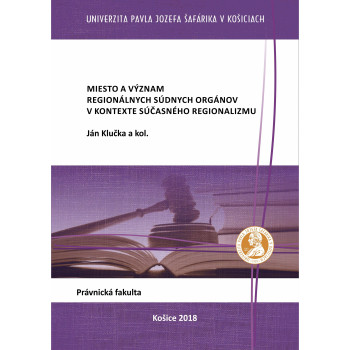
Miesto a význam regionálnych súdnych orgánov v kontexte súčasného regionalizmu

Miesto a význam regionálnych súdnych orgánov v...

E-book

E-book

Ján Klučka et al.

The aim of the current monograph is to provide comprehensive view of the status of regional judicial organs in current conditions of regionalism. Based on selected issues examined in individual chapters research team presents the comprehensive study focused on clarification of the status and significance of regional judicial organs in terms of new regionalism.

Research of the role of regional courts in the system of peaceful settlement of disputes demonstrates the significant role of the regional courts within the promotion of the rule of law, regional integration and also significant role of regional courts to ensure legal certainty within the system of compliance with decisions of regional courts. The result of examination of possibilities of individuals to access to regional judicial organs is comparative evaluation of regional possibilities of individual to defend his/her rights within regional courts of various regions. Particular part of this area is the right to an effective remedy and to a fair trial as basic rights within the proceedings of regional judicial organs. Within the examination of preliminary rulings of international regional courts of different regions the role of regional judicial organs in the process of effective implementation of the principle of the rule of law was the subject of examination.

For the proper functioning of the regional judicial organs as well as independence of judges and legal certainty in International law, the ethical rules of international judicial organs and tribunals, which are the subject of the last chapter, are significant.
Download the e-book for free  (pdf)

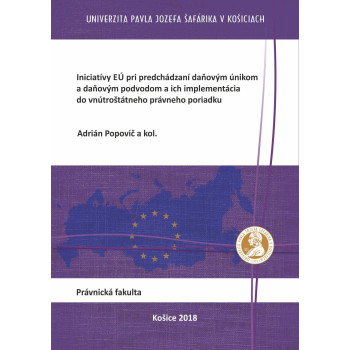
Iniciatívy EÚ pri predchádzaní daňovým únikom a daňovým podvodom a ich implementácia do vnútroštátneho právneho poriadku

Iniciatívy EÚ pri predchádzaní daňovým únikom a...

E-book

E-book

Adrián Popovič a kol.

The possibility of solving the grant project VVGS-2016-284 has provided a unique opportunity for members of the author´s team in the interdisciplinary composition to examine the issue not only from a tax-law point of view, but also from a political point of view. In the presented monograph, the authors focused on the characterization of different aspects of the EU in order to allow the reader correctly understand its position in relation to the outside world and to its inward relations within its Member States in the context of the creation and implementation of the EU tax policy.

Particular attention is paid to the definition of the relationship between national tax legislation and EU law, the impact of the EU's tax policy on the national laws of its Member States, with reference to the identification of the harmonized areas with the approximation of their current stage of development and the final objective. This definition can be seen as a prerequisite for a correct and comprehensive understanding of the application and implementation of EU institutions' initiatives to prevent tax evasion and tax fraud and their implementation into the national legal order of the Slovak Republic. In the last part of the monograph, the authors focused on defining individual EU initiatives to combat tax evasion and tax fraud as a means of implementing its tax policy, in the area of ​​indirect taxation, in particular in the field of value added tax and in the field of direct taxation, especially with regard to corporate taxation, and to evaluate their projection into the national tax legislation of the Slovak Republic. At the same time, in these chapters, they assessed the real impact and effect of the measures admitted on the basis of the initiatives in practice.

The presented work is intended for a university student studying in the field of Tax Law and European Law, as well as the broader legal and economic community. However, in view of the scope and recency of the subject under consideration, the authors believe that the publication will find its application not only in the theoretical field but also in the practical field.

 JUDr. Adrián Popovič

Download the e-book for free (pdf)

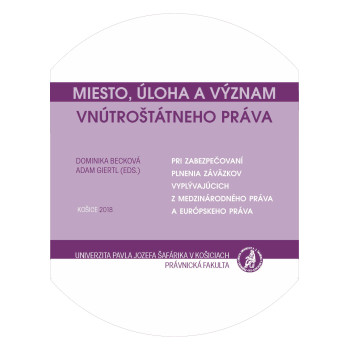
The place, role and significance of domestic law

The place, role and significance of domestic law

E-book

E-book

Dominika Becková - Adam Giertl (eds.)

Collection of Papers of PhD. students and young researchers

Institute of International Law and European Law offered a place to PhD. students and young researchers to publish scientific outputs of their research. Submited collection of scientific contributions is the result of that initiative. Papers deal with the implementation of international law and law of the EU into the domestic legal system.

Thematically is the collection of contributions divided into several parts, that are dedicated to contributions dealing with the issues of legal theory and international and european law.

Contributions are addressing issues of human rights protection, they aim to the roles of international and supranational judiciary, environment, criminal and public law. Collection of contributions includes also chosen problems of private law and it also dedicates space for contributions focused on foreign investments.

Download the e-book for free  (pdf)

Regionalizmus a jeho prínos pre všeobecné medzinárodné právo

Regionalizmus a jeho prínos pre všeobecné...

E-book

E-book

Ján Klučka a kol.

The presented monograph, “Regionalism and Its Contribution to General International Law,” was prepared at the Institute of European Law and the Department of International Law of the Faculty of Law at Pavol Jozef Šafárik University in Košice as part of a project of the same name (APVV-0823-11) carried out in the years 2011–2015, and represents one of its final publication outputs.

The main reason for choosing this topic was the effort to evaluate regionalism in its various forms in relation to international law, and, conversely, to assess the place, significance, and role of international law in the creation and functioning of different forms of regional groupings. In fact, although regionalism is receiving increasing attention in doctrine, a more comprehensive assessment of its impact on international law and vice versa has so far been lacking.

This monograph attempts to partially fill this gap. Against the background of a brief historical development of regionalism, as well as its substantive and terminological components, the monograph examines in greater detail the individual types of regionalism—such as old and new regionalism, as well as contractual and institutional regionalism—their specific features, and their contribution to general international law.

Attention is also devoted to a specific phenomenon of contemporary regionalism, namely the influence of the European Union on its stabilization and development, both through practical measures and through a set of measures regulated by international treaties.

Download the e-book for free (pdf)

Regionalism and Its Contribution to General International Law

Regionalism and Its Contribution to General...

E-book

E-book

Ján Klučka - Ľudmila Elbert

The present monograph "Regionalism and its Contribution to General International Law" was written at the Institute of European Law and Department of International Law, Faculty of Law, Pavol Jozef Safarik University in Kosice, as a part of the project (APVV-O823-11) carried out in 2011-2015, representing one of its final publication utputs. 

The main reason for choosing the topic was to evaluate regionalism in its various relationships and forms with respect to international law, and also to evaluate the place,importance and duties of international law in respect to the establishment and functioning of various forms of regionalgroups.

It is a fact that even though a lot of attention has been paid to regionalism, a more complex evaluation of the impact it has had on international law, and vice versa, is still lacking. The efforts of the present monograph are to partially eliminate this gap.

After giving a brief insight into how regionalism has developed, its content and terminology, the monograph studies in more details individual types of regionalism in the form of old and new regionalism, as well as treaty and institutional regionalism; its specifications and contributions to the international law.

Download the e-book for free (pdf)

Ochrana kultúrnych hodnôt prostriedkami medzinárodného a regionálneho práva

Ochrana kultúrnych hodnôt prostriedkami...

E-book

E-book

Adam Giertl - Ľudmila Elbert

Collection of Papers from the 8th Student Symposium held on April 20–21, 2015 in Danišovce

The capture of the historic Syrian city of Palmyra by fighters of the radical Islamic State caused shock among the global public. The main reason is the barbarism with which this organization proceeds, not only in relation to the treasures of the world’s cultural heritage. The situation in the Middle East, where cultural treasures of inestimable value are under direct threat, demonstrates how fragile the world’s cultural heritage is. The reaction of the international public and world leaders shows how sensitively the destruction of cultural heritage is perceived.

The quoted statement chosen by the editors relates to the threat posed by the Islamic State—however, the spirit of this statement can be applied to any cultural wealth that forms part of the world’s cultural heritage. The destruction or damage of these values primarily represents a loss for humanity as such. Each destroyed artifact of world cultural heritage signifies the disappearance of a unique legacy left by previous generations for the future. At the same time, cultural heritage must be understood as a broad spectrum of assets—both tangible and intangible. Their legal protection was the topic of this year’s symposium. As with any social interest, the protection of cultural heritage can be ensured through various mechanisms and under different forms of social organization.

These diverse approaches are unified by law as a normative system. The question for the 8th year of the symposium on international law was what role international law plays in the protection of cultural heritage. In the context of the European region, the role of the European Union as a regional organization was examined.

Download the e-book for free (pdf)

Rule of Law a medzinárodné právo

Rule of Law a medzinárodné právo

E-book

E-book

Ľudmila Elbert

The presented scientific monograph addresses the issue of the Rule of Law and its place, roles, and particularities at the level of international law. The Rule of Law is understood as a value that should govern communities, both domestic and international. It is thus compared to Kelsen’s basic norm, which should stand at the top of the legal order as the norm justifying the validity and existence of the norms of the legal order, both domestic and international.

Although the Rule of Law is studied at the international law level, it cannot be considered without understanding the Rule of Law in domestic law. Just as its development differs depending on whether it evolved within Anglo-American or continental law, its application and development also differ between domestic law and international law.

These differences are mainly caused by the roles and objectives that international Rule of Law is meant to secure, as well as by the distinct characteristics of domestic and international law.

Download the e-book for free (pdf)

This website uses cookies to ensure you get the best experience on our website