Filter By

Year of publication:

Year of publication:

Publication language:

Publication language:

Faculty:

Faculty:

Active filters

  • Year of publication:: 2009
  • Year of publication:: 2009
  • Year of publication:: 2010
  • Year of publication:: 2013
  • Year of publication:: 2014
  • Year of publication:: 2017
Globálne navigačné satelitné systémy

Globálne navigačné satelitné systémy

E-book

E-book

Vladimír Sedlák

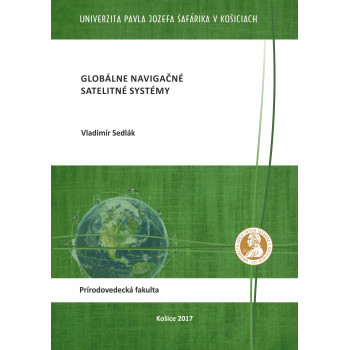
In the presented university textbooks, so-called satellite-based augmentation systems (SBAS, from the English Satellite Based Augmentation Systems, in Slovak Systémy rozširujúce základné satelitné systémy) are also discussed. These systems enhance, expand, or refine the basic satellite navigation systems. They are supportive satellite systems for GNSS (Global Navigation Satellite Systems). Currently, the long-operational American GPS and Russian GLONASS systems, as well as the partially operational European Galileo system (since December 2016), have and will continue to have broad applications in various fields of human activity, both professional and personal.

The university textbook Globálne navigačné satelitné systémy (Global Navigation Satellite Systems) reflects the current progressive development in the technological and instrumental principles and components of such satellite navigation systems. It presents the state of these satellite technologies from their historical origins and development to the present. The rapid advancements, particularly in the instrumental base of satellite navigation systems, will require updates on their current state in future editions of these university textbooks.
Download the e-book for free (pdf)

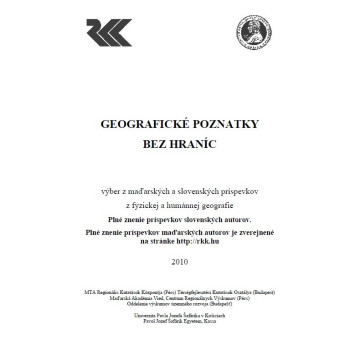
Geografické poznatky bez hraníc - výber z maďarských a slovenských príspevkov z fyzickej a humánnej geografie.

Geografické poznatky bez hraníc - výber z...

E-book

E-book

Dušan Barabas a kol.

The presented text is the final product of work within the project "Tanuljunk egymástól!/Let’s Learn from Each Other!" The project emerged from long-standing contacts between the staff of the Centre for Regional Studies of the Hungarian Academy of Sciences and the Institute of Geography at the Faculty of Science, Pavol Jozef Šafárik University in Košice, as a natural effort to expand mutual cooperation. The first step was collaboration within Interreg II projects, involving a broad range of institutions from both academic and non-academic environments. This initial attempt was unsuccessful due to administrative errors. Consequently, a project titled HUSK/0801/1.6.1/0003 "Tanuljunk egymástól!/Let’s Learn from Each Other!" was prepared and developed in agreement with the Hungarian side. It was approved and co-financed by the European Regional Development Fund under the Hungary-Slovakia Cross-Border Cooperation Program 2007–2013.

Download the e-book for free (pdf)

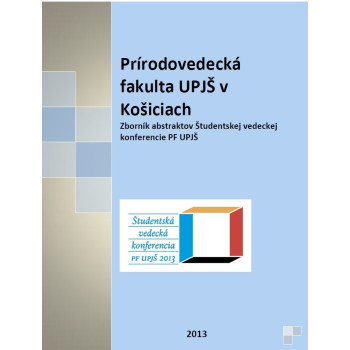
Študentská vedecká konferencia PF UPJŠ 2013

Študentská vedecká konferencia PF UPJŠ 2013

E-book

E-book

Vladimír Zeleňák (ed.)

The publication contains abstracts of contributions presented at the Student Scientific Conference of the Faculty of Natural Sciences at UPJŠ in Košice, held on April 25, 2013. The event was marked by the celebration of the 50th anniversary of the Faculty of Natural Sciences at UPJŠ and was part of a series of events called ScienceFest.

Download the e-book for free (pdf)

Vybrané kapitoly z biogeografie pre geografov

Vybrané kapitoly z biogeografie pre geografov

E-book

E-book

Dušan BarabasAlena Labunová

These study materials aim to provide basic information about biogeographical issues from a geographical perspective, i.e., a perspective focused primarily on the aspect of spatial differentiation of the biosphere. The basis for the division of the biosphere is its historical development, during which individual taxa and communities were formed.

The historical development of the biosphere did not occur under stable, constant conditions, but rather in ever-changing conditions caused by the position of our planet within the solar system, the position of the Earth's axis relative to the ecliptic, and also the position of the solar system within the galaxy. All changes in the Earth's position, together with the movement of continents (drift) and climate changes, created the prerequisites for the spatial expansion of the biosphere. The historical development of the biosphere, various perspectives, the hierarchical level of differentiation, and the causes of differentiation are incorporated in this study material, whose aim is to outline the basic principles of this division.

The goal is also to highlight certain differences in the understanding of terminology, as well as to point out some fundamental relationships operating within the landscape system in the broadest sense of the word. The section devoted to the ecological principles of the functioning and formation of the landscape system, according to MIČIAN and ZATKALÍK (1984), outlines the issues of understanding the terms ecosystem and geosystem. For this reason, the presented text includes chapters that attempt to explain the understanding and approach to some basic concepts.

These study materials are intended for students of single-subject, interdisciplinary, and supplementary studies as basic teaching material. By expanding the knowledge from this study material with further information, which is elaborated in more detail in the literature listed in the bibliography of this text, graduates will gain a comprehensive view of biogeographical issues.

Authors

Download the e-book for free (pdf)

English for Chemists

English for Chemists

E-book

E-book

Božena Velebná

The following material has been created during the two years of teaching English for Chemists at the Faculty of Science of the Pavol Jozef Šafárik University and is therefore designed to meet the needs of this course. The main motivation was the lack of appropriate materials, especially as the groups generally comprise students with a very diverse level of English. This diversity therefore became the main criterion determining both the form and the content of this text.

In the ten units that provide material for a one semester course, the emphasis is put on teaching the students vocabulary and terminology, which is introduced via authentic texts, depending on the topic of each unit. Students are encouraged to learn the meaning of new words in context. Grammar is included too, with the aim of demonstrating and explaining grammatical rules by means of examples taken directly from the texts. For the more advanced students, grammatical exercises in this material can serve for revision while the beginners might need more supplementary materials.

I hope that this material, the preparation of which has been a challenging as well as enjoyable experience will be useful for future teachers and the students of this course.

Download the e-book for free (pdf)

This website uses cookies to ensure you get the best experience on our website