Filter By

Selections

Selections

Year of publication:

Year of publication:

Faculty:

Faculty:

Active filters

  • Year of publication:: 2012
  • Year of publication:: 2014
  • Year of publication:: 2026
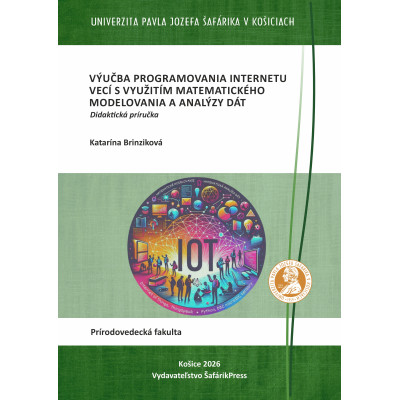
Výučba programovania internetu vecí s využitím matematického modelovania a analýzy dát
  • New

Výučba programovania internetu vecí s využitím...

E-book

E-book

Katarína Brinziková

This teaching guide for instructing students in Internet of Things programming using mathematical modeling and data analysis is intended for mathematics and computer science teachers in elementary and secondary schools, as well as for students training to teach these subjects. It responds to the requirements of the new curriculum reform in Slovakia, which emphasizes a cyclical learning process, the development of data, digital, and mathematical literacy, and the integration of teaching with real-world problems and technologies. The guide is designed in accordance with the methodological framework of design-based research. It contains technological and methodological foundations, as well as a set of proven teaching activities divided into three levels of difficulty. The teaching guide provides teachers with specific instructions, recommendations, and examples of best practices for the meaningful integration of IoT and mathematical modeling into teaching across different educational cycles, creating space for modern, interdisciplinary, and data-driven education.

Download the e-book for free (pdf)

Určitý integrál

Určitý integrál

E-book

E-book

Ondrej Hutník

The concept of the integral is one of the most significant concepts in mathematics as a whole. In its most primitive form, it was already used by the ancient Greeks in the creation of Euclidean geometry. However, it was only after Descartes' work on analytical geometry in 1637 that mathematicians could begin to consider the integral as a subject of analysis. Descartes' work laid the groundwork for the discovery of infinitesimal calculus by Leibniz and Newton around 1665. At that time, a great dispute arose over the priority of this discovery, dividing scholars of Germany and England into two opposing camps, each favoring their own champion. Today, we know that Newton's work on fluxions and fluents was somewhat earlier, but Leibniz's notation and approach have gained more acceptance in the mathematical world, and the symbols ∫ ∫ and d d are still used today. A brief overview of the history of the integral will be presented in Chapter 1.

Today, there is a plethora of scripts, textbooks, and books dedicated to explaining the concept of the integral. Therefore, every potential author faces the initial question of whether to write another text on this topic. Our affirmative answer to this question was driven by the students' request to find the subject matter of a part of the winter semester of the second year presented in a coherent form. The second motivation is a slightly different approach to the topic. If we consider the methods typically used in solving problems and gaining routine with a certain integral, it mainly involves the Newton-Leibniz formula, and often there is little time left to compute the definite (Riemann) integral using its definition. Therefore, we included a discussion of the Newton integral in Chapter 2, which reflects this fact and is directly related to the indefinite integral, whose various calculation methods receive relatively much attention in the previous semester. Only after that, in Chapter 3, do we build the theory of the Riemann integral, present criteria for its existence, classes of integrable functions, basic properties, and finally its relationship with the Newton integral. Questions primarily concerning geometric applications are addressed in Chapter 4, and in the final chapter, we focus on extending the Riemann integral to unbounded functions and unbounded intervals.

Download the e-book for free (pdf)

Tvorba úloh pre programátorské súťaže

Tvorba úloh pre programátorské súťaže

E-book

E-book

Ľubomír ŠnajderJán Guniš

The publication lists interim results of qualitative educational research focused on the development and evaluation of programming tasks being carried out by authors since 2005 in the frame of programming competition PALMA junior.

The publication consists of three chapters: Computer science competitions in Slovakia, Tasks in computer science education, Selected problems of PALMA junior competition. The first chapter provides an overview of computer science competitions for a primary and secondary schools in Slovakia. The second chapter described the issue of learning tasks - their components, focus, formulation types, and development system of tasks. The third chapter contains the assignments and commented author solutions of selected problems represented focus of PALMA junior competition – programming, algorithms and mathematics.

For each problem is mentioned analysis of pupils’ solutions aimed to ways of thinking, typical misconceptions, sets of preparatory and extended problems. The publication is addressed to computer science teacher trainers, authors of programming competitions problems, and computer science teachers.  

Download the e-book for free (pdf)

This website uses cookies to ensure you get the best experience on our website