Filter By

Categories

Categories

Selections

Selections

Year of publication:

Year of publication:

Publication language:

Publication language:

Faculty:

Faculty:

Active filters

  • Categories: Social sciences
  • Year of publication:: 2010
  • Year of publication:: 2026
  • Year of publication:: 2026
  • Publication language:: Slovak
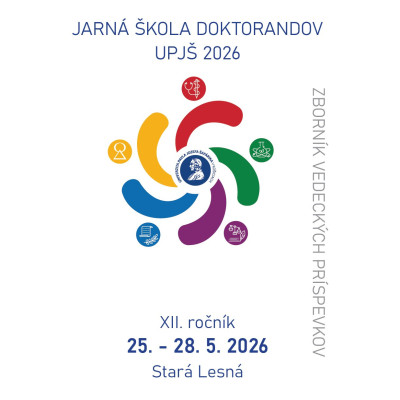
Jarná škola doktorandov 2026
  • New

Jarná škola doktorandov 2026

E-book

E-book

Monika Halánová (ed.)

On May 25 -28. 2026, Stará Lesná will host the 12th year of the university-wide event ‘Spring School of Doctoral Students of Pavol Jozef Šafárik University in Košice’. As part of the professional program, there will be six plenary lectures by prominent experts from Pavol Jozef Šafárik University in Košice and two workshops will be held. A total of 49 full-time doctoral students will present the results of their scientific research work, of which 21 doctoral students in the section of medical and natural sciences (Faculty of Medicine/Faculty of Science) and 28 doctoral students in the section of social sciences and humanities (Faculty of Law/Faculty of Public Administration/Faculty of Arts).

Download the e-book for free (pdf)

Úvodné kapitoly do základných modelov systemickej terapie

Úvodné kapitoly do základných modelov...

E-book

E-book

Ondrej Kalina

The publication provides a systematic overview of the core models of systemic therapy and its theoretical as well as practical foundations. The opening chapters of the textbook outline the historical development of psychotherapeutic approaches and the shift toward the systemic paradigm, which emphasizes the importance of relationships, context, and circularity in understanding psychological phenomena.

The core of the text focuses on the philosophical foundations of systemic therapy, particularly general systems theory, cybernetics, constructivism, and social constructionism, all of which have significantly shaped the understanding of reality, knowledge, and the therapeutic process. Subsequent chapters address biological and social foundations, including the concepts of autopoiesis, cognition, and communication, and their relevance to the functioning of social systems. The publication further elaborates on the practical implications of these theoretical frameworks, especially in relation to causality, language, and the construction of social reality. Systemic understanding of problems is presented as a dynamic and relational process maintained through interactional patterns within the system.

Download the e-book for free (pdf)

Pedagogická prax študentov učiteľstva akademických predmetov

Pedagogická prax študentov učiteľstva...

E-book

E-book

Silvia Kontírová a kol.

Pedagogical practice is an organizational form of higher education training for prospective teachers, implemented through mandatory pedagogical practice subjects.

These subjects have an integrative and practical-training character, building upon the theoretical and practical instruction provided to students at the faculty. They are conducted within the scope defined by curricula in the conditions of specialized workplaces (training schools) and under the supervision of qualified professionals (training teachers). Unlike other higher education subjects, pedagogical practice primarily provides students with opportunities for independent creative teaching in real school environments.

The practical activities of students in training schools are characterized as supervised, monitored, and evaluated by designated entities.

Download the e-book for free (pdf)

Dejiny filozofie ako filozofický problém

Dejiny filozofie ako filozofický problém

E-book

E-book

Vladimír Leško - Pavol Tholt (eds.)

Proceedings of the Fourth International Philosophical Symposium History of Philosophy as a Philosophical Problem, held on 14-15 October 2010

The Philosophical Proceedings is the final presentation of the results of the work of the research teams of the research projects VEGA 1/0650/08 - Heidegger and the History of Philosophy and VEGA 1/4679/07 - Jan Patočka's Asubjective Phenomenology and the History of Philosophy solved at the Department of Philosophy and the History of Philosophy of the Faculty of Philosophy of the University of Applied Sciences in Košice.

Download the e-book for free (pdf)

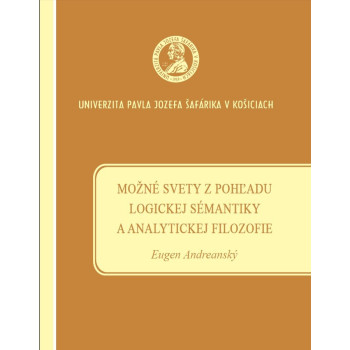
Možné svety z pohľadu logickej sémantiky a analytickej filozofie

Možné svety z pohľadu logickej sémantiky a...

E-book

E-book

Eugen Andreanský

The presented monograph aims to critically map the understanding of the concept of possible worlds.

The first chapter describes the formation of the semantics of possible worlds, along with indicating some problems it brings, which were incisively revealed primarily by W. V. O. Quine. In the next two chapters, the work focuses on more modern views on the nature of possible worlds, with the main attention given to the dichotomy between the possibilist and actualist approach to the question of modalities, alongside which it is necessary to assess other distinctions (essentialism - anti-essentialism, realism - reductionism (or ersatzism or fictionalism), naturalism - non-naturalism, etc.). Increased attention in the work is specifically devoted to the possibilism of D. Lewis and the actualist concepts of S. Kripke, A. Plantinga, R. M. Adams, N. Rescher, D. Armstrong, and J. Hintikka.

An unconventional approach to the issue of possible worlds is captured in the fourth chapter. It is primarily dedicated to the significant concept of Jaakko Hintikka, which works with the notion of epistemic possible worlds and documents the inclination towards the modification and relativization of modal discourse. The conclusion provides an evaluation of the discussion that touches on the main problems associated with considerations of possible worlds.

In the presented monograph, some representative concepts of possible worlds, or possible individuals, are clarified, and the overall process is indicated from assessing possible worlds as ideal logical constructs through their relativization by separate domains of individuals for individual worlds and further through the relationship of attainability to financial, impossible, and non-standard possible worlds.

Download the e-book for free (pdf)

This website uses cookies to ensure you get the best experience on our website