Filter By

Categories

Categories

Selections

Selections

Year of publication:

Year of publication:

Publication language:

Publication language:

Faculty:

Faculty:

UPJŠ Unit

UPJŠ Unit

Method of publication:

Method of publication:

Active filters

  • Year of publication:: 2015
  • Year of publication:: 2017
  • Year of publication:: 2017
  • Year of publication:: 2017
  • Year of publication:: 2017
  • Year of publication:: 2022
  • Year of publication:: 2022
  • Year of publication:: 2022
  • Year of publication:: 2022
  • Year of publication:: 2022
  • Year of publication:: 2022
  • Year of publication:: 2022
  • Year of publication:: 2022
  • Year of publication:: 2022
  • Year of publication:: 2022
  • Year of publication:: 2022
  • Year of publication:: 2022
  • Year of publication:: 2022
  • Year of publication:: 2022
  • Year of publication:: 2022
  • Year of publication:: 2022
  • Year of publication:: 2022
  • Year of publication:: 2024
  • Year of publication:: 2024
  • Year of publication:: 2024
  • Year of publication:: 2024
  • Year of publication:: 2024
  • Year of publication:: 2024
  • Year of publication:: 2024
  • Year of publication:: 2024
  • Year of publication:: 2024
  • Year of publication:: 2024
  • Year of publication:: 2024
  • Year of publication:: 2024
  • Year of publication:: 2024
  • Year of publication:: 2024
  • Year of publication:: 2024
  • Year of publication:: 2024
  • Year of publication:: 2024
  • Year of publication:: 2026
  • Year of publication:: 2026
  • Year of publication:: 2026
  • Year of publication:: 2026
  • Year of publication:: 2026
  • Year of publication:: 2026
  • Year of publication:: 2026
  • Year of publication:: 2026
  • Year of publication:: 2026
  • Year of publication:: 2026
  • Year of publication:: 2026
  • Year of publication:: 2026
  • Method of publication:: E-book (pdf)
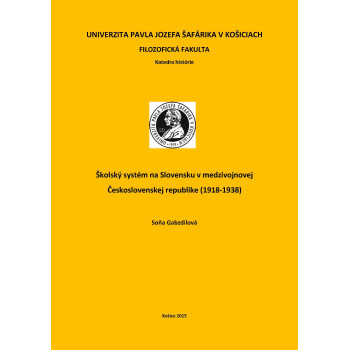
Školský systém na Slovensku v medzivojnovej Československej republike (1918 - 1938)

Školský systém na Slovensku v medzivojnovej...

E-book

E-book

Soňa Gabzdilová

The educational system (schooling) is one of the most effective tools for shaping the young generation in any advanced society. Schools not only create the knowledge base necessary for fulfilling the demands of the economy and the social sphere, but they also shape the national and ideological identity of each member of society. The school plays a decisive role in forming positive values, but it can also become a breeding ground for xenophobia and racist attitudes. The school has an irreplaceable role in creating national consciousness, identification with one's own nation, its history, the heroic deeds of ancestors, and the meaning of its existence.

After the dissolution of Austria-Hungary, there were fundamental geopolitical changes in Central Europe. One of these was the creation of Czechoslovakia, a state founded on radically different principles than pre-war Hungary. The founders of the Czechoslovak Republic (CSR), the personalities who decisively determined the character of the political system in the newly established republic, did not belong to the privileged classes of the previous regime. Unlike Hungary, where political power was controlled almost without exception by the nobility, the elite in Czechoslovakia consisted of men who were radical critics of Austria-Hungary.

A fitting example was the most influential figure of interwar Czechoslovakia, President Tomáš Garrigue Masaryk. Despite his origins, Masaryk was perceived by both Czechs and Slovaks as the founder of the state, a legendary figure whose political and social influence far exceeded the powers of the presidential office.

Download the e-book for free (pdf)

Začínajúci učiteľ a školská legislatíva I.

Začínajúci učiteľ a školská legislatíva I.

E-book

E-book

Zuzana Boberová

The aim of this university textbook is primarily to provide a comprehensive and systematic overview of the basic legislative documents related to pedagogical activities and the educational work of teachers in school practice. The textbook is primarily intended for students of academic teacher training programs, as well as recent graduates of teacher education who are beginning their teaching careers.

This publication is unique in that it does not focus on specific legislative documents and their descriptions, but rather presents the meaning and wording of various legislative documents in the context of key concepts of educational activities and typical school situations. The publication does not include the full text of cited paragraphs from laws, decrees, and ministerial guidelines, but only excerpts that are relevant to the focus and needs of the textbook.

In this way, we aim to help teacher training students and beginning teachers orient themselves regarding their rights and responsibilities as defined and delineated by school legislation, and especially to help them understand the basic legislative requirements placed on every teacher in school practice. This includes participation in the preparation of the school educational program, understanding the professional development of teachers, student assessment, approaches to students with special needs, as well as handling common school situations such as disciplinary measures, school accidents, ski training, or school events.

Given the scope of these areas, we have divided the topics into two publications according to their thematic focus.

Download the e-book for free (pdf)

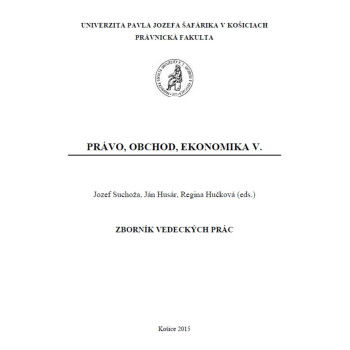
Právo - obchod - ekonomika V.

Právo - obchod - ekonomika V.

E-book

E-book

Jozef Suchoža - Ján Husár - Regina Hučková (eds.)

Collection of Scientific Works

The scientific papers presented in this Collection are primarily the result of academic research conducted by experts working within the academic environment—particularly at Faculties of Law in the Slovak Republic and the Czech Republic, as well as by foreign experts, including those from Poland, the Russian Federation, Serbia, and others. In addition to academic contributions, this Collection also includes scientific and professional articles authored by legal practitioners, especially lawyers, notaries, and judges—not only from our own jurisdiction, but also judges from the General Court of the European Union. Contributions from professionals in the field of banking have also enriched this Collection. Moreover, the Collection provides space for aspiring scholars in the field of legal science, thereby combining timelessness with dynamism.

Given the diversity of the published contributions, it can be said that this Collection represents a connection between theory and practice, private and public law, as well as various branches of law. Nevertheless, the content of this Collection aligns with and reflects the central theme of the international symposium, namely: "CORPORATIONS – CONTRACTS – CODIFICATIONS – CONTEXTS." The individual sections of the Collection are interconnected and create a coherent whole, subsumed under a publication characterized by unity.

Download the e-book for free (pdf)

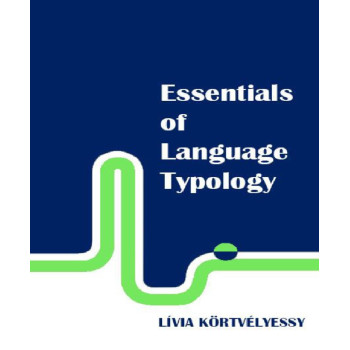
Essentials of Language Typology

Essentials of Language Typology

E-book

E-book

Lívia Körtvélyessy

This university textbook explains to students enrolled in the course Linguistic Typology and Universals the basic terminology, theoretical approaches, and research methods. The textbook is divided into eleven chapters. Each chapter presents theoretical knowledge in an accessible manner, along with practical exercises aimed at developing students’ skills in the respective area.

The textbook covers the following topics: the subject and nature of linguistic typology, a brief history of this linguistic discipline, genealogical classification of languages, various approaches and main objectives of typology across different linguistic levels (phonology, morphology, syntax, and lexicon), as well as areal typology, complex issues of language universals, and the nature and essence of typologists’ work. Given the extensive research activities of linguists from the Department of British and American Studies at Pavol Jozef Šafárik University in Košice, the textbook also introduces students to the results achieved by these scholars in this rapidly developing field of linguistics.

Download the e-book for free (pdf)

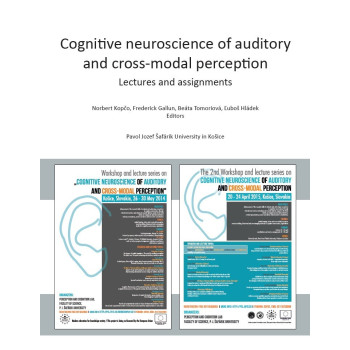
Cognitive neuroscience of auditory and cross-modal perception - Lectures and assignments

Cognitive neuroscience of auditory and...

E-book

Norbert Kopčo - Frederick Gallun - Beáta Tomoriová - Ľuboš Hládek(eds.)

Cognitive neuroscience is a fast developing scientific field which aims at uncovering the neural basis of human perception and cognition. To achieve this goal, cognitive neuroscience uses a variety of tools and approaches ranging from non-invasive brain imaging to psychophysics and neural modeling. Mastering such tools requires skills and knowledge from multiple scientific domains, including neurophysiology, cognitive psychology, and several computational fields.

Access on request via email: kogneuro (@) gmail.com

http://pcl.upjs.sk/workshopcd 

https://sites.google.com/site/kogneuro/

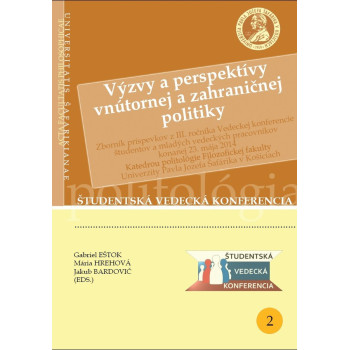
Výzvy a perspektívy vnútornej a zahraničnej politiky

Výzvy a perspektívy vnútornej a zahraničnej...

E-book

E-book

Gabriel Eštok- Mária Hrehová- Jakub Bardovič (eds.)

Proceedings of the 3rd Annual Scientific Conference of Students and Young Researchers held on May 23, 2014, by the Department of Political Science, Faculty of Arts, Pavol Jozef Šafárik University in Košice

On May 23, 2014, the Department of Political Science at the Faculty of Arts, Pavol Jozef Šafárik University in Košice hosted a conference entitled “Challenges and Perspectives of Domestic and Foreign Policy.” This was the third conference for students and young researchers organized by the Department of Political Science in cooperation with the civic association Res Publica. The event featured numerous young people interested in contemporary political issues, each presenting on a topic related to domestic or foreign policy. It can be stated that these presentations were of a high professional standard and stimulated discussion on the topics and problems raised.

The publication you are holding is a collection of scholarly works by students and young experts who focused on a variety of subjects. Some authors addressed issues of foreign policy, particularly the analysis of selected countries’ policies (Slovak Republic, USA), examined the Iranian nuclear program, or explored the possibilities of federalizing Ukraine as a solution to the emerging situation. Another contribution offered a perspective on foreign policy from the viewpoint of Slovak emigrants in Australia. Despite the wide range of topics addressed in the individual contributions, a common denominator can be found: the effort to highlight a particular problem or propose its solution, thereby contributing to the fulfillment of the ideal of democracy, the improvement of policy-making and functioning, and, above all, making the world a better place for all of us.

Editors

Download the e-book for free(pdf)

This website uses cookies to ensure you get the best experience on our website