Filter By

Categories

Categories

Year of publication:

Year of publication:

Publication language:

Publication language:

Faculty:

Faculty:

UPJŠ Unit

UPJŠ Unit

Method of publication:

Method of publication:

Active filters

  • Year of publication:: 2024
  • Year of publication:: 2024
  • Year of publication:: 2024
  • Year of publication:: 2024
  • Year of publication:: 2025
  • Year of publication:: 2025
  • Publication language:: English
  • Method of publication:: E-book (pdf)
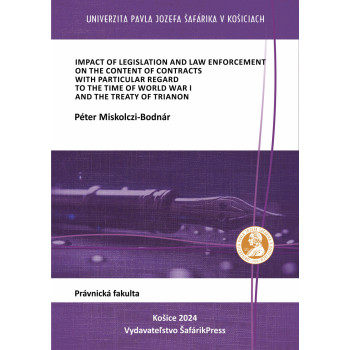
Impact of legislation and law enforcement  on the content of contracts with particular regard to  the time of World War I ...

Impact of legislation and law enforcement on...

E-book

E-book

Péter Miskolczi Bodnár

This monograph examines when the state has the right to intervene in the legal relationship between contracting parties, and if it is possible, when it can act as a legislator and/or a law applier and what the nature of the intervention may be. In this study, the limits related to the rights and obligations of the parties are scrutinized. The monograph delineates the theoretical frameworks of state intervention. The author distinguishes the forms of intervention concerning future contracts and those already concluded. The study lists the circumstances grounding the mandatory norms concerning future contracts with the presentation of Roman law. In the context of state influence on the content of contracts already concluded, judicial decisions play a stronger role than legislation and government measures also appear. The monograph presents the legislative measures affecting the contracts already concluded and the reasons thereof in a differentiated way, divided into different periods. In the author's view, World War I and especially the subsequent Treaty of Trianon brought a significant change in the assessment of state intervention, and therefore, he devotes special attention to the examination of this period. The monograph provides an outline of overview of the international tendencies of the period from the peace treaty to the present day. The study presents the era of Hungarian legislation being prone to make mandatory rules and delineates the relevant provisions of the applicable Hungarian law. At the end of the monograph the reader can find the author’s evaluative comments. While acknowledging the positive aspects of state involvement, attention should also be paid to the dangers of excessive state intervention in Eastern Europe.

Download e-book for free (pdf)

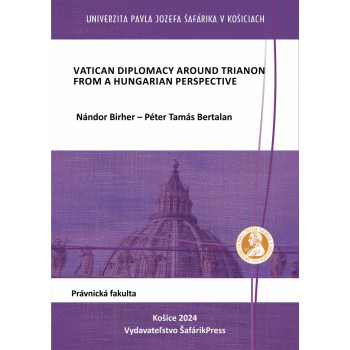
Vatican diplomacy around Trianon from a Hungarian Perspective

Vatican diplomacy around Trianon from a...

E-book

E-book

Nándor Birher-Péter Tamás Bertalan

The document, titled "Vatican Diplomacy Around Trianon from a Hungarian Perspective," is a scholarly work that examines the geopolitical and ecclesiastical changes in East-Central Europe after the Treaty of Trianon in 1920, with a focus on the role of the Vatican. The book explores the interactions between the Vatican and the reshaped geopolitical landscape, emphasizing the influence of religious and ecclesiastical issues on international relations. The monograph posits that Central Europe is not merely a geographic or economic concept but a "spiritual kingdom" with a shared destiny shaped by interdependence and cultural achievements, despite its history of conflicts. Central Europe's rich intellectual and cultural heritage, deeply influenced by religious convictions and Vatican diplomacy, continues to impact the region's identity and unity. The book suggests that the lessons from the early 20th century, including the Trianon Peace Treaty and subsequent geopolitical shifts, are still relevant in understanding the contemporary political and cultural dynamics of Central Europe. The authors encourage readers to reflect on the past and consider how historical events and decisions have shaped present-day Central Europe. The book aims to provide insights into the region's complex history and its ongoing struggle to find its place in the broader European and global context.

Download e-book for free (pdf)

The XIV. European Magnetic Sensors and Actuators Conference – EMSA2024 - Book of Abstracts

The XIV. European Magnetic Sensors and...

E-book

E-book

Jozef Bednarčík (ed.)

The European Magnetic Sensors and Actuators Conference (EMSA) is a consolidated European forum that serves to assess the status, recent progress, and development in the field of magnetic sensor technology and magnetic actuators. It was first held in 1996 in Iasi (Romania) and since then has continued every two-three years in different European cities. The aim of the conference is to generate an overview of research in magnetic sensors and actuators, to recognize their relevance in modern industry and to identify potential future collaborations. EMSA 2024 will provide an excellent opportunity to bring together scientists and engineers from universities, research institutes and industry to present and discuss their most recent results covering both fundamental and applied aspects of magnetic sensors and actuators.

Download e-book for free (pdf)

Student scientific international conference  “GenICa”. BOOK OF ABSTRACTS

Student scientific international conference...

E-book

E-book

Martina Šemeláková (ed.)

Proceedings contain abstracts from participants of the scientific conference with international participation under the name: Student scientific international conference GenICa”, supported by the project "Bilateral relations and common knowledge between Slovakia and Iceland research at Universities on the topic "Genomic instability and cancer "GenICa", funded under the EEA and Norwegian 2014-2021 Financial Mechanism Programme (FBR02, bilateral initiatives under the Fund for Bilateral Relations at national level co-financed by EEA and Norwegian Financial Mechanism 2014-2021) which took place on 19 - 21 June 2024 in the premises of Hotel Sorea Trigan, Štrbské Pleso, Slovakia.

Download e-book for free (pdf)

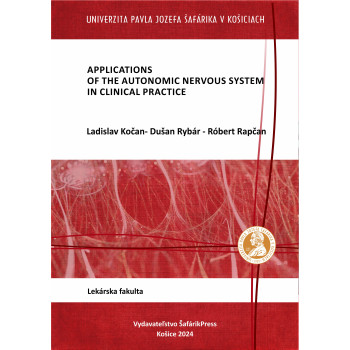
Applications of the Autonomic Nervous System in Clinical Practice

Applications of the Autonomic Nervous System in...

E-book

E-book

Ladislav Kočan - Dušan Rybár - Róbert Rapčan

The autonomic nervous system is a vital component of the peripheral nervous system, responsible for maintaining homeostasis and regulating internal processes within the body. Unlike the voluntary control exerted by the central nervous system, the autonomic nervous system operates involuntarily, innervating smooth organs, vessels, skin glands, and even exerting some influence over skeletal muscles in connection with vegetative functions such as breathing, digestion, and the urinary and gonadal systems. Its impact extends crucially to the cardiac muscles of the heart and plays a significant role in endocrine and metabolic functions, thermoregulation, as well as emotional and behavioral responses, including adaptive reactions to stressors.

The aim of this publication is to provide a comprehensive and objective exploration of the anatomical and physiological intricacies of the autonomic nervous system, offering insights into its clinical applications. Within these pages, we meticulously delineate various interventional therapeutic procedures tailored to specific diagnoses related to the autonomic nervous system, aligning each intervention with the anatomical framework of the autonomic system. The efficacy of these procedures is evaluated based on the level of evidence, as per the current recommendations of Evidence-Based Medicine.

This publication is primarily crafted for fifth and sixth-year medical students and medical professionals specializing in anesthesiology, intensive care, and pain medicine. It serves as a valuable resource for gaining a deeper understanding of autonomic nervous system function and its clinical implications, facilitating informed decision-making in clinical practice.

Download the e-book for free (pdf)

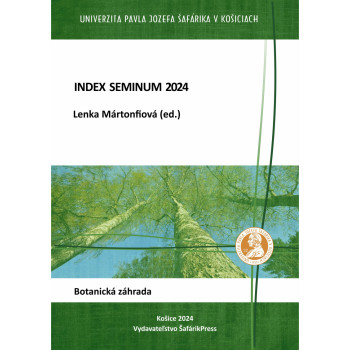
Index Seminum 2024

Index Seminum 2024

E-book

E-book

Lenka Mártonfiová (ed.)

The Index Seminum 2024 of the Botanical Garden of the Pavol Jozef Šafárik University contains a list of 260 seed samples offered for the international exchange among botanical gardens on the world. It includes seeds collected from the wild plants in natural localities of Slovakia with a detailed description of the localities with coordinates and date of collection (111 samples) and seeds of plants grown in the Botanical Garden (23 samples) and seeds from Exposition of the Tatra Mountain Nature of the State Forests of Tatra National Park, Tatranská Lomnica (64 samples) as well as 62 seed samples fromHrádocké Arboretum of the Secondary Forestry School of Jozef Dekret Matejovie in Liptovský Hrádok. The index includes a desiderata table that can be used when ordering seeds.

Download e-book for free (pdf)

This website uses cookies to ensure you get the best experience on our website