Filter By

Categories

Categories

Year of publication:

Year of publication:

Publication language:

Publication language:

Faculty:

Faculty:

Method of publication:

Method of publication:

Active filters

  • Year of publication:: 2023
  • Year of publication:: 2023
  • Year of publication:: 2023
  • Year of publication:: 2023
  • Year of publication:: 2024
  • Year of publication:: 2024
  • Year of publication:: 2024
  • Year of publication:: 2024
  • Year of publication:: 2024
  • Faculty:: Faculty of Arts
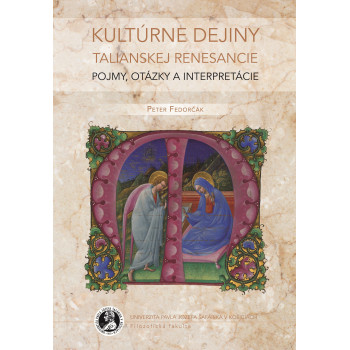
Kultúrne dejiny talianskej renesancie: Pojmy, otázky a interpretácie

Kultúrne dejiny talianskej renesancie: Pojmy,...

E-book

E-bool

Peter Fedorčák

When studying the Renaissance, researchers utilize various critical and core terms and concepts which it is necessary to characterize.

However, many such points, notably the following, are problematic: The relationship between the Renaissance and the antiquity; The connection with the Middle Ages; The transformation to Mannerism and Baroque; Realism and Secularism in Renaissance art; The individualism of the Renaissance artist; The reasons for the creation of Renaissance art in Italy, its determinants and stimulators; Distinguishing between the analysis of the genesis of the Renaissance and the analysis of the creation of the period’s art generally; Regional differences in Italy and their impact on the art; Chronological limits of the Renaissance and its milestones; The terms “Medieval Ages” and “Early Modern Period”; The impact, and its extent, of the artistic influences of the Byzantine, Gothic and Romanesque arts on the Renaissance. The term “Renaissance” itself, its content and existence, are also the subject of the discussion with students, alongside learning how such terms and definitions came about and continue to evolve, how they attain their content, how this content morphs in the historical discourse, what academical pluralism and freedom of thinking look like in the discourse led by historians, what the differences are between scientists and schools of thought on the same subject and how it is possible that they are so numerous.

The students will come to recognize the leading scholars in the field, and follow their arguments and methodological approaches. They shall be invited to closely trace and scrutinize the logic which those historians use in building their argumentation. It shall be seen that the freedom to create terms, concepts and new definitions cannot stand on an ignorance of the (historical) facts, as becomes clear with expanding knowledge of those historical facts, the variability of their interpretation growing in tandem. This approach, actually used across the whole range of seminars and lectures, shall drive discussion on the topics covered, students being invited to formulate their own theses and antitheses.
Download the e-book for free  (pdf)

Doktorandské miscelaneá 8

Doktorandské miscelaneá 8

E-book

Lukáš Šutor

Currently, the eighth issue of the Doctoral Miscellanea consists of thirteen contributions from four study programs. The publication of these contributions is traditionally associated with the Autumn School for Doctoral Students at the Faculty of Arts of UPJŠ in Košice, where third-cycle students have the opportunity to first try out the conference format of presenting their research results and subsequently expand them into full studies.

Unlike last year, when the proceedings were non-conference due to the pandemic situation, we consider the return to plenary dialogue beneficial. A distinctive feature of our proceedings is its multidisciplinary nature, encompassing humanities and social science fields. Despite this diversity, interesting connections often emerge among the topics, relating to generational reassessments of regularly recurring issues as well as research on highly current phenomena.

Download the e-book for free (pdf)

Študentská vedecká konferencia XI.

Študentská vedecká konferencia XI.

E-book

E-book

Mikuláš Jančura - Maroš Melichárek (eds.)

The textbook is derived from the outcomes of the eleventh annual student scientific conference, which took place in December 2022.

The student scientific conference is an integral component of the curriculum within the Department of History at the Faculty of Arts, UPJŠ, and has been implemented since 2011. Its primary objective is to provide a platform for Bachelor's and Master's degree students to present segments of their original research as part of their thesis development.

The purpose of this textbook extends beyond the mere publication of these diverse thematic texts. It also strives to emphasize the significance of exceptional pedagogical initiatives and the added value of university education for students, manifested through the dissemination of their scholarly output.

Download the e-book for free  (pdf)

Truth vs. Post-Truth. „It is not true, but it could be.”

Truth vs. Post-Truth. „It is not true, but it...

E-book

E-book

Michaela Ružičková - Patrik Furik - Lukáš Jakabovič (eds.)

The collection of articles from the XI. International Scientific Conference for Students and Young Scientists, organized by the Department of Political Science of the Faculty of Arts of the Pavol Jozef Šafárik University in Košice, in cooperation with the Res Publica Civic Association, the Department of Security Studies of the Faculty of Political Science and International Relations of the Matej Bel University in Banská Bystrica, Institute of Political Sciences and Administration, Faculty of Political Science and Journalism, Marie Curie-Sklodowska University in Lublin, Institute of Social Studies, Faculty of Regional Development and International Studies, Mendel University in Brno, and the Department of Political Science, Faculty of Arts, University of Miskolc, held on 20 May 2022 in Košice.

The aim of this publication, entitled Truth vs. Post-Truth. „It is not true, but it could be.”, is to highlight the threats arising from the issue of the spread of disinformation, conspiracies and hoaxes today, reflecting not only on the national context, but also on the impact of these elements in the international environment.

The proceedings consist of 12 articles written in Slovak and English. The individual contributions deal with selected topics and aspects of the spread of disinformation, conspiracy theories or hoaxes, among others in the context of elections, media landscape and politics.

The topics of the contributions are the limits of freedom of expression, media freedom and regulation in the media space, the issue of propaganda or information warfare. The present volume also includes papers focusing on issues in the field of political ideologies or the issue of false narratives about the COVID-19 disease.

Download the e-book for free  (pdf)

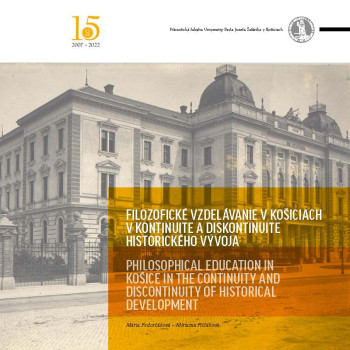
Philosophical Education in Košice in the Continuity and Discontinuity of Historical Development

Philosophical Education in Košice in the...

E-book

E-book

Mária Fedorčáková - Miriama Filčáková

Current publication is dealing with the history of philosophical education in Košice since the beginning to the foundation of the Faculty of Arts at Pavol Jozef Šafárik University in Košice in 2007. Beginnings of philosophical education in Košice are connected to the fundation of the University of Košice in 1657, which was originally founded as Jesuit university with two faculties – Faculty of Theology and Faculy of Arts.

The publication is dealing with the philosophy teaching in the Faculty of Arts and examines the philosophy teachers and students. Another interest is given to decline of philosophy teaching caused by transformation of the University into the Royal Academy and the Academy of Law at the end of the 18 and during 19 century. The second part of the publication is dealing with the history of higher education after the second world war and the foundation of the University of Pavol Jozef Šafárik in Košice.

The authoress focuses on circumstances of the foundation of the Faculty of Arts in Prešov and its history and later development after 1989, which included also division of the university in 1997. The last part of publication presents the history of the university buildings, in which the Faculty of Arts is situated.

Download the e-book for free  (pdf)

This website uses cookies to ensure you get the best experience on our website