Filter By

Categories

Categories

Selections

Selections

Year of publication:

Year of publication:

Publication language:

Publication language:

Faculty:

Faculty:

Method of publication:

Method of publication:

Active filters

  • Year of publication:: 2013
  • Year of publication:: 2015
  • Year of publication:: 2020
  • Year of publication:: 2026
  • Year of publication:: 2026
  • Year of publication:: 2026
  • Faculty:: Prírodovedecká fakulta
  • Faculty:: Prírodovedecká fakulta
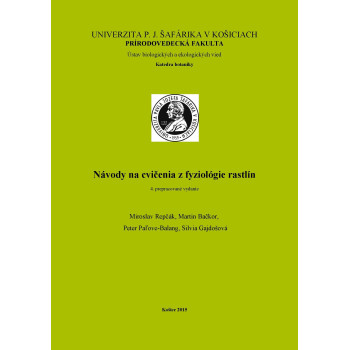
Návody na cvičenia z fyziológie rastlín

Návody na cvičenia z fyziológie rastlín

E-book

E-book

Miroslav Repčák - Martin Bačkor - Peter Paľove-Balang - Silvia Gajdošová

The establishment of the Plant Physiology Laboratory at the Department of Botany, Faculty of Arts, Pavol Jozef Šafárik University in Košice in 1969 was associated with the name of Ing. Štefan Kocúrik, CSc. (1923–2006), who also prepared the first "Instructions for Exercises in Plant Physiology" (Košice 1972, 1976).

Since 1980, the manual by Associate Professor RNDr. Karol Erdelský, CSc., and Ing. Fridrich Frič, DrSc., titled "Practicum and Analytical Methods in Plant Physiology" (Bratislava 1980) has been used. With the increase in the number of students, it became relevant in 1991 to publish the "Instructions for Exercises in Plant Physiology" again to improve preparation and the efficient organization of practical work. Associate Professor RNDr. A. Košturiak, CSc., contributed significantly to the expansion of the introductory part of the instructions with his valuable advice, for which the authors are grateful. For the fourth edition, some tasks were updated and modernized, taking into account the possibilities of the renovated laboratory. The selection of tasks was adapted to the current scope of exercises for individual plant physiology subjects within the bachelor's and master's study programs in biology and ecology. These subjects include: Plant Physiology, Plant Metabolism, Mineral Nutrition of Plants, Plant Growth and Development, and Plant Ecology. Some tasks are also suitable for high school experiments.

The choice of topics was influenced by the research focus of our workplace on secondary metabolism, ecophysiology, and medicinal plants. The instructions generally adhere to the SI unit system, occasionally including other commonly used units.
Download the e-book for free (pdf)

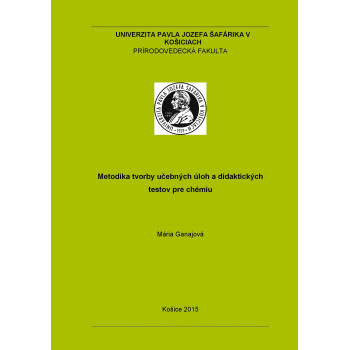
Metodika tvorby učebných úloh a didaktických testov pre chémiu

Metodika tvorby učebných úloh a didaktických...

E-book

E-book

Mária Ganajová

The current teaching of chemistry has its specific problems. On one hand, due to the shift of the focus of chemistry curriculum towards theoretical content, the difficulty of chemistry material has increased, and in connection with this, students' interest in chemistry has decreased.

The lack of student interest in chemistry is mostly supported by the opinion that it is precisely chemistry that significantly contributes to the deterioration of environmental quality. On the other hand, we live in an era where we encounter chemical products practically everywhere. It is necessary to learn the basics of chemistry as well as possible, which makes the question of increasing interest in chemistry education and improving its effectiveness very relevant. State educational programs have been introduced into Slovak schools as a foundation for the creation of school educational programs. These emphasize not only acquiring a certain amount of knowledge but also the development and enhancement of key and specific competencies of students, preparing them for lifelong learning and their application in life.

Therefore, increasing attention is being paid to one of the fundamental didactic tools for raising student activity in teaching, and thus improving the effectiveness of chemistry education – learning tasks. From both theory and practice of chemistry teaching, we know that learning tasks, questions, examples, exercises, etc., are among the important components of every teaching lesson. Learning tasks are applied in all phases of teaching – in the motivational phase, the phase of acquiring knowledge, the phase of consolidating knowledge, and the phase of checking the acquired knowledge. It is therefore clear that every teacher will sooner or later find themselves in a situation where they will have to select learning tasks from textbooks, workbooks, collections of problems and examples, or create them themselves.

This scientific monograph is intended for educational specialists and chemistry teachers, aiming to familiarize them with examples of various types and forms of learning tasks and the basics of their creation in chemistry. It can also be helpful for them in preparing certification works focused on test creation and their statistical evaluation.

Download the e-book for free (pdf)

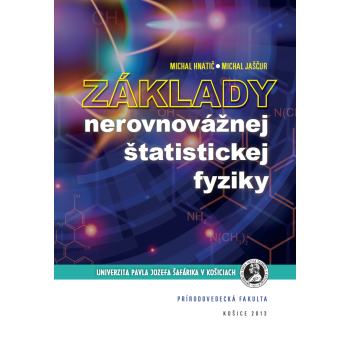
Foundations of nonequilibrium statistical physics

Foundations of nonequilibrium statistical physics

€29.22
Availability: 10 In Stock

Michal Jaščur -Michal Hnatič

In the textbook, the processes belonging to an area of  nonequilibrium physics, which make the basis for the study and analysis of compex phenomena  of statistical mechanics, are described. The Boltzmann equation for distribution function is derived and on this basis the hydrodynamic equations are constructed.  Stochastic processes are described separately and Fokker-Planck equation for density probability  is derived. Textbook is intended for the students of second year of master study at Faculty of Science of P. J. Šafarik University.   

Autors

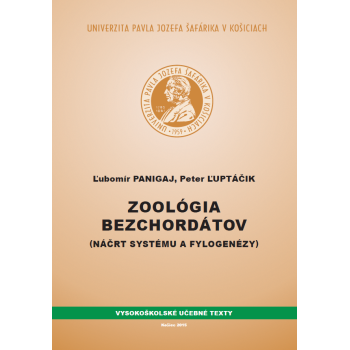
Zoológia bezchordátov

Zoológia bezchordátov

€9.12
Availability: 120 In Stock

 Ľubomír Panigaj - Peter Ľuptáčik 

(Náčrt systému a fylogenézy)

Učebný text je primárne určený pre študentov jednoodborového štúdia biológie a všeobecnej ekológie, ako aj odborom učiteľského štúdia v rôznych kombináciách s biológiou. Venuje sa v nich opisu jednotlivých skupín živočíchov, ich morfológiu a anatómiu ilustruje na obrazových materiáloch. K jednotlivým morfologickým a anatomickým štruktúram sa v texte nevyjadrujeme podrobnejšie, nakoľko text nadväzuje na predmet Porovnávacia morfológia živočíchov, kde na úrovni organológie boli tieto najvýznamnejšie štruktúry v rámci prednášok a cvičení detailne vysvetlené a opísané. Rozsah učebného textu nie je veľký, podávame v ňom základné minimum poznatkov, čo je podmienené jednak rozsahom predmetu, ktorý je len jednosemestrový, jednak tým, že ďalšie, špecializované predmety rozširujú spektrum poznatkov napr. na úrovni entomológie, hydrobiológie alebo pôdnej biológie. V zavere niektorých kapitol formulujeme niekoľko cvičných otázok, ktoré si študenti môžu na základe predchádzajúceho textu zodpovedať, s podobnými otázkami sa totiž môžu stretnúť na skúške alebo na štátniciach.

Autori

This website uses cookies to ensure you get the best experience on our website