Filter By

Year of publication:

Year of publication:

Publication language:

Publication language:

Active filters

  • Year of publication:: 2013
  • Year of publication:: 2020
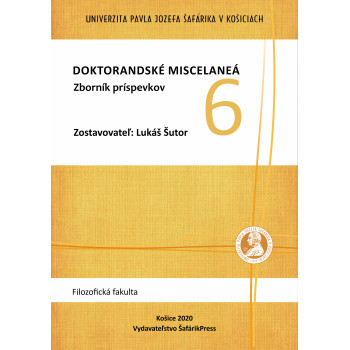
Doktorandské miscelaneá 6

Doktorandské miscelaneá 6

E-book

E-book

Lukáš Šutor (ed.)

The current sixth volume of the Doctoral Miscellanea consists of eight contributions from four study programs, with two contributions also involving authors outside of doctoral studies. Given the limitations on the length of individual contributions and the uniqueness of the research, the authors have chosen varying widths and depths in presenting their dissertation topics. Some contributions serve as an introduction to the issues, others provide a summary of previous results, and still others focus on a detailed analysis of a specific problem. These three approaches may not only reveal the stage of research in which the doctoral candidate finds themselves but also their potential research priorities.

The main commonality across all issues of the proceedings remains interdisciplinary diversity, which shows a certain continuity. Specific themes appear regularly. In these cases, alongside alternating doctoral candidates, the key figure is the supervisor (in the role of co-author) and their research focus/project in which the doctoral candidates participate. This development of research continuity is particularly evident in contributions from the field of social work.
Download the e-book for free  (pdf)

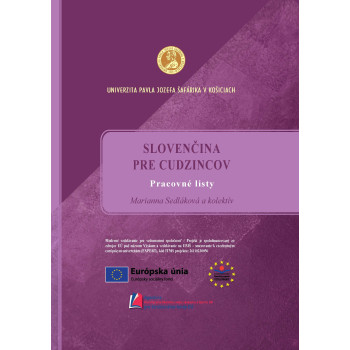
Slovenčina pre cudzincov (Pracovné listy)

Slovenčina pre cudzincov (Pracovné listy)

E-book

E-book

Marianna Sedláková a kol. 

The worksheets, based on the direct specific needs of teaching medical students in Košice, respect the real situation of teaching Slovak as a foreign language at UPJŠ.

They also reflect the relatively high number of Slavic students, especially from neighboring countries, who, although just beginning with the Slovak language, are at a higher communicative level compared to students from non-Slavic countries. Therefore, a special part of the worksheets with exercises is dedicated to them, which includes special exercises and dictionaries aimed at eliminating Slovak-Polish or Slovak-Ukrainian interference phenomena. Since some non-Slavic students come from the Czech language environment, we also add a glossary of the most common different expressions in Slovak, Czech, and, for the aforementioned reasons, Polish and Ukrainian. In the part intended for all students, both Slavic and non-Slavic, communicatively focused exercises for practicing grammatical phenomena predominantly at the A1 and A2 communication skill levels (according to the Common European Framework of Reference) prevail, and last but not least, exercises thematically focused on medicine and healthcare.

The texts from the thematic area are, of course, supplemented with realia of the city of Košice. As a functional supplement in the working material, we also publish test samples.

Download the e-book for free (pdf)

This website uses cookies to ensure you get the best experience on our website