Filter By

Year of publication:

Year of publication:

Publication language:

Publication language:

Active filters

  • Publication language:: English
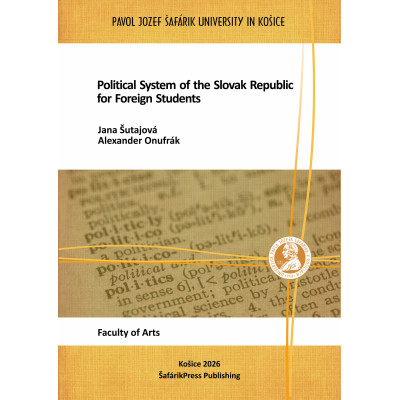
Political System of the Slovak Republic for Foreign Students

Political System of the Slovak Republic for...

E-book

E-book

Jana Šutajová Alexander Onufrák

This university textbook, „Political System of the Slovak Republic for Foreign Students“, is designed to introduce Erasmus students and other international students to basic information regarding the historical and political development of Slovakia and the political system of the Slovak Republic. It focuses on political developments since 1918.

It introduces foreign students to pivotal historical events that influenced political developments in Slovakia (the establishment of the First Czechoslovak Republic, the Munich Agreement and the Vienna Arbitration, the Slovak State, postwar developments and the Košice Government Program, the 1946 elections, February 1948, the Prague Spring of 1968, normalization, the Velvet Revolution of 1989, the dissolution of the Czechoslovak Federal Republic, the establishment of the Slovak Republic, and its integration into the European Union and the North Atlantic Treaty Organization) and with the political system of the Slovak Republic (constitutional institutions, the party system, the electoral system). 
Download the e-book for free (pdf)

Research Into Correlations Between Deformations of Political Awareness...

Research Into Correlations Between Deformations...

E-book

E-book

Marcela Gbúrová - Daniel Dobiaš - Jana Šutajová - Gabriel Eštok - Ján Ruman - Tomáš Dvorský

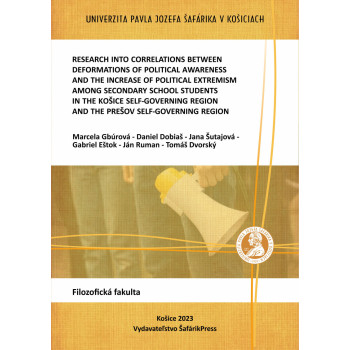
Research Into Correlations Between Deformations of Political Awareness and the Increase of Political Extremism Among Secondary School Students in the Košice Self-governing Region and the Prešov.

Self-governing Region The issue of political extremism has a relatively long research period, and it should be emphasised that, especially in the recent period, it has received increased attention in the political science community not just in Slovakia but also abroad. Given the specifics of this anti-democratic form of political discourse, which has not only explicit forms, but also highly sophisticated manifestations against democracy (extremism of the centre, or centrist extremism), it is also addressed by experts of other humanities and social disciplines: history, psychology, anthropology, sociology, etc.

The common interest of this professional community is both to analyse different forms of extremist discourses and narratives, to search for national specificities of extremism that are anchored in their historical, social and cultural contexts, but at the same time to reveal transnational extremist influences within a globalizing world and to propose evidence-based strategies to counter extremist discourses.

Download e-book for free (pdf)

Myths and Manipulation in Political Discourse

Myths and Manipulation in Political Discourse

E-book

E-book

Jaroslav Marcin - Viktória Marcinová a kol.

This little book started out in a way that probably many other scholarly publications do: When the five of us met as doctoral students and instructors in the Department of British and American Studies, we soon realized that our research overlapped on a number of points. Most prominent among those was our interest in political or politicallymotivated discourse and the study of myths and manipulation that it employed. 

In the end, we decided to pool the results of our research together in order to create a more complex picture, providing a variety of perspectives and voices. In our endeavor, we were greatly aided by the financial support we received from a grant offered by the Šafárik University. The outcome of these efforts is the five chapters of this brief, but hopefully informative and insightful monograph.

In Chapter 1, Viktória Marcinová deals with the impact of totalitarian ideology on the translation of so-called “capitalist” drama during the first stage of normalization in Slovakia (1948-1968). In Chapter 2, the focus shifts to political discourse and manipulation in a democracy, as Jaroslav Marcin takes a closer look at the wartime rhetoric of American presidents. USA remains the focus also in Chapter 3, but this time the question, addressed by Martina Martausová, will be one of the myth of the American Dream and its presentation in post-9/11 United States. A similar idea, though in a different geographical-cultural context, is dealt with in Chapter 4, where Božena Velebná identifies myths of Scottish identity as portrayed in historic films. Finally, in Chapter 5, Eduard Soták will take a look at the role of the mass media within the topic of politically-motivated discourse and spread of political ideology.

Download the e-book for free (pdf)

This website uses cookies to ensure you get the best experience on our website