Filter By

Year of publication:

Year of publication:

Faculty:

Faculty:

Active filters

  • Year of publication:: 2019
  • Year of publication:: 2019
  • Year of publication:: 2025
  • Year of publication:: 2025
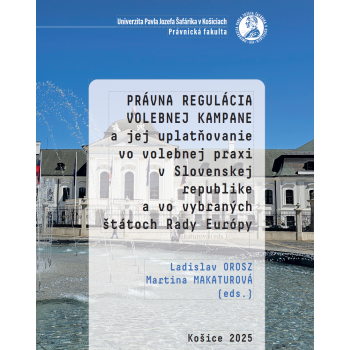
Právna regulácia volebnej kampane a jej uplatňovanie vo volebnej praxi v SR a vo vybraných štátoch Rady Európy (2025))

Právna regulácia volebnej kampane a jej...

E-book

E-book

Ladislav Orosz, Martina Makaturová

This scientific volume has been published as an output of the VEGA grant project No. 1/0474/24 Audit of Slovak Electoral and Referendum Legislation. Thematically, it focuses on the issue of the legal regulation of election campaigns and a critical analysis of the experience of its application in electoral practice. On this basis, the authors also formulate proposals for improving the current legal framework of election campaigns.

The proceedings include contributions presented at the scientific conference of the same name held in May 2025. The volume contains papers not only from domestic but also from foreign authors, who present the legal regulation of election campaigns in their respective home countries. Contributions from academics are complemented and enriched by those of representatives of non-governmental organizations engaged in election and campaign monitoring, as well as by contributions from authors working in public authorities responsible for the administration of elections and for overseeing the constitutionality and legality of elections.

Download the e-book for free (pdf)

Konanie o súlade právnych predpisov – návrhové oprávnenie a účinky rozhodnutí ústavného súdu. XIII.ústavné dni

Konanie o súlade právnych predpisov – návrhové...

E-book

E-book

Ladislav OroszSimona KarafováMartina Makaturová (eds.)

Zborník z XIII. ústavných dní s názvom „Konanie o súlade právnych predpisov – návrhové oprávnenie a účinky rozhodnutí ústavného súdu“ reflektuje novú právnu úpravu účinnú od 1. januára 2025, konkrétne čl. 127 ods. 5 Ústavy SR, ktorá rozširuje právomoci sťažovateľov iniciovať konanie o súlade právnych predpisov prostredníctvom Ústavného súdu Slovenskej republiky. Príspevky renomovaných odborníkov mapujú teoretické aj praktické výzvy spojené s touto novou kompetenciou. Zborník tematicky pokrýva otázky týkajúce sa iniciačných mechanizmov senátov Ústavného súdu, derogačných a časových účinkov rozhodnutí či komparatívnych skúseností z Českej republiky, Maďarska a Poľska. Publikácia zároveň ponúka reflexiu širších javov, ako je judicializácia politického života, či rast implicitných právomocí ústavných súdov. Niektoré príspevky sa zameriavajú na otázky právnej istoty a retroaktivity derogačných nálezov, najmä v konaniach iniciovaných všeobecnými súdmi. Iné analyzujú aplikačné dopady spojenia individuálnej ústavnej sťažnosti a abstraktnej kontroly právnych predpisov. Publikácia obsahuje aj úvahy o ústavnoprávnych dôsledkoch porušenia konzultačnej povinnosti s Európskou centrálnou bankou. Nechýbajú reflexie o možnostiach ústavného preskúmania noriem v oblasti rozpočtovej zodpovednosti. Zborník ponúka pestrú škálu domácich aj komparatívnych prístupov k výzvam spojeným s novou rozhodovacou agendou. Je tak hodnotným príspevkom do diskusie o posilnení ochrany ústavnosti v Slovenskej republike.

Download the e-book for free (pdf)

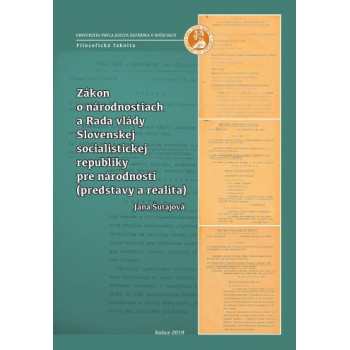
Zákon o národnostiach a Rada vlády Slovenskej socialistickej republiky pre národnosti (predstavy a realita)

Zákon o národnostiach a Rada vlády Slovenskej...

E-book

E-book

Jana Šutajová

From January 1, 1969, the Constitutional Act on the Status of Nationalities in the Czechoslovak Socialist Republic (ČSSR) and the Constitutional Act on the Federation came into effect. The Constitutional Act on the Status of Nationalities represented at least a formal significant step forward in the legal regulation of minority rights. However, this law was intended to serve as a foundation for further legal adjustments. It was declared that additional steps and negotiations for the adoption of implementing regulations would follow and that further laws would be enacted at both the federal and national levels. Nevertheless, no additional law or government regulation related to the constitutional act on the status of nationalities in the ČSSR was ever issued.

During the normalization period, issues concerning further legislation related to national minorities were not addressed. However, in the brief period following the adoption of the constitutional act in 1968 until the end of 1969, some institutions attempted to prepare and promote such legal norms. One of these institutions was the Government Council of the Slovak Socialist Republic (SSR) for Nationalities (hereafter referred to as the Council or the Government Council for Nationalities). The monograph provides an insight into the development of additional legal norms arising from the constitutional act on the status of nationalities in the Slovak Socialist Republic, prepared by the Government Council of SSR for Nationalities. This council was one of the institutions established in Slovakia after the formation of the Czechoslovak federation and dealt with nationality issues.

In addressing further legal norms stemming from the constitutional act on nationalities in ČSSR, it was necessary to consider prior developments. Therefore, the first part of the monograph examines the status of minorities in Czechoslovakia before adopting the constitutional act, activities of nationalities preceding its adoption, and its enactment itself. Subsequent sections focus on institutional changes in SSR following federalization, the establishment of the Government Council of SSR for Nationalities, and specific actions taken by this Council and its expert bodies in drafting proposals for laws concerning nationalities in the Slovak Socialist Republic.

The motivation for writing this monograph stemmed from the fact that this topic has so far received attention only in a few studies in Slovakia, which primarily focused on the Hungarian minority during either the Prague Spring or normalization periods.

Download the e-book for free (pdf)

Právny jazyk v aplikačnej praxi

Právny jazyk v aplikačnej praxi

E-book

E-book

Marcel Dolobáč - Ľuboš Dobrovič (eds.)

Reviewed Proceedings of Contributions from a Scientific Conference

This reviewed collection of contributions from the scientific e-conference Legal Language in Application Practice, held from December 3 to 21, 2018, presents various academic contributions.

Legal language, as expressed in legal norms, is specific and should ideally be unambiguous, concise, and resistant to multiple interpretations. Is this an ideal world that does not exist but is worth striving for? Interpretative challenges and ambiguities in legal language and terminology (especially in the Labour Code) led the Department of Labour Law and Social Security Law at UPJŠ in Košice to undertake the VEGA grant project No. 1/0526/17 titled Linguistic and Sanction Mechanisms in the Creation and Operation of Labour Law Norms.

As part of this grant project, the department organized an e-conference open not only to labor law specialists but also to experts from other legal fields. Unsurprisingly, interpretative issues extend beyond labor law. The contributions in this collection are thus somewhat interdisciplinary, though with a focus on labor law. We hope this collection serves as an introduction to broader research and deeper study of legal language by experts beyond legal theory. Additionally, we trust these contributions will inspire you, the readers.

Authors

Download the e-book for free  (pdf)

This website uses cookies to ensure you get the best experience on our website