Filter By

Year of publication:

Year of publication:

Active filters

  • Year of publication:: 2013
  • Year of publication:: 2016
  • Year of publication:: 2021
  • Year of publication:: 2022
  • Publication language:: Slovak
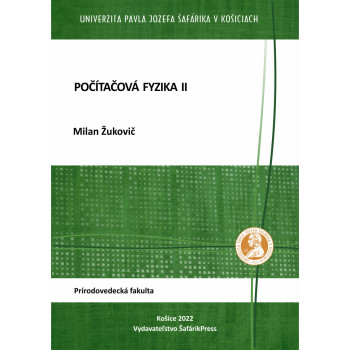
Počítačová fyzika II

Počítačová fyzika II

E-book

E-book

Milan Žukovič

This textbook is intended for master's degree students and is a follow-up to the Computational Physics I course studied at the bachelor's level. The content of the textbook Computational Physics II focuses on stochastic methods of solving physical problems, mainly on Monte Carlo (MC) simulation of many-particle systems.

The focus on this computationally intensive approach is motivated by the gradual increase in the computing capacities of ordinary computers as well as the introduction of high-performance computing clusters. This has led to significant progress in the development of new simulation techniques, thanks to which MC simulations have found application in various areas of research and application practice. Considering the main research focus of the department, this text is particularly devoted to the presentation of basic and more advanced MC simulation techniques applied to a simple Ising spin model in order to investigate its magnetic, thermodynamic and critical properties.

The next part is devoted to MC simulations of random processes. It focuses on the simplest but also the most basic random walk process and demonstrates its applications in financial analysis and the solution of a quantum system described by the time-dependent Schrödinger equation. The last part is dedicated to the basics of molecular dynamics, applied to simulating the classical movement of atoms in a given force field. By mastering the problems addressed in this course, students will obtain a potential tool for working out of their diploma theses, or a methodology useful for their further scientific and research practice in the field of investigating of complex systems.

The lectured topic is subsequently exercised in the form of preparing projects implemented in the freely distributable software Octave, which is easy on the user's programming skills and which students have the opportunity to familiarize themselves with in the previous study.

Download e-book for free (pdf)
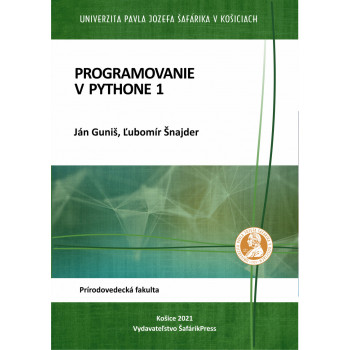
Programovanie v Pythone 1

Programovanie v Pythone 1

E-book

E-book

Ján GunišĽubomír Šnajder

Prílohy

College scripts Programming in Python 1 are intended for future teachers of computer science. The content of the course is related to the teaching of programming in Scratch and is an introduction to text-based programming in Python.

Programming is introduced as a means of developing problem-solving skills. The first chapter is devoted to problem solving. The next 12 chapters sequentially introduce basic language constructions, data structures, and selected types of algorithms. Each of these chapters begins with an introduction to the problem. This section is primarily intended for self-study, to prepare students for the exercises. The following subchapter summarizes and completes the knowledge, and additional insights and approaches related to the chapter topic are presented. The chapters include a collection of exercises designed to practice and deepen knowledge and skills on the topic.

The final part of the chapter presents the solved problems. This section serves as a guide to solving the problems in the collection.

i

Download the e-book for free (pdf)

Študentská vedecká konferencia PF UPJŠ 2013

Študentská vedecká konferencia PF UPJŠ 2013

E-book

E-book

Vladimír Zeleňák (ed.)

The publication contains abstracts of contributions presented at the Student Scientific Conference of the Faculty of Natural Sciences at UPJŠ in Košice, held on April 25, 2013. The event was marked by the celebration of the 50th anniversary of the Faculty of Natural Sciences at UPJŠ and was part of a series of events called ScienceFest.

Download the e-book for free (pdf)

Študentská vedecká konferencia PF UPJŠ 2016

Študentská vedecká konferencia PF UPJŠ 2016

E-book

E-book

Vladimír Zeleňák (ed.)

Proceedings of Abstracts of the Student Scientific Conference of the Faculty of Science, Pavol Jozef Šafárik University in Košice

A characteristic feature of education at high-quality universities — among which the Faculty of Science at Pavol Jozef Šafárik University (UPJŠ) in Košice proudly belongs — is the close connection between education and scientific research. Students gain knowledge in their field of study not only through theoretical coursework in individual disciplines, but also through active involvement in solving specific scientific tasks as part of research teams. This can occur during the development of final theses or through participation in the Student Research Assistant Program (ŠPVS), which was revitalized at the faculty in 2015.

The Student Scientific Conference (ŠVK) is one of the faculty’s traditional events, organized during the Faculty’s Science Days as part of Sciencefest. By its very nature, it fits seamlessly into the aforementioned framework of combining education with research, and it has long enjoyed great popularity and student interest. In 2016, the conference featured presentations by 125 students of the Faculty of Science at UPJŠ in Košice, across 16 thematic sections. This collection of abstracts provides an overview of the focus and goals of the student projects. We believe it will serve as inspiration for other potential participants of future conferences and will also be of interest to the broader public, offering additional insight into the faculty's activities.

Download the e-book for free (pdf)

Bádateľsky orientované vyučovanie matematiky a informatiky na stredných školách

Bádateľsky orientované vyučovanie matematiky a...

E-book

E-book

Stanislav Lukáč - Ľubomír Šnajder - Ján Guniš - Zuzana Ješková

The publication is intended for researchers in didactics and teachers of mathematics and computer science. Our aim is to provide readers with a basic orientation in the issue of inquiry-based teaching, to explain and demonstrate several levels of student inquiry through examples, and to offer a classification of inquiry skills.

The core part of the publication consists of methodologies for inquiry-based teaching of specific topics from school mathematics and computer science. We present ideas for implementing inquiry activities, active work with information in solving various types of problems, and the application of modern digital technologies in exploring and discovering patterns.

The publication includes seven methodologies for teaching mathematics and eight methodologies for teaching computer science in the 1st and 2nd years of secondary school.

Download the e-book for free (pdf)

Prílohy

This website uses cookies to ensure you get the best experience on our website