Filter By

Categories

Categories

Year of publication:

Year of publication:

Publication language:

Publication language:

Faculty:

Faculty:

Active filters

  • Categories: E-books
  • Categories: Science
  • Publication language:: Hungarian
  • Publication language:: slovenčina, poľština
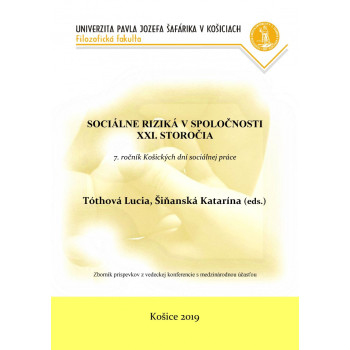
Sociálne riziká v spoločnosti XXI. storočia

Sociálne riziká v spoločnosti XXI. storočia

E-book

E-book

Lucia TóthováKatarína Šiňanská (eds.)

Proceedings of the scientific conference with international participation held on November 30, 2018, in Košice

Current social work addresses the serious development problems of society such as poverty, unemployment, chronic diseases, socially vulnerable groups and others. We must not forget that enough attention must be paid to the discovery of causes and a detailed analysis of these problems. The thing is that social problems have been around for a long time, they just changed their shape, old forms of social risks were replaced by the new ones that need to be explored and analyzed in order to be able to perform measures and remove the causes of social risks of the 21st century. Proceedings of the scientific conference with international participation entitled Social Risks in the Society of the XXI. Century is therefore devoted to various perspectives related to social risks of modern society in the variety of contributions, indicating the broad-spectrum not only of the proceedings, but also the social work itself.
Download the e-book for free (pdf)

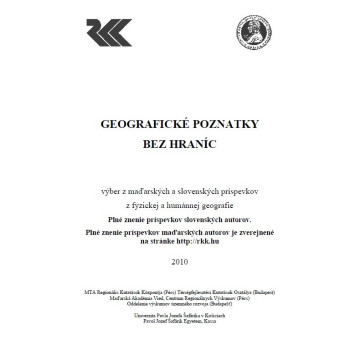
Geografické poznatky bez hraníc - výber z maďarských a slovenských príspevkov z fyzickej a humánnej geografie.

Geografické poznatky bez hraníc - výber z...

E-book

E-book

Dušan Barabas a kol.

The presented text is the final product of work within the project "Tanuljunk egymástól!/Let’s Learn from Each Other!" The project emerged from long-standing contacts between the staff of the Centre for Regional Studies of the Hungarian Academy of Sciences and the Institute of Geography at the Faculty of Science, Pavol Jozef Šafárik University in Košice, as a natural effort to expand mutual cooperation. The first step was collaboration within Interreg II projects, involving a broad range of institutions from both academic and non-academic environments. This initial attempt was unsuccessful due to administrative errors. Consequently, a project titled HUSK/0801/1.6.1/0003 "Tanuljunk egymástól!/Let’s Learn from Each Other!" was prepared and developed in agreement with the Hungarian side. It was approved and co-financed by the European Regional Development Fund under the Hungary-Slovakia Cross-Border Cooperation Program 2007–2013.

Download the e-book for free (pdf)

This website uses cookies to ensure you get the best experience on our website