Filter By

Categories

Categories

Year of publication:

Year of publication:

Publication language:

Publication language:

Faculty:

Faculty:

UPJŠ Unit

UPJŠ Unit

Method of publication:

Method of publication:

Active filters

  • Year of publication:: 2008
  • Year of publication:: 2012
  • Year of publication:: 2024
  • Year of publication:: 2024
  • Year of publication:: 2024
  • Year of publication:: 2024
  • Year of publication:: 2024
  • Year of publication:: 2024
  • Year of publication:: 2024
  • Year of publication:: 2024
  • Year of publication:: 2024
  • Year of publication:: 2024
  • Year of publication:: 2024
  • Year of publication:: 2024
  • Year of publication:: 2024
  • Year of publication:: 2024
  • Year of publication:: 2024
  • Year of publication:: 2024
  • Year of publication:: 2024
  • Method of publication:: E-book (pdf)
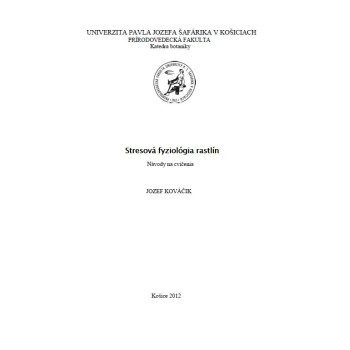
Stresová fyziológia rastlín - Návody na cvičenia

Stresová fyziológia rastlín - Návody na cvičenia

E-book

E-book

Jozef Kováčik

These "Exercise Manuals" present a concise overview of commonly used methodologies as well as progressive techniques, such as the use of liquid chromatography and fluorescence microscopy. Individual tasks were selected based on the research focus of the Department of Botany at the Faculty of Science, Pavol Jozef Šafárik University in Košice, particularly in the context of "stress physiology."

Some tasks can also be utilized within the subject "Plant Ecology." Chamomile (Matricaria chamomilla) is typically used as a model plant for individual tasks due to its long-standing history of research at the Department of Botany and its ease of cultivation under laboratory conditions. The chapters also briefly discuss the significance of monitored parameters, principles of their determination, and metabolism (formation or degradation), aiming to indicate their mutual context.

This approach highlights that determining an individual parameter cannot provide a general explanation for the overall causes and impacts of observed changes; however, it can serve as a basis for testing hypotheses at the level of other parameters.

For deeper study of specific issues, there is an abundance of high-quality international monographs and review articles available.
Download the e-book for free (pdf)

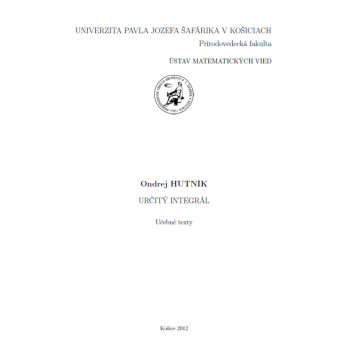
Určitý integrál

Určitý integrál

E-book

E-book

Ondrej Hutník

The concept of the integral is one of the most significant concepts in mathematics as a whole. In its most primitive form, it was already used by the ancient Greeks in the creation of Euclidean geometry. However, it was only after Descartes' work on analytical geometry in 1637 that mathematicians could begin to consider the integral as a subject of analysis. Descartes' work laid the groundwork for the discovery of infinitesimal calculus by Leibniz and Newton around 1665. At that time, a great dispute arose over the priority of this discovery, dividing scholars of Germany and England into two opposing camps, each favoring their own champion. Today, we know that Newton's work on fluxions and fluents was somewhat earlier, but Leibniz's notation and approach have gained more acceptance in the mathematical world, and the symbols ∫ ∫ and d d are still used today. A brief overview of the history of the integral will be presented in Chapter 1.

Today, there is a plethora of scripts, textbooks, and books dedicated to explaining the concept of the integral. Therefore, every potential author faces the initial question of whether to write another text on this topic. Our affirmative answer to this question was driven by the students' request to find the subject matter of a part of the winter semester of the second year presented in a coherent form. The second motivation is a slightly different approach to the topic. If we consider the methods typically used in solving problems and gaining routine with a certain integral, it mainly involves the Newton-Leibniz formula, and often there is little time left to compute the definite (Riemann) integral using its definition. Therefore, we included a discussion of the Newton integral in Chapter 2, which reflects this fact and is directly related to the indefinite integral, whose various calculation methods receive relatively much attention in the previous semester. Only after that, in Chapter 3, do we build the theory of the Riemann integral, present criteria for its existence, classes of integrable functions, basic properties, and finally its relationship with the Newton integral. Questions primarily concerning geometric applications are addressed in Chapter 4, and in the final chapter, we focus on extending the Riemann integral to unbounded functions and unbounded intervals.

Download the e-book for free (pdf)

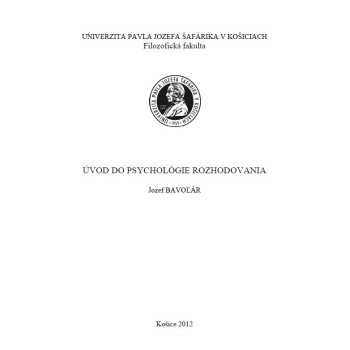
Úvod do psychológie rozhodovania

Úvod do psychológie rozhodovania

E-book

E-book

Jozef Bavoľár

Decision-making is an everyday activity for us, whether it involves decisions about routine matters such as what to have for breakfast or more significant choices like selecting a career after finishing school. Due to the far-reaching consequences that a single decision can have on our entire lives, this area has received considerable attention in psychology. After all, the classic goals of psychology—describing, explaining, and predicting human behavior—are essentially attempts to understand decision-making and identify and describe the factors influencing it. Fundamental psychological disciplines such as the psychology of emotions and motivation, cognitive psychology, social psychology, and personality psychology all strive to achieve this understanding.

The presented text primarily adopts a cognitive approach, focusing on the processes of information processing and utilization. Since there are very few events in the future we can be completely certain about, key concepts include terms expressing uncertainty about the future, such as uncertainty, risk, objective probability, and subjective probability.

The central question thus lies in processing information from the environment and utilizing it in the decision-making process.

Download the e-book for free (pdf)

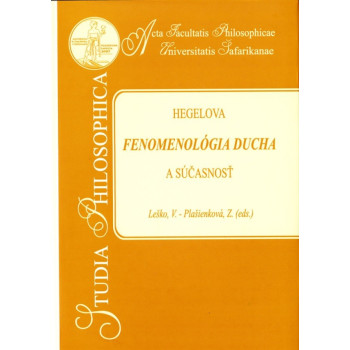
Hegelova Fenomenológia ducha a súčasnosť

Hegelova Fenomenológia ducha a súčasnosť

E-book

E-book

Vladimír Leško - Zlatica Plašienková (eds.)

In 2007, the philosophical world commemorated an extraordinary anniversary - two hundred years since the first publication of Georg Wilhelm Friedrich Hegel's brilliant work The Phenomenology of Spirit (1807). Of course, we can have different value scales of the most important philosophical works written in the history of philosophy, but the above-mentioned work of Hegel should certainly not be absent from the top places in them. Hegel's Phenomenology of Spirit decisively changed the philosophical discourse of the 19th century and greatly influenced philosophy in the 20th century. Few of the great philosophers after Hegel could afford to pass over the philosophical work of the 1807 supreme representative of German classical philosophy and not draw, either positively or critically, on his philosophical legacy.

The philosophical conference entitled Hegel's "Phenomenology of Spirit" and the Present, dedicated to Hegel's work Phenomenology of Spirit, was prepared by the Department of Philosophy and History of Philosophy of the Faculty of Arts of the Pavol Jozef Šafárik University in Košice in cooperation with the Slovak Philosophical Association at the Slovak Academy of Sciences in Bratislava on October 4, 2007 and was organized by the Slovak Philosophical Association in Košice.

Download the e-book for free (pdf)

This website uses cookies to ensure you get the best experience on our website