Filter By

Categories

Categories

Selections

Selections

Year of publication:

Year of publication:

Publication language:

Publication language:

Faculty:

Faculty:

Method of publication:

Method of publication:

Active filters

  • Year of publication:: 2009
  • Year of publication:: 2011
  • Year of publication:: 2013
  • Year of publication:: 2023
  • Year of publication:: 2023
  • Year of publication:: 2023
  • Year of publication:: 2023
  • Year of publication:: 2023
  • Year of publication:: 2023
  • Year of publication:: 2026
  • Year of publication:: 2026
  • Year of publication:: 2026
  • Faculty:: Prírodovedecká fakulta
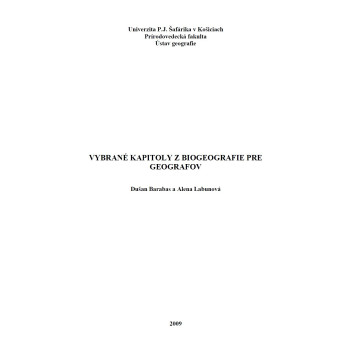
Vybrané kapitoly z biogeografie pre geografov

Vybrané kapitoly z biogeografie pre geografov

E-book

E-book

Dušan BarabasAlena Labunová

These study materials aim to provide basic information about biogeographical issues from a geographical perspective, i.e., a perspective focused primarily on the aspect of spatial differentiation of the biosphere. The basis for the division of the biosphere is its historical development, during which individual taxa and communities were formed.

The historical development of the biosphere did not occur under stable, constant conditions, but rather in ever-changing conditions caused by the position of our planet within the solar system, the position of the Earth's axis relative to the ecliptic, and also the position of the solar system within the galaxy. All changes in the Earth's position, together with the movement of continents (drift) and climate changes, created the prerequisites for the spatial expansion of the biosphere. The historical development of the biosphere, various perspectives, the hierarchical level of differentiation, and the causes of differentiation are incorporated in this study material, whose aim is to outline the basic principles of this division.

The goal is also to highlight certain differences in the understanding of terminology, as well as to point out some fundamental relationships operating within the landscape system in the broadest sense of the word. The section devoted to the ecological principles of the functioning and formation of the landscape system, according to MIČIAN and ZATKALÍK (1984), outlines the issues of understanding the terms ecosystem and geosystem. For this reason, the presented text includes chapters that attempt to explain the understanding and approach to some basic concepts.

These study materials are intended for students of single-subject, interdisciplinary, and supplementary studies as basic teaching material. By expanding the knowledge from this study material with further information, which is elaborated in more detail in the literature listed in the bibliography of this text, graduates will gain a comprehensive view of biogeographical issues.

Authors
Download the e-book for free (pdf)

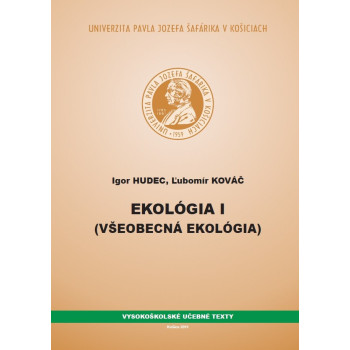
Ecology I (General Ecology)
  • On sale!
  • -€10.35

Ecology I (General Ecology)

€11.35 €1.00 -€10.35
Availability: 70 In Stock

Igor HudecĽubomír Kováč 

The study course provides the basic knowledge on the fundamental parameters, relationships and processes in ecological sciences. Brief content: ecological factors and relations to environment (air, water, soil); influence of ecological factors upon organisms (morphological adaptations, behavioural responses); populations and communities (external and internal parameters of populations, population dynamics); ecosystems (impact assessment) and biomes (basic features and human impact); cycles (hydrologic, gaseous, sedimentation) of basic elements on Earth.  

Authors

Foundations of nonequilibrium statistical physics

Foundations of nonequilibrium statistical physics

€29.22
Availability: 10 In Stock

Michal Jaščur -Michal Hnatič

In the textbook, the processes belonging to an area of  nonequilibrium physics, which make the basis for the study and analysis of compex phenomena  of statistical mechanics, are described. The Boltzmann equation for distribution function is derived and on this basis the hydrodynamic equations are constructed.  Stochastic processes are described separately and Fokker-Planck equation for density probability  is derived. Textbook is intended for the students of second year of master study at Faculty of Science of P. J. Šafarik University.   

Autors

This website uses cookies to ensure you get the best experience on our website