Filter By

Year of publication:

Year of publication:

Publication language:

Publication language:

Active filters

  • Year of publication:: 2016
  • Year of publication:: 2023
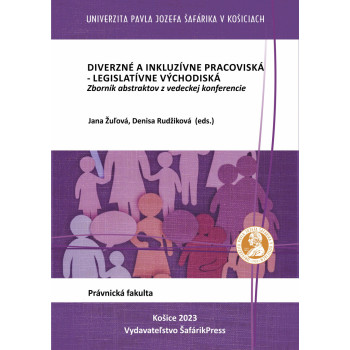
Diverzné a inkluzívne pracoviská - legislatívne východiská

Diverzné a inkluzívne pracoviská - legislatívne...

E-book

E-book

Jana ŽuľováDenisa Rudžiková

In the environment of Slovak employers, an active approach to diversity and inclusion in the workplace is coming to the fore. Targeted diversity and inclusion programs help make employers more attractive on the labor market and attract more job seekers. Proactively, better working conditions are created for employees with responsibilities to the family (in most cases still in relation to mothers), groups of people who have been on the fringes of interest until now are also employed (elderly, disabled, LGBT groups, minorities, graduates of secondary and higher education schools).

The presented collection of abstracts responds to the outlined facts, which is a grouping of the starting motives and conclusions of the contributions presented at the scientific conference Diverse and inclusive workplaces - legislative starting points organized by the department of labor law and social security law of the Faculty of Law of the P. J. Šafárik University in Košice, which took place on September 29, 2023 in a hybrid form.

With their abstracts, the authors point to a range of problematic areas that are not only a reflection of academic considerations, but also those legal questions that have to be dealt with in ordinary legal practice. The goal is to use analysis and explanation to define the existing labor law measures/tools applicable to the implementation of diversity and inclusion in the workplace according to the current Slovak legal framework and the EU legal framework and thus emphasize the starting point of any effort to build diversity and the implementation of inclusion in the workplace.

Download e-book for free (pdf)
Ochrana súkromia zamestnanca

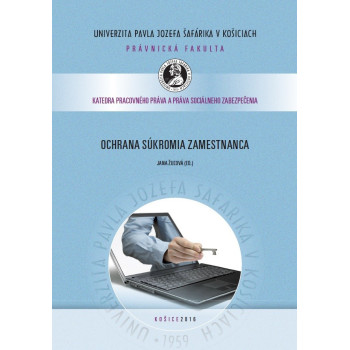
Ochrana súkromia zamestnanca

E-book

E-book

Jana Žuľová(ed.)

Proceedings from the 1st Annual Student Symposium on Labor Law held on April 8–9, 2016 in Danišovce

Discussions on the topic of privacy are currently very topical and interesting. The advancement and progress of technology have added a new dimension to individual privacy. With the use of modern electronic devices, terms such as precious commodity, chimera, or illusion are increasingly associated with privacy. Workplaces have not remained immune to modernization either. Machines are replacing human labor, programming and planning the production process, but also controlling, monitoring, and recording the fulfillment of assigned work tasks.

The availability of technology and its implementation in employers’ operations intrude upon the personal and private sphere of employees, which is an inherent part of every person’s life and does not remain left behind the doors of the workplace. Proper and correct use of monitoring mechanisms by employers means not only mastering their technical installation at the workplace and covering the associated financial costs, but also respecting the privacy of employees.

It cannot be overlooked that the right to privacy is among the fundamental human rights and freedoms, enjoying the corresponding characteristics (inalienability, non-transferability, irrevocability, etc.) and appropriate legal protection. And even though it is not absolute and may be suspended in favor of another right (especially the employer’s right to protect their property), every intervention—such as comprehensive camera surveillance, monitoring of phone calls, email correspondence, blocking certain websites, etc.—always has adverse consequences for the privacy of the employee.

Download the e-book for free (pdf)

This website uses cookies to ensure you get the best experience on our website