Filter By

Year of publication:

Year of publication:

Publication language:

Publication language:

Faculty:

Faculty:

Active filters

  • Year of publication:: 2018
  • Year of publication:: 2019
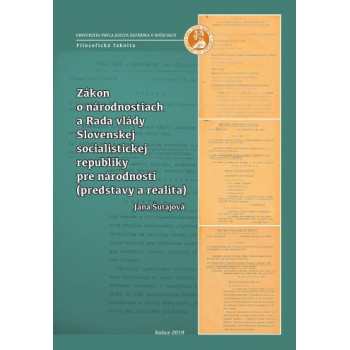
Zákon o národnostiach a Rada vlády Slovenskej socialistickej republiky pre národnosti (predstavy a realita)

Zákon o národnostiach a Rada vlády Slovenskej...

E-book

E-book

Jana Šutajová

From January 1, 1969, the Constitutional Act on the Status of Nationalities in the Czechoslovak Socialist Republic (ČSSR) and the Constitutional Act on the Federation came into effect. The Constitutional Act on the Status of Nationalities represented at least a formal significant step forward in the legal regulation of minority rights. However, this law was intended to serve as a foundation for further legal adjustments. It was declared that additional steps and negotiations for the adoption of implementing regulations would follow and that further laws would be enacted at both the federal and national levels. Nevertheless, no additional law or government regulation related to the constitutional act on the status of nationalities in the ČSSR was ever issued.

During the normalization period, issues concerning further legislation related to national minorities were not addressed. However, in the brief period following the adoption of the constitutional act in 1968 until the end of 1969, some institutions attempted to prepare and promote such legal norms. One of these institutions was the Government Council of the Slovak Socialist Republic (SSR) for Nationalities (hereafter referred to as the Council or the Government Council for Nationalities). The monograph provides an insight into the development of additional legal norms arising from the constitutional act on the status of nationalities in the Slovak Socialist Republic, prepared by the Government Council of SSR for Nationalities. This council was one of the institutions established in Slovakia after the formation of the Czechoslovak federation and dealt with nationality issues.

In addressing further legal norms stemming from the constitutional act on nationalities in ČSSR, it was necessary to consider prior developments. Therefore, the first part of the monograph examines the status of minorities in Czechoslovakia before adopting the constitutional act, activities of nationalities preceding its adoption, and its enactment itself. Subsequent sections focus on institutional changes in SSR following federalization, the establishment of the Government Council of SSR for Nationalities, and specific actions taken by this Council and its expert bodies in drafting proposals for laws concerning nationalities in the Slovak Socialist Republic.

The motivation for writing this monograph stemmed from the fact that this topic has so far received attention only in a few studies in Slovakia, which primarily focused on the Hungarian minority during either the Prague Spring or normalization periods.
Download the e-book for free (pdf)

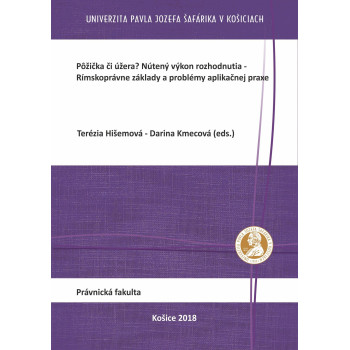
The loan or usury? Compulsory enforcement of judgment - roman and law foundations and problems of application practice

The loan or usury? Compulsory enforcement of...

E-book

E-book

Terézia HišemováDarina Kmecová (eds.)

Reviewed proceedings of scientific papers of Conference of Slovak and Czech law romanists, which take place at May, 10.-11.5.2018, at Faculty of Law, UPJŠ in Košice.

The submitted reviewed proceeding of scientific papers on „The loan or usury? Compulsory enforcement of roman - law basics and problems of application practice.”  is prepared within the solution of the grant project VEGA on: „The loan or usury? Compulsory enforcement of historical - law basics and problems of application practice.”, no. p. 1/0198/17.

The authors of papers are important personalities of Roman law working in the Slovak and Czech Republic, as well as PhD students and young scientists from Slovak and foreign universities who are active in the academic environment as well as in legal practice. The main goal of the editors is to help improve the current legal situation, which is assessed as unsatisfactory, and through a historical excursion of the development of the loan institute and then the forced execution of the decision, to create de lege ferenda proposals considering all areas of research.

The Proceedings trace the interrelationships between the substantive law institute in terms of the Roman law of contractus unilaterales - mutuum in its various types, often realized by the attachment of high interest rates, which bordered on the insurrection and the procedural law of individual lawsuits enforced in the legislative, formular and cognitive process. If there was no possibility to impose certain behaviour on the obligated person (the debtor, the sentenced person), then the declared general obligation to enforce the legal norms was only a legal term. It has always been the case that every internally well-organized state, whether antique or present, has to use power tools - often with the use of gross violence - but within the limits of the law, to promote what it has declared valid law. It must protect creditors on the one hand, but it must also prevent self-help and the use of illegal, unjustified and disproportionate violence.

The loan contract as a real contract has often become an integral part and relatively the most frequent reason leading to the compulsory enforcement, especially when contracting parties often agree on the connection of interest - sometimes within the legal limit, sometimes exceeding the legal framework - and in this way the potential future creditor (the plaintiff) significantly increased the insolvency risk of the debtor (the defendant, the sentenced) and of the subsequent execution. The pronounced and deepening social stratification of the Roman population and the secondary depreciation effort, the cancellation of the debts of the poor part of the population logically culminated in social unrest and revolt against the enforcement of the enforcement law.

The proceedings capture not only the rich scientific discussion of Slovak and Czech legal Romanists, but also the opinions, experience and knowledge of experts on contemporary law dealing with this type of issues. As a result, it provides a unique interdisciplinary view of the subject and raises many stimulus points for future research. This work proves that the problems encountered by the various representatives of the Roman jurisprudence and their legal and theoretical bases and solutions are undoubtedly useful and serve as a guideline also for solving legal issues in the field of modern enforcement proceedings.

Download the e-book for free (pdf)

This website uses cookies to ensure you get the best experience on our website