Slovenčina




Gustáv Dianiška a kolektív
Piate aktualizované a doplnené vydanie učebnice zachováva a inovuje osvedčené tradičné témy. Dopĺňa ich o fenomenologické údaje vývoja kriminality v SR do roku 2024 a etiológiu obohacuje o vývoj kriminogénnych činiteľov na prahu 21. storočia. Čitateľ zaregistruje nové kapitoly, ktoré poukazujú na dynamický rozvoj kriminologických tém súčasnosti. Patrí k nim korupcia, extrémizmus, terorizmus a sociálna patológia v akademickom prostredí. Samostatný priestor v učebnici získala kapitola venovaná kriminologickým teóriam. Tradične učebnica prezentuje racionálny obsah a zároveň dbá na jeho aktivizačnú formu. Kladenie otázok, zamýšľanie sa nad obsahom, nabádanie k aktivite smeruje k podpore snahy čitateľa hlbšie poznať problém, účelne si ho osvojiť a využiť v praxi. Učebnica je určená študentom a učiteľom fakúlt, osobitne právnických, ako aj tých, ktoré majú kriminológiu v učebných plánoch. Môže byť cenným pomocníkom i pre právnikov v praxi, pracovníkov v oblasti trestnej politiky a prevencii kriminality, novinárov kriminovín a verejnosti, ktorá sa zaujíma o dynamiku kriminality a jej prevenciu.

Data sheet
Specific References
Sergej Romža a kolektív
OBSAH:
1 HISTORICKO-PRÁVNE ASPEKTY
2 KOMPARATÍVNE ASPEKTY
3 JURISTICKÉ ASPEKTY
4 KRIMINOLOGICKÉ ASPEKTY
5 PENOLOGICKÉ ASPEKTY
6 VIKTIMOLOGICKÉ ASPEKTY
7 ORGANIZAČNO TECHNICKÉ ASPEKTY
E-book
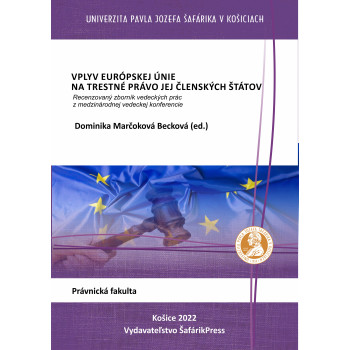
Dominika Marčoková Becková (ed.)
Reviewed collection of papers of the international scientific conference is the output of the international scientific conference held on 7th October 2022 within the framework of the project APVV-18-0421 „European Public Prosecutor's Office in Connections of the Constitutional Order of the Slovak Republic as Strengthening of the European Integration through Law“.
Unlike other areas of activities of the European Union, the European Union did not begin to enter the area of criminal law and criminal policy until much later. The reason is that the sphere of criminal law has traditionally been associated with the sovereignty of the state, which is why the Member States of the European Union are very slow to allow the European Union into it. The issue of the European Union's influence on the criminal law of its Member States is therefore becoming actual and raises many questions and application problems. In their papers, the authors address the various problems posed by the European Union's influence in the area of criminal law. Among the scientific problems and issues that the authors paid attention to in their works are the following: reasons for competence of the European Union within the field of criminal law; Impact of the EU legislation on criminal law of EU Member States; proposals to improve existing legislation, whether at European Union or national level, cooperation of the Court of Justice of the European Union and national judges via preliminary proceedings within the field of criminal law; as well as the issue of the European Public Prosecutor's Office.
E-book
Žofia Mrázová (ed.)
Proceedings of Contributions from the V. Student Symposium on Commercial Law
The proceedings are the result of student works presented at the fifth annual student symposium organized by the Department of Commercial Law and Economic Law, Faculty of Law, UPJŠ in Košice, which took place on November 30 – December 1, 2017, at the UPJŠ educational and training facility in Danišovce.
This year’s symposium focused on problematic issues related to creditor rights protection in commercial contractual relationships.
The purpose of these annually organized symposia is to provide students with a platform to present their own opinions and improve their analytical and argumentation skills.
E-book
Vladimír Lichner - Dušan Šlosár
Issues of punishment are directly linked to a state’s criminal policy, which is an inseparable part of its social policy. Historically, the state has held a unique dominant position in the realm of punishment. Once the conditions for imposing a penalty are met, the state fulfills its obligation by sentencing through independent courts. However, it does not address questions of satisfaction, which belong to the victim. The victim may be a specific physical person or legal entity that suffered harm due to the criminal act. This harm simultaneously affects civil society as a whole. The state prioritizes its duty to punish and decide on the matter over compensating the harmed individual or civil society.
By mediation in criminal cases, we mean extrajudicial facilitation of resolving disputes between the offender and the harmed party, with the assistance and personal participation of a mediator. The mediator, as an independent and impartial person, helps parties identify their interests and supports them in finding shared, practical, and realistic solutions to the points causing their conflict. Probation refers to monitoring, supervising the accused, defendant, or convicted individual, as well as providing individual assistance to the offender and encouraging them to lead a lawful life. This reduces the risk of recidivism, or repeated criminal behavior.