Slovenčina


E-book
The university textbook Didactics of Geography (not only) for the new curriculum responds to current curricular changes in geographical education in Slovakia and to the need to modernize the training of future geography teachers. Didactics of geography is an independent scientific discipline, the brief historical development of which is presented in the introductory chapter. The goals and content of geographical education in the context of school reforms are elaborated in subsequent chapters.
Special emphasis is placed on the development of geographical and geospatial thinking, inquiry-oriented teaching and STEM education. A significant part of the publication consists of chapters devoted to methods, organizational forms and teaching aids in geography.
The university textbook Didactics of Geography (not only) for the new curriculum responds to current curricular changes in geographical education in Slovakia and to the need to modernize the training of future geography teachers. Didactics of geography is an independent scientific discipline, the brief historical development of which is presented in the introductory chapter. The goals and content of geographical education in the context of school reforms are elaborated in subsequent chapters.
Special emphasis is placed on the development of geographical and geospatial thinking, inquiry-oriented teaching and STEM education. A significant part of the publication consists of chapters devoted to methods, organizational forms and teaching aids in geography. Separate chapters are devoted to assessment and formative assessment in geography teaching. The authors also focus on the integration of digital and geospatial technologies and artificial intelligence into geography teaching. The publication connects theoretical foundations with practical examples and reflective recommendations for beginning teachers. The text offers a wealth of didactic inspiration, reflective questions and resources for further study. The teaching text is intended primarily for geography teacher students, but is also useful for teachers in practice.

Data sheet
E-book
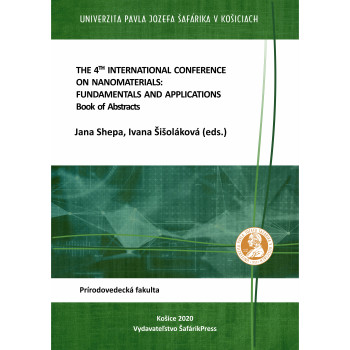
Jana Shepa - Ivana Šišoláková (eds.)
Abstracts of the 4th International Conference Nanomaterials: Fundamentals and Applications (NFA) 2020 is the contributions summary of the conference participants. The conference will feature three invited lectures and eight registered lectures. This conference is a tool for creating a dialogue between experts in the field of nanomaterials, their use and overall application in various fields. Papers in the proceedings are thematically divided into 6 areas. All contributions are highly professional and interesting and can contribute to further creative scientific work.
E-book
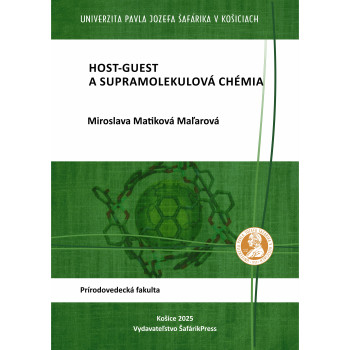
The university textbook entitled: Host-guest and supramolecular chemistry provides basic information about this scientific field as well as the types of compounds that belong to it. It provides basic characteristics of non-bonded interactions as well as methods of characterization and classification for these compounds. It summarizes knowledge about various types of host-guest systems from the oldest such as Hofmann clathrates to inclusive compounds such as cyclodextrins and calixarenes. In addition to structural and synthetic information, which is supplemented with images, the textbook also addresses the possibilities of application or practical use of compounds. The conclusion of each chapter is supplemented with tasks for elaboration on a given topic.
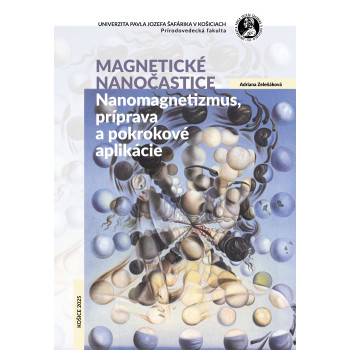
Magnetic nanoparticles are extremely interesting magnetic objects that still hide much that is undiscovered, both because of their physical properties and because of their diverse applications. Iron nanoparticles, or iron oxides, are used in medical diagnostics for magnetic resonance imaging, in the treatment of hyperthermia, and an important application is the use of magnetic particles for targeted drug delivery.
The textbook "Magnetic Nanoparticles: Nanomagnetism, Preparation and Advanced Applications" is intended primarily for students of the Master's programme in Physics and students of related disciplines at universities and faculties with a physical, chemical, metallurgical and biophysical focus. The motivation for writing this textbook was to develop study material that would contribute to improving the quality of teaching in the profile subject Nanomaterials and Nanotechnology at the Institute of Physical, Faculty of Sciences, UPJŠ, in the Master's programme Condensed Matter Physics, as well as in the profile subject in the PhD programme Advanced Materials.
The university textbook is divided into eight chapters. The first and second chapters are devoted to basic information about magnetism, the origin of nanomagnetism in nanoparticles and surface phenomena. The third and fourth chapters are devoted to nanomagnetism in nanoparticle systems. The fifth chapter describes in detail individual protocols for investigating the phenomenon of superparamagnetism and the phenomenon of superspin glass using the SQUID device. The sixth chapter describes individual procedures for the preparation of magnetic nanoparticles and the seventh chapter describes individual experimental techniques for the study of magnetic nanoparticles. The final eighth chapter describes the applications of nanoparticles in biomedicine.
During the writing of this textbook, the chapters were prepared using the foreign-language specialist literature listed in the recommended reading list.
E-book
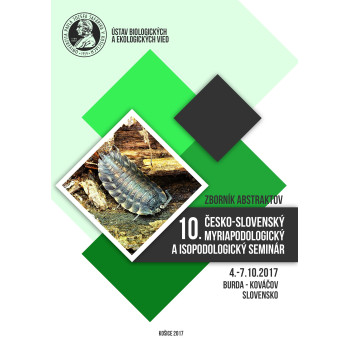
Burda - Kováčov, Slovensko, 4.-7.10.2017
Abstracts of lectures by Czech and Slovak zoologists, ecologists, and physiologists, who study soil arthropods in the taxa Myriapoda and Oniscidea as model groups, presented at the 10th seminar in Kováčová near Chľaba, Slovakia.