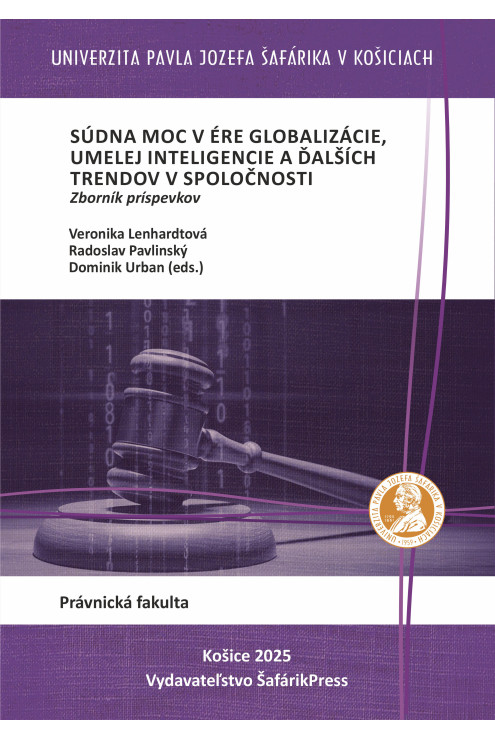
Súdna moc v ére globalizácie, umelej inteligencie a ďalších trendov v spoločnosti

E-publication
Veronika Lenhardtová-Radoslav Pavlinský-Dominik Urban

The collection Judicial Power in the Era of Globalization, Artificial Intelligence and Other Trends in Society provides a comprehensive and up-to-date perspective on the transformation of the judiciary amid rapid technological and social change. It contains 25 contributions primarily focused on the introduction and use of artificial intelligence tools in law. The authors examine not only the technical and institutional aspects of this transformation but also issues of judicial legitimacy and public trust in an independent justice system. The publication also offers a critical reflection on potential risks, limitations, and ethical dilemmas associated with the automation and digitalization of judicial processes. Several contributions compare national and supranational legal frameworks, offering valuable insights into differences in regulatory approaches around the world. All texts are united by a common question concerning the future of judicial power in a changing world. The contributions are written in an accessible manner, making the collection suitable for both legal experts and the broader public.
Download the e-book for free

Quantity

978-80-574-0476-7

Data sheet

Method of publication:
E-book (pdf)
Editors:
Veronika Lenhardtová-Radoslav Pavlinský-Dominik Urban
Document type:
Proceedings
Number of pages:
246
Available from:
17.12.2025
Year of publication:
2025
Edition:
1st edition
Publication language:
Slovak
Faculty:
Faculty of Law
Note:
Zborník vznikol v rámci riešenia projektu APVV-21-0336 Analýza súdnych rozhodnutí metódami umelej inteligencie.
License:
CC BY NC ND (Uveďte autora - Nepoužívajte komerčne - Nespracovávajte)
DOI:
https://doi.org/10.33542/SMV-0476-7

16 other products in the same category:

PRÁVO – OBCHOD – EKONOMIKA XI.

E-book

E-book

Jozef SuchožaJán HusárRegina Hučková

In 2020 and 2021, the tradition of holding the Law – Business – Economics conference was exceptionally interrupted due to the unprecedented situation associated with the spread of Covid-19. This year, the situation allows us to restore the tradition of our Tatra conference and, after two years, to once again meet in person with our traditional domestic and international participants. At the same time, we look forward to welcoming participants who are attending our conference for the first time (and we hope it will not be the last).

You are holding in your hands the proceedings of scientific papers, published in connection with the implementation of scientific projects at the scientific workplace – the Department of Commercial and Economic Law, as the main organizer of the scientific conference, as well as at other departments of the Faculty of Law at UPJŠ and at many academic institutions both at home and abroad. The proceedings are published with the support of the Slovak Research and Development Agency. The editors would like to thank everyone who contributed their scientific articles, as well as the reviewers for their valuable comments and recommendations.

Download e-book for free(pdf)

Ochrana (duševného) zdravia zamestnanca v...

E-book

E-book

Marcel DolobáčMonika Seilerová

The Industrial Revolution cannot be avoided or hidden from, but it is equally wrong to see it only in gray tones. Let us be optimistic. The Information Age can also mean a reduction in working hours, perhaps more time for family and interpersonal relationships, or an overall increase in individual economic luxury. The Information Age will take away many job opportunities but will put many others on the table, though mostly for the educated. Science and research will become even more important for overall economic development than they are today. Let us be prepared.

The ambition of this monograph is not, and cannot be, to provide an exhaustive answer to the above-outlined debates. Its goal is to stimulate broader scientific discussion, particularly on the issue of mental health protection in correlation with the advent of the Information Age. The subject of study is the protection of the individual—the employee—who must adapt to a new technological environment and its associated demands.

The monograph represents a comprehensive output by authors who, over the past two years, have published on similar topics within the APVV-16-0002 grant "Mental Health in the Workplace and Assessment of Employee Health Capability." The authors believe that thanks to this APVV grant, they will continue to build on this topic in the coming years. Most importantly, they hope that its content will engage you, the readers.


Marcel Dolobáč

Download the e-book for free (pdf)

Zamestnanec v digitálnom prostredí

E-book

E-book

Monika MinčičováMarcel DolobáčJana Žuľová

The presented proceedings of papers is the result of the international scientific conference "Employee in the digital environment", which was organized as part of the research project VEGA 1/0790/20 Employee protection in the context of the Industrial Revolution 5.0 - starting points, opportunities and risks. The online scientific conference took place on the 5th of November 2021 under the auspices of the Department of Labour Law and Social Security Law, Faculty of Law, P. J. Šafárik University in Košice. The proceedings includes a variety of scientific papers focused on the study of current issues caused by the digital transformation of society.Authors respond to partial legal problems of labour law and social security law at the theoretical-legal and application level and reflect on the consequences of ongoing phenomena for the labour market and labour law legislation.

Download e-book for free(pdf)

Právo informačných a komunikačných technológií

€19.50
Availability: 5 In Stock

Regina Hučková - Diana Treščáková - Laura Rózenfeldová

Vysokoškolská učebnica Právo informačných a komunikačných technológií je určená študentom vysokých škôl vo všeobecnosti, najmä však študentom Právnickej fakulty, ktorí majú záujem o štúdium práva v spojení s informačnými a komunikačnými technológiami. Učebnica predstavuje zdroj informácií potrebných nielen pre štúdium tejto problematiky, ale aj pre rozšírenie celkového obzoru v danej problematike.

Prípadové štúdie zo správneho práva

€20.00
Availability: 28 In Stock

Jozef Tekeli a kolektív

The work "Case Studies in Administrative Law" is an extensive and practice-oriented publication primarily intended for students of law faculties and universities with a focus on public administration. Its main objective is to deepen the reader’s knowledge in various areas of administrative law through specific case studies, with an emphasis on the application of legal norms in real-life situations. The publication consists of 20 thematically organized chapters that cover a wide range of administrative agendas, such as internal administration, trade licensing, environmental protection, healthcare, transportation, education, justice, and national defense.

Each chapter contains multiple casuistic cases, in which the reader encounters practical problems and must assess the legality of administrative procedures, the substantive and territorial jurisdiction of public authorities, and the application of relevant legal regulations. The case studies are presented systematically—beginning with a factual scenario, followed by a legal analysis based on applicable legislation.

The work is exceptional for its comprehensiveness, up-to-date content, and emphasis on interdisciplinary connections within administrative law. The final chapter includes cross-sectional exercises involving multiple areas of administration through complex scenarios, encouraging the development of synthetic legal thinking. The publication thus serves not only as a valuable study resource but also as an excellent tool for seminar work, exam preparation, and practical training in legal reasoning and decision-making.

Blockchain technológia ako činiteľ (faktor)...

E-book

E-book

Ladislav Hrabčák et al.

The comprehensive work represents the final output from solving Project VVGS-2019-1068 titled 'Blockchain technology as a factor influencing the current form of law' and was created simultaneously as one of the partial outputs from Project APVV-19-0124 titled 'Tax Law and New Phenomena in Economy (Digital Services, Shared Economy, Virtual Currencies)'. The partial overlap in research topics between these projects allowed for such research, especially regarding digital (virtual) currencies.

Download e-book for free (pdf)

Obchodné záväzky: Všeobecná časť

E-book

E-book

Dominika Zavadová(ed.)

Proceedings from the 3rd Student Symposium on Commercial Law

In November 2015, the third annual Student Symposium on Commercial Law took place at the university facility in Danišovce.

After two years of symposia focused on company law, the main topic of the third edition was the general part of commercial obligations law. This year as well, the goal of the student symposium remained to provide more space for students to formulate their own perspectives on current legal issues and to present the results of their own work.

The overarching topic made it possible to assign several current issues, allowing students to tackle problems they are likely to encounter in their future practice. The selected topics are not among those unanimously accepted by legal doctrine or established case law. On the contrary, the topics were deliberately chosen for the lack of sufficient domestic literary sources. As a result, processing the individual topics required more than just standard textbook or commentary knowledge.

The participating members of the department, both teachers and doctoral candidates, acted this year primarily as contact persons, rather than as consultants or supervisors of the students’ work. The primary purpose of the symposium at the faculty is to enable students interested in commercial law to develop their analytical and argumentative skills, as well as to express their personalities. We aim for students to develop not only professional knowledge but also personal skills-so-called soft skills-the art of presenting their own opinions and arguing persuasively.

Download the e-book for free (pdf)

Učíme právo zážitkovo

E-book

E-book

Daniela Lamačková-Renáta Orosová- Beáta Sakalová- Diana Repiščáková

Methodological guide for teachers for classroom lessons and civics Teaching law experientially? Is it even possible? The answers to these questions are provided by a methodological guide that uniquely links experiential learning methods with legal content. This methodological guide is a set of techniques based on the use of interactive and participatory learning methods, focusing on selected human rights and value-oriented topics, which also have the potential to develop other key competences of students, such as their communication skills, their ability to learn and educate independently, their ability to think critically, their ability to work with and analyse texts, their ability to discuss and express their opinions, and their ability to listen to each other. The methodological guide consists of a set of training activities - techniques, while each technique contains a precise description of the procedure for conducting a specific activity, the expected duration of the activity, aids, discussion topics and also a short pedagogical and legal commentary, precisely "tailored" to the specific legal topic. The legal topics are chosen to be generally applicable to both classroom and civics lessons, to raise questions about the functioning of rules and the need to respect them, mutual respect and tolerance, and to encourage reflection on the limits of individual rights and on responsibility in exercising one's rights. The techniques use training methods such as group work, brainstorming, role-playing, dealing with model situations, as well as a simulated court process. The methodological guide is intended for classroom teachers in the implementation of classroom lessons, and also for the purposes of the subject of civics, as well as for students of pedagogy at the Pavol Jozef Šafárik University in Košice.

Download e-book for free (pdf)

Právo-Obchod-Ekonomika XIV (2025)

E-book

E-publication

Ján Husár - Regina Hučková (eds.)

Proceedings LAW – BUSINESS – ECONOMICS XIV. present an interdisciplinary collection of scholarly contributions that reflect current trends, challenges, and developments in the fields of law, business, and economics. The publication brings together authors from academia as well as professional practice and offers analytical, comparative, and application-oriented studies. The thematic core of the proceedings consists primarily of issues related to contemporary legal regulation and its impacts on the business environment, economic aspects of legislative changes, as well as topics such as digital transformation, international trade, and financial markets. The contributions are characterized by their topical relevance, academic depth, and emphasis on connecting theory with practical solutions. The proceedings are intended for the professional public, academics, students of law and economics, as well as practitioners working in the legal, business, and economic spheres. They represent a valuable source of information for understanding current interdisciplinary trends and their effects on the legal and economic environment.

Download the e-book for free

Miesto a význam regionálnych súdnych orgánov v...

E-book

E-book

Ján Klučka et al.

The aim of the current monograph is to provide comprehensive view of the status of regional judicial organs in current conditions of regionalism. Based on selected issues examined in individual chapters research team presents the comprehensive study focused on clarification of the status and significance of regional judicial organs in terms of new regionalism.

Research of the role of regional courts in the system of peaceful settlement of disputes demonstrates the significant role of the regional courts within the promotion of the rule of law, regional integration and also significant role of regional courts to ensure legal certainty within the system of compliance with decisions of regional courts. The result of examination of possibilities of individuals to access to regional judicial organs is comparative evaluation of regional possibilities of individual to defend his/her rights within regional courts of various regions. Particular part of this area is the right to an effective remedy and to a fair trial as basic rights within the proceedings of regional judicial organs. Within the examination of preliminary rulings of international regional courts of different regions the role of regional judicial organs in the process of effective implementation of the principle of the rule of law was the subject of examination.

For the proper functioning of the regional judicial organs as well as independence of judges and legal certainty in International law, the ethical rules of international judicial organs and tribunals, which are the subject of the last chapter, are significant.

Download the e-book for free  (pdf)

Základné zásady v rozhodovacej činnosti súdnej...

E-book

E-book

Alexander Bröstl - Marta Breichová Lapčáková - Martin Štrkolec (eds.)

Collection of scientific papers by doctoral students.

Thematically, the contributions are diverse: they feature fundamental principles in public law (basic principles of criminal proceedings, the principle of contradiction, basic principles of constitutional court proceedings, basic principles in private law and procedural law (superficies solo cedit), the principle of civil court proceedings in deciding labor disputes, equality of participants and the duty to instruct, objection of bias in light of the right to an impartial court, the principle of speed and the principle of economy in the decision-making activities of general courts, basic principles in legal theory and international law (general legal principles recognized by civilized nations), coexistence of the principle of equality and the principle of non-discrimination in the legal order of the European Union, argumentation through the principle of rule of law in the decision-making activities of courts, the impact of fundamental principles on the interpretation of legal norms.

It is important that the authors, i.e., doctoral students from law faculties in the Czech Republic and the Slovak Republic, almost unanimously examine these principles in the process of application (interpretation) of law, from the perspective of how legal (primarily judicial) practice deals with them. This should be fundamentally welcomed and appreciated.

Download the e-book for free (pdf)

Právna regulácia volebnej kampane a jej...

E-book

E-book

Ladislav Orosz, Martina Makaturová

This scientific volume has been published as an output of the VEGA grant project No. 1/0474/24 Audit of Slovak Electoral and Referendum Legislation. Thematically, it focuses on the issue of the legal regulation of election campaigns and a critical analysis of the experience of its application in electoral practice. On this basis, the authors also formulate proposals for improving the current legal framework of election campaigns.

The proceedings include contributions presented at the scientific conference of the same name held in May 2025. The volume contains papers not only from domestic but also from foreign authors, who present the legal regulation of election campaigns in their respective home countries. Contributions from academics are complemented and enriched by those of representatives of non-governmental organizations engaged in election and campaign monitoring, as well as by contributions from authors working in public authorities responsible for the administration of elections and for overseeing the constitutionality and legality of elections.

Download the e-book for free (pdf)

Zdravotná spôsobilosť zamestnancov

E-book

E-book

Monika Minčičová - Marcel Dolobáč - Jana Žuľová (eds.)

Peer-reviewed proceedings of the scientific conference

Health determines an individual's life in all activities and interests, including the possibility and ability to work. Work and health are in the mutual interaction. Work leads to social inclusion, financial self-sufficiency, finding confirmation of one's own usefulness or achieving personal ambitions. Work can have therapeutic effects, but at the same time it can have an adverse effect on health.

Overlapping factors of work environment, alone or in combination with non-work influences, can lead to illnesses that temporarily or permanently exclude an employee from his or her profession. For these reasons, health enjoys fundamental legal protection as one of the most important values, not only in labour relations.

Download e-book for free (pdf)

The loan or usury? Compulsory enforcement of...

E-book

E-book

Terézia HišemováDarina Kmecová (eds.)

Reviewed proceedings of scientific papers of Conference of Slovak and Czech law romanists, which take place at May, 10.-11.5.2018, at Faculty of Law, UPJŠ in Košice.

The submitted reviewed proceeding of scientific papers on „The loan or usury? Compulsory enforcement of roman - law basics and problems of application practice.”  is prepared within the solution of the grant project VEGA on: „The loan or usury? Compulsory enforcement of historical - law basics and problems of application practice.”, no. p. 1/0198/17.

The authors of papers are important personalities of Roman law working in the Slovak and Czech Republic, as well as PhD students and young scientists from Slovak and foreign universities who are active in the academic environment as well as in legal practice. The main goal of the editors is to help improve the current legal situation, which is assessed as unsatisfactory, and through a historical excursion of the development of the loan institute and then the forced execution of the decision, to create de lege ferenda proposals considering all areas of research.

The Proceedings trace the interrelationships between the substantive law institute in terms of the Roman law of contractus unilaterales - mutuum in its various types, often realized by the attachment of high interest rates, which bordered on the insurrection and the procedural law of individual lawsuits enforced in the legislative, formular and cognitive process. If there was no possibility to impose certain behaviour on the obligated person (the debtor, the sentenced person), then the declared general obligation to enforce the legal norms was only a legal term. It has always been the case that every internally well-organized state, whether antique or present, has to use power tools - often with the use of gross violence - but within the limits of the law, to promote what it has declared valid law. It must protect creditors on the one hand, but it must also prevent self-help and the use of illegal, unjustified and disproportionate violence.

The loan contract as a real contract has often become an integral part and relatively the most frequent reason leading to the compulsory enforcement, especially when contracting parties often agree on the connection of interest - sometimes within the legal limit, sometimes exceeding the legal framework - and in this way the potential future creditor (the plaintiff) significantly increased the insolvency risk of the debtor (the defendant, the sentenced) and of the subsequent execution. The pronounced and deepening social stratification of the Roman population and the secondary depreciation effort, the cancellation of the debts of the poor part of the population logically culminated in social unrest and revolt against the enforcement of the enforcement law.

The proceedings capture not only the rich scientific discussion of Slovak and Czech legal Romanists, but also the opinions, experience and knowledge of experts on contemporary law dealing with this type of issues. As a result, it provides a unique interdisciplinary view of the subject and raises many stimulus points for future research. This work proves that the problems encountered by the various representatives of the Roman jurisprudence and their legal and theoretical bases and solutions are undoubtedly useful and serve as a guideline also for solving legal issues in the field of modern enforcement proceedings.

Download the e-book for free (pdf)

10 rokov v EÚ: Vzťahy, otázky, problémy

E-book

E-book

Ján Klučka(ed.)

Collection of Papers from the International Scientific Conference Held on May 29–30, 2014 at the Faculty of Law, Pavol Jozef Šafárik University in Košice.

In the first half of this year, a scientific conference entitled “10 Years in the EU: Relations, Questions, Issues” was held in Košice, and the contributions from this event constitute the content of the present collection bearing the same name.

The aim of the organizers—namely, the Slovak Association of European Law, the Representation of the European Commission in the Slovak Republic, and the Institute of European Law together with the Department of International Law of the Faculty of Law at Pavol Jozef Šafárik University—was not only (even if loosely) to follow up on the previous 2009 conference “Community Law in Slovakia – Five Years ‘After’”, but, after another five years, to continue its main objective: to provide participants from both the academic and non-academic community with a space for further analysis and exchange of views on legal issues related to the membership of the Slovak Republic in the European Union and various current issues of the Union’s legal order.

From this perspective, a shift in the overall focus of the conference contributions in 2009 and 2014 can be observed. While the contributions from the first conference focused primarily on various aspects of the application of Union law in the Slovak legal system and related application problems, especially before courts and other authorities, the basic orientation of the contributions from the second conference is already different. The present collection also confirms that the contributions focus primarily on current issues of the European legal order and on certain aspects of the Union’s external policy, while the relationship of Union law to the Slovak legal system is no longer given primary attention.

Several contributions focus on areas characterized by a certain overlap or “cohabitation” of Union law with public international law, private international law, or, more broadly, international relations.

Download the e-book for free (pdf)

This website uses cookies to ensure you get the best experience on our website