- New

Zavolajte nám:
+421 55 234 1635E-book
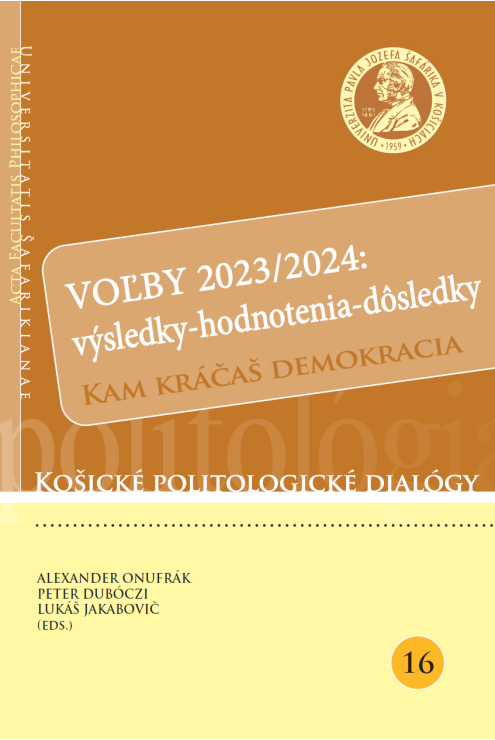
Alexander Onufrák, Peter Dubóczi, Lukáš Jakabovič
The submitted publication entitled Voľby 2023/2024: výsledky – hodnotenia – dôsledky reflects a wide range of topics related to the electoral processes that took place in 2023 and 2024 in Slovakia and abroad. The publication deals with both the evaluation of the currently valid electoral legislation, including proposals for its further improvement, and the broader socio-political consequences of the elections in connection with democratization and integration processes. The submitted publication is published as an output of the VEGA project No. 1/0474/24 Audit of Slovak electoral and referendum legislation, the project leader of which is prof. JUDr. Ladislav Orosz, CSc. from the Faculty of Law of the Pavol Jozef Šafárik University in Košice and in which the Department of Political Science of the Faculty of Arts of the Pavol Jozef Šafárik University in Košice also participates. The authors of the individual contributions analyze all types of elections, from municipal and regional, through parliamentary and presidential, to elections to the European Parliament. While some authors focused primarily on the local or regional level, others chose an approach focused on the national or supranational level, and the geographical scope of the cases examined was extremely diverse.
Download the e-book for free (pdf.)
In the thematic area focused on legislative issues, several authors criticize the frequent amendments to electoral legislation in Slovakia. The most frequently analyzed topics included the election campaign, the division of constituencies, the electoral deposit, the moratorium, the quorum, the closing clause, the electronic nationwide voter list, the financing of political parties, the status of the Central Election Commission and its relationship to the Ministry of the Interior of the Slovak Republic, as well as the possibilities of alternative forms of voting, etc. The phenomenon of so-called crypto-coalitions also deserves special attention. The most extensive thematic area of the publication is the area dedicated to political actors and the broader socio-political context of elections. The works emphasize the role of political parties, whether coalition or opposition, as key actors in the political struggle, while the authors also address their ideological and value anchoring and ability to influence public policy. In addition to political parties, other entities with an influence on the course and results of elections are also analyzed, primarily civil society entities, including so-called third parties, various interest groups, socio-political movements, and electronic and print media, including alternative media. Questioning the reliability of vote counting, election results, and the credibility of the electoral process as such is gradually becoming a socially accepted norm.
Data sheet
E-book
The textbook for the course of Philosophical Anthropology should help the students of philosophy in major subject as much as of philosophy as minor in combination with other study programs in social sciences and STEM disciplines, to develop their own ideas and opinions about the question of human being in the philosophy. Its aim is to make a short introduction into the field of philosophical anthropology and to educate the students in the most important topics of the discipline.
Every chapter consist of the theoretical part and of the practical analysis of the text, which is followed by three questions at the end of each chapter. Students, who will later become the philosophy teachers, shall learn how to discuss and teach several topics from the philosophical anthropology in their future classes. Therefore, the textbook is suitable as much for the pedagogical as for the non-pedagogical study programs.
E-book
Ingrid Madárová - Lívia Barnišinová - Barbara Mitríková - Zuzana Kolaříková - Veronika Pálová - Lucia Tóthová
This handbook is primarily intended for university teachers who regularly come into contact with international students. It focuses on supporting effective intercultural communication in the academic environment. Through examples of specific situations from everyday academic life, it offers recommendations on how to prevent potential misunderstandings arising from intercultural differences. It also includes practical advice aimed at building open, culturally sensitive, and respectful communication that enhances mutual understanding and fosters an inclusive educational environment.
E-book
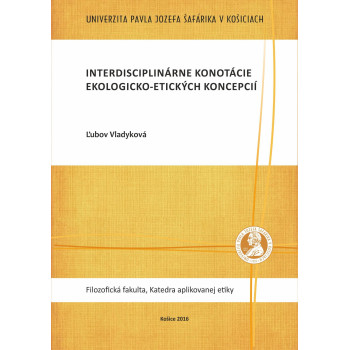
The university textbook presents a panorama of ecological-ethical concepts - ecological ethics, as a possibility of cultural development and indicates the continuing search for relationships with the aim to recognize the importance of ethics and its influence on our understanding and our relationship with the natural world, including scenarios adequately reflecting human-nature interaction in all their complexity.
Special attention is paid to the question of internal evaluation of nature, human and non-human life, both at individual and holistic levels (biocentrism) and the value of physical elements of ecosystems (ecocentrism).
E-book
Introduction to clinical psychology is designed as a teaching text. It is intended primarily for students of psychology at the bachelor degree. The publication offers the basic knowledge needed in the study of clinical psychology. It represents the theoretical basis for the following courses Clinical Psychology, Psychodiagnostics and Psychotherapy in the master's degree.
The text is divided into two parts. The first part deals with general issues of clinical psychology: its parts, history, professional practice of clinical psychologist, classification of mental disorders, or the specifics of research in clinical psychology. It covers also the topics of ethical work and the conditions of education of future clinical psychologists. The second part is focused on the issue of clinical-psychological practice in psychodiagnostics, the specifics of clinical-psychological work with patients with somatic diseases and disabilities. The publication does not describe psychopathology, psychodiagnostics and psychotherapy of mental disorders.
The aim of the publication is to acquaint students with the basic general knowledge necessary for building knowledge in the field of clinical psychology and its practice. To offer the necessary theoretical and practical basis for follow-up clinical psychological subjects and follow-up study in this area.
E-book
The presented university textbook deals with various views on the issue of youth work in the non-governmental non-profit sector, with which the area of social work or other helping professions is closely connected. It offers theoretical analysis as a basic theoretical framework of the issue, which is necessary to know during the study and in the performance of the practice in the helping profession.
It also offers an application through practical demonstrations. The area of youth work is frequent in the non-profit sector. Many diverse activities and projects are being developed based on the basic concept of empowerment. Their aim is to involve young people as much as possible in public life. In addition, with a specific focus on those young people who are struggling with some form of disadvantage.
E-book
Zuzana Kolaříková - Helena Petruňová - Renáta Timková
The publication contributes to an active acquisition and development of language skills in the area of academic English.
Individual lessons include tasks in which the user will find a lot of useful vocabulary in the form of collocations, phrases and sentences which can be applied in practice. The tasks are focused on the area of English pronunciation, grammar, word formation, vocabulary, improving communicative competence in written and verbal communication, improvement of professional skills of presentation, academic writing, etc.
The publication provides space for complementing and creating own database of vocabulary (topic pages).
E-book
Mikuláš Jančura - Maroš Melichárek (eds.)
The textbook is derived from the outcomes of the eleventh annual student scientific conference, which took place in December 2022.
The student scientific conference is an integral component of the curriculum within the Department of History at the Faculty of Arts, UPJŠ, and has been implemented since 2011. Its primary objective is to provide a platform for Bachelor's and Master's degree students to present segments of their original research as part of their thesis development.
The purpose of this textbook extends beyond the mere publication of these diverse thematic texts. It also strives to emphasize the significance of exceptional pedagogical initiatives and the added value of university education for students, manifested through the dissemination of their scholarly output.
E-bool
When studying the Renaissance, researchers utilize various critical and core terms and concepts which it is necessary to characterize.
However, many such points, notably the following, are problematic: The relationship between the Renaissance and the antiquity; The connection with the Middle Ages; The transformation to Mannerism and Baroque; Realism and Secularism in Renaissance art; The individualism of the Renaissance artist; The reasons for the creation of Renaissance art in Italy, its determinants and stimulators; Distinguishing between the analysis of the genesis of the Renaissance and the analysis of the creation of the period’s art generally; Regional differences in Italy and their impact on the art; Chronological limits of the Renaissance and its milestones; The terms “Medieval Ages” and “Early Modern Period”; The impact, and its extent, of the artistic influences of the Byzantine, Gothic and Romanesque arts on the Renaissance. The term “Renaissance” itself, its content and existence, are also the subject of the discussion with students, alongside learning how such terms and definitions came about and continue to evolve, how they attain their content, how this content morphs in the historical discourse, what academical pluralism and freedom of thinking look like in the discourse led by historians, what the differences are between scientists and schools of thought on the same subject and how it is possible that they are so numerous.
The students will come to recognize the leading scholars in the field, and follow their arguments and methodological approaches. They shall be invited to closely trace and scrutinize the logic which those historians use in building their argumentation. It shall be seen that the freedom to create terms, concepts and new definitions cannot stand on an ignorance of the (historical) facts, as becomes clear with expanding knowledge of those historical facts, the variability of their interpretation growing in tandem. This approach, actually used across the whole range of seminars and lectures, shall drive discussion on the topics covered, students being invited to formulate their own theses and antitheses.
E-book
Ján Juščák - Renáta Orosová - Zuzana Nováková
Proceedings of the International Scientific Conference February 5 -február 2014 6, 2014
Conference proceedings of abstracts is one of the outputs of the international scientific conference entitled Education 2014: Contexts of education in the current perspective held 5 to 6 Feb 2014 at University of Pavol Jozef Šafárika in Kosice. This conference focused on the issues of education and emphasizes the current state and prospects of educational practice, topical aspects of undergraduate teacher training, health psychology in educational practice, as well as pedagogical and psychological aspects of education in primary educational institutions in view of the broad educational community. It was aimed for scientists, young university teachers, PhD students as well as experts and teachers, to present trends in education and to stimulate discussion on topical issues presented in the field of education.
E-book
Despite the fact that a psychologist may have a good moral background, it is necessary for everyone to know and act in accordance with ethical professional principles in order not to harm the clients with whom they work in the course of psychological practice. There are many case studies in the professional literature that describe serious situations of violations of psychological ethics. On the one hand, they depict conscious professional misconduct or ignorance. On the other hand, they have contributed to the introduction of even legal standards for the ethical behavior of psychologists as professionals. Completion of a course or training in the topic of psychological ethics is required by several professional associations abroad, especially in the last years of undergraduate studies. Their goal is to supervise the quality and preparation of future psychologists. The university textbook Do I Have It or Not: Ethics in Psychological Practice provides a summary of essential information on the ethics of conducting psychological practice, the boundaries of the relationship with the client, and the rules of confidentiality. The goal is not for the student, as a future psychologist, to know ethical rules word for word, but for them to be sufficiently ethically sensitive.
E-book
Vladimír Lichner - Dušan Šlosár
Issues of punishment are directly linked to a state’s criminal policy, which is an inseparable part of its social policy. Historically, the state has held a unique dominant position in the realm of punishment. Once the conditions for imposing a penalty are met, the state fulfills its obligation by sentencing through independent courts. However, it does not address questions of satisfaction, which belong to the victim. The victim may be a specific physical person or legal entity that suffered harm due to the criminal act. This harm simultaneously affects civil society as a whole. The state prioritizes its duty to punish and decide on the matter over compensating the harmed individual or civil society.
By mediation in criminal cases, we mean extrajudicial facilitation of resolving disputes between the offender and the harmed party, with the assistance and personal participation of a mediator. The mediator, as an independent and impartial person, helps parties identify their interests and supports them in finding shared, practical, and realistic solutions to the points causing their conflict. Probation refers to monitoring, supervising the accused, defendant, or convicted individual, as well as providing individual assistance to the offender and encouraging them to lead a lawful life. This reduces the risk of recidivism, or repeated criminal behavior.
E-book
The foundations of the presented work were developed alongside the emerging research on child language in Slovakia. An enthusiastic team of individuals from several scientific fields—psychology (Marína Mikulajová), speech therapy (Svetlana Kapalková), and linguistics (Daniela Slančová, Jana Kesselová, Zuzana Ondráčková, Stanislava Zajacová, Iveta Bónová)—met regularly, discussed, and sought ways to mobilize efforts to achieve their set goals: conducting research on the language of intact (healthily developing) children based on actual longitudinal observation.
I am very pleased and grateful to have been part of the team at the beginning of systematic research in the field of child language acquisition in Slovakia. As a member of this team and a co-researcher on several projects in this area, I had the opportunity to participate in research on child language, which is no longer "on the fringes" of scientific interest. It has become a serious, exact study supported by quantitative and qualitative data, conducted systematically "at an excellent scientific level" (Průcha, 2011, p. 14).
The research itself was naturally preceded by data collection. The technologies of the late 20th century enabled the replacement of the outdated diary recording method with what is now the most commonly applied approach to material collection—audio-visual recordings. The synthesis of analyzed data collected over time, its explanation, generalization, and integration into a broader interdisciplinary research context is all the more interesting and beneficial as it contributes to speech therapy practice. Thanks to the results of the latest research, intervention possibilities in speech therapy are expanding, and methods for (early) diagnosis and stimulation are being developed and refined.
E-book
The present monograph titled Evolutionary Ethics: Selected Issues and Challenges discusses a range of problems, theoretical concepts, and beliefs from the perspective of evolutionary ethics. The term evolution has become one of the central terms in contemporary science and philosophy.
In social sciences in general, and in socio-biology and evolutionary psychology in particular, evolution has had great impact on our understanding of the genesis of culture. Evolutionary theories play a similar role within the theory of consciousness and of the mind (evolutionary epistemology). The interrelation between our evolutionary past and our sense of good and evil is also a subject of heightened interest in ethics; it has in fact become one of its challenges. The concept of evolution challenges the way we create thought patterns through which we understand, or hope to understand, ourselves and the world around us.
This monograph represents a general summary of selected issues in evolutionary ethics, touching upon various aspects of current research into evolutionary ethics and the related domains of evolution, science, ethics, and morals. Evolutionary ethics has become a project which presupposes that in order to understand the essence and basis of morals one must turn to the process of evolution of thought, and to the theories put forth by evolutionists, specifically evolutionary biologists.
The structure of this monograph, as well as its potential usefulness for research and education clearly show that the analysis of the problems discussed here has significant implications for domains far removed from the purely theoretical parts of moral philosophy or biology. The advantage of such discourse is that it enables the implementation of evolutionary ethics in social and ethical issues of public interest (for example Sex Literacy, Sex Education), and this should be recognised and welcome.
E-book
Jana Balegová - František Šimon
The university textbook "Lingua Latina – Exercise Book for Philosophers" is a parallel study material to the textbook "Lingua Latina – Cursus Communis." It is designed for practicing grammatical lessons at home. The content of the exercises corresponds to the focus of each lesson in the mentioned textbook, both in terms of the covered grammatical phenomena and vocabulary. For this reason, only vocabulary not included in the lessons of the textbook is presented in the exercises.
The Latin-Slovak dictionary at the end of the exercise book contains the entire vocabulary from both the exercise book and the textbook, while the Slovak-Latin dictionary includes the vocabulary from exercises that require translation into Latin. The vocabulary in this exercise book is oriented towards the needs of philosophy students and, with regard to the selection of source materials, also includes non-classical lexicon or non-classical meanings of classical words (this lexicon is marked with an asterisk *).
The exercise book includes a key that allows students to directly verify the correctness of their work. The textbook "Lingua Latina – Exercise Book for Philosophers" is available electronically in PDF format. As part of the educational program, online tests available on the website of the Department of Classical Philology at the Faculty of Arts, UPJŠ (https://www.upjs.sk/filozoficka-fakulta/katedra-klasickejfilologie/katedra/) also serve to practice the covered material.
E-book
For a non-governmental organization to be successful, it must focus, among other things, on its main goal of spreading its vision and mission to another area. It can achieve success by increasing its visibility and raising awareness about its activities in society, sending a clear message, and maintaining transparency.
The monograph deals with specific areas in which non-profit NGOs are active, i.e. marketing and fundraising. Both these areas are of key importance for the NGO’s success, therefore they require particular attention. It is well known that NGOs lack proper support in Slovakia and their funding is insufficient given the demand for their services. NGOs therefore search for multiple sources of funding and use marketing as a tool.
The monograph explains the importance of NGOs in the non-profit sector and justifies the tools they employ when navigating the commercial space.
E-book
Ľubov Vladyková - Marián Bednár a kol.
The university textbook Ethics of Science and Technique (Selected Problems) is a collection of contributions by various authors who deal with selected problems and areas of science and technique. For the last hundred years, we can observe the rapid development of science and technique (technology). The transition of society in the 20th century into the information age and in the current 21st century into the digital age brings radical challenges and changes in all areas of human life, but especially in the moral field.
Ethical discussions, responding to the development of science and technique (technology), have stimulated the emergence of ethics of science and technique, which as a subdiscipline of applied ethics is a way out of the conflict between professional autonomy, social control and self-regulation of action and behaviour; not only in science and technique, but also in economy and politics. In the digital age, technique, technology and science are fundamentally changing our lives; from the way we work to the way we communicate, how we fight local and global problems, and how we try to solve societal problems.
These radical changes are not without controversy, and many provoke intense debates that are often polarized or associated with scientific ambiguities or dishonest demagoguery and ideology.
This website uses cookies to ensure you get the best experience on our website