Slovenčina


E-book
Magdaléna Hovanová (ed.)
The collection of works originated from the event of the eighteenth annual nationwide Student Scientific and Professional Activity (ŠVOČ) in the field of social work, which took place on May 12, 2022. It was organizationally overseen by the Department of Social Work of the Faculty of Arts at Pavol Jozef Šafárik University in Košice.
Every year, this event provides an opportunity for selected top students—future professionals in social work—to meet, as well as a chance to present the level of their knowledge and their ability to apply theoretical insights and acquired skills to future social work practice.
The contributions in this collection address topics such as the risks of modern technologies in the context of social work, social support and risk factors within families in the context of adolescent radicalization processes, the issue of cyberbullying in elementary schools, Ukrainian student migration in Slovakia, factors influencing job satisfaction among social workers, and the social support of families as clients of social work during the current pandemic situation.

Data sheet
E-book
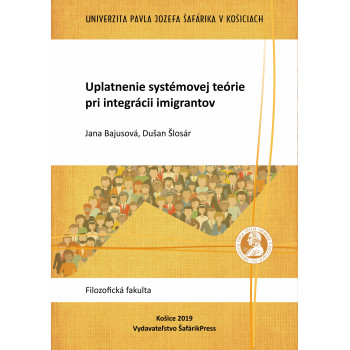
The integration of immigrants into society is currently of interest to many professionals and to the general public. Immigration is a consequence of a variety of factors, mainly due to political, social, economic or security conditions in the countries of origin. Immigration is subsequently linked to the process of integrating immigrants into the host country. The integration of immigrants into society or integration, as this process is called in the monograph, is a complex phenomenon that extends to many spheres of everyday life for the citizens of the receiving country, and at the same time is often difficult for immigrants. Many governmental and non-governmental organizations are involved in the process of social integration of immigrants, who develop different strategies and mechanisms to streamline the outcome of this process.
In relation to immigrants, the Slovak Republic is bound to provide social and legal protection and therefore it is necessary to deal with the issue of social services, which could potentially significantly contribute to their social integration into Slovak society. From the legislative point of view, however, these services are unified and do not take into account the differences of immigrants resulting from their culture, religion, social, ethical or other characteristics. That is why the monograph focuses on social integration of immigrants in Slovakia in the context of provided social services.
E-book
Renáta Orosová, Michal Novocký, Beáta Sakalová, Zuzana Vagaská (eds.)
Zborník príspevkov z medzinárodnej vedeckej konferencie, 11. september 2025
Medzinárodná vedecká konferencia je zameraná na problematiku vzdelávania a výchovy v oblasti základného, stredného a vysokého školstva a školských zariadení z pohľadu pedagóga. Zreteľ kladie na perspektívy pedagóga 21. storočia v edukačnej praxi a inovatívne aspekty pregraduálnej prípravy pedagógov. Je určená vedeckým pracovníkom, mladým vysokoškolským učiteľom, doktorandom s cieľom prezentovať učiteľa v súčasnej perspektíve a vyvolať diskusiu k aktuálnym otázkam prezentovaných oblastí výchovy a vzdelávania v kontexte súčasnej situácie v školstve.
Ciele konferencie:
SLOVAK IN DIALOGUES FOR BEGINNERS – INTERNATIONAL MEDICAL STUDENTS - Workbook
E-book
Ingrid Madárová - Veronika Pálová - Lucia Tóthová
Audio attachments - format RAR
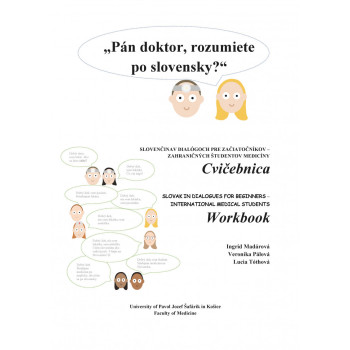
The audio-exercise workbook “Pán doktor, rozumiete po slovensky?”is a follow-up to the textbook “Pán doktor, hovoríte po slovensky?” (Madárová et al.)and is intended for international students of Slovak as a foreign language in the medical environment.
This workbook provides the students with an opportunity to practise and enhance mostly their listening skills and pronunciation through various short dialogues between doctors and patients in the Slovak language. Dialogues contain the vocabulary used in the textbook Pán doktor, hovoríte po slovensky?. Students are encouraged to build their confidence in speaking Slovak by practising these dialogues in the new workbook.
The audio-exercise workbook is comprised of 16 units. Each unit offers short dialogues and recordings
A number of dialogues enable its wide use for self-studying while the most frequent phrases related primarily to body parts, signs and symptoms of illnesses, diseases or various medical conditions are practised in different contexts in a variety of exercises.
Original illustrations enable students to understand dialogues more easily and the correct answers of the exercises and the scripts of the recordings can be found in the Answer key at the end of the workbook.
E-book
Gabriel Eštok- Mária Hrehová- Jakub Bardovič (eds.)
Proceedings of the 3rd Annual Scientific Conference of Students and Young Researchers held on May 23, 2014, by the Department of Political Science, Faculty of Arts, Pavol Jozef Šafárik University in Košice
On May 23, 2014, the Department of Political Science at the Faculty of Arts, Pavol Jozef Šafárik University in Košice hosted a conference entitled “Challenges and Perspectives of Domestic and Foreign Policy.” This was the third conference for students and young researchers organized by the Department of Political Science in cooperation with the civic association Res Publica. The event featured numerous young people interested in contemporary political issues, each presenting on a topic related to domestic or foreign policy. It can be stated that these presentations were of a high professional standard and stimulated discussion on the topics and problems raised.
The publication you are holding is a collection of scholarly works by students and young experts who focused on a variety of subjects. Some authors addressed issues of foreign policy, particularly the analysis of selected countries’ policies (Slovak Republic, USA), examined the Iranian nuclear program, or explored the possibilities of federalizing Ukraine as a solution to the emerging situation. Another contribution offered a perspective on foreign policy from the viewpoint of Slovak emigrants in Australia. Despite the wide range of topics addressed in the individual contributions, a common denominator can be found: the effort to highlight a particular problem or propose its solution, thereby contributing to the fulfillment of the ideal of democracy, the improvement of policy-making and functioning, and, above all, making the world a better place for all of us.
Editors